
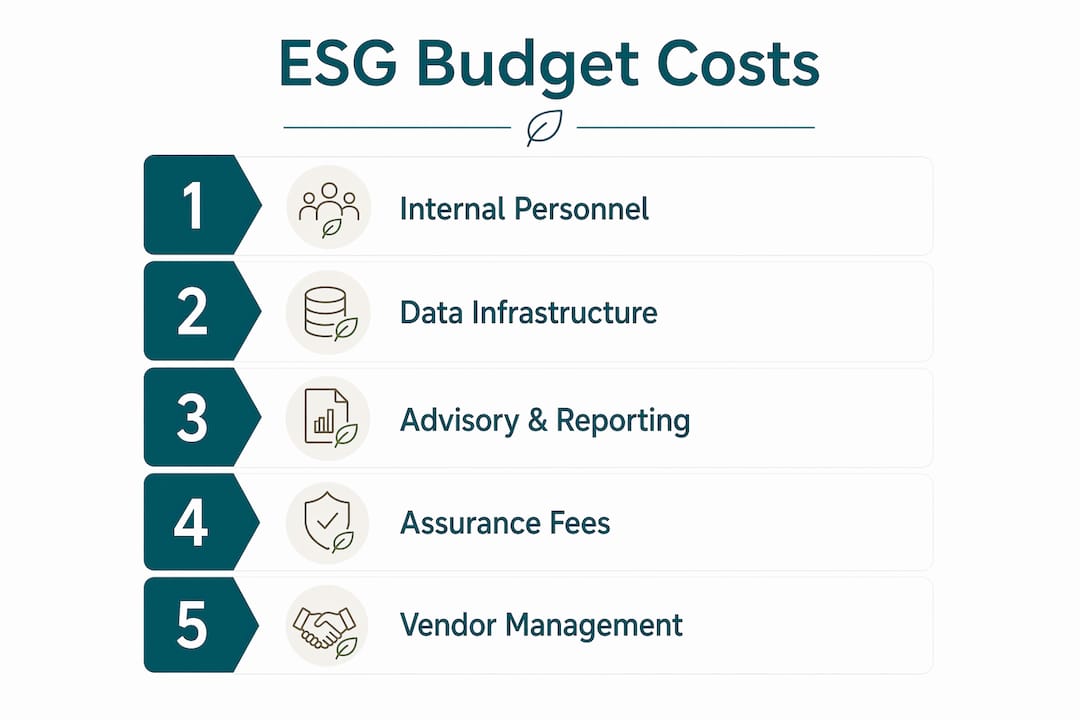
An ESG compliance budget is the total financial plan covering every cost tied to meeting environmental, social, and governance regulatory obligations, from data collection to external assurance. The esg compliance budget explained in practical terms spans five cost categories: internal personnel, data infrastructure, external advisory, assurance fees, and reporting production. Large enterprises face multi-million dollar annual costs, with Siemens reporting a 2024 sustainability reporting budget of €14.2 million and a projected steady-state of €9.8 million annually from 2025. Frameworks like CSRD, GRI, TCFD, SASB, and CDP each carry distinct compliance obligations that shape how you allocate funds across those categories.
What are the main cost drivers in an ESG compliance budget?
Five distinct cost buckets define where ESG compliance spending goes. Understanding each one prevents budget surprises and helps you defend allocations to the board.
Internal personnel
Dedicated ESG staff represent the largest single line item for most organizations. Siemens’ budget includes 42 FTE personnel costing €4.4 million annually. That figure covers sustainability managers, data analysts, legal reviewers, and finance controllers who own the reporting process.

Data infrastructure
Data systems are the second largest cost bucket and the most underestimated. Data integration accounts for 30–50% of first-year ESG compliance costs. The reason is the complexity of extracting reliable metrics from ERP systems, operational databases, and supplier portals that were never designed to talk to each other.
External advisory, assurance, and reporting
Advisory fees, audit costs, and report production round out the budget. These vary most by company size and the assurance level required under your applicable framework.
The table below shows typical annual cost ranges by company profile:
| Cost category | Large enterprise (5,000+ employees) | Mid-market (500–3,000 employees) |
|---|---|---|
| Internal personnel | €3.5M–€5M | €400K–€900K |
| Data infrastructure | €3M–€5M | €200K–€600K |
| External advisory | €500K–€1.5M | €100K–€400K |
| Assurance fees (limited) | €1.5M–€2.5M | €150K–€400K |
| Report production | €300K–€700K | €50K–€150K |
Pro Tip: Build your data infrastructure budget as a capital investment, not an annual operating expense. Reusable data integration assets cut repeat costs in year two and beyond, so the first-year spend pays dividends across multiple reporting cycles.
Mid-market firms with 500–3,000 employees budget €400,000–€1.8 million annually depending on operational complexity and framework adoption. Manufacturing companies sit at the top of that range because environmental data collection requires more sensors, more systems, and more verification than service or technology businesses.
How do assurance levels impact ESG compliance budgets?
Assurance level is the single biggest variable in your ESG compliance cost model. Under CSRD and most major frameworks, you choose between limited assurance and reasonable assurance. The difference is not just procedural. It is financial.
Limited assurance requires auditors to perform inquiry and analytical procedures. Reasonable assurance requires full substantive testing, expanded sampling, and higher auditor liability coverage. That expanded scope drives costs up sharply.
Reasonable assurance costs 150–200% more than limited assurance. Siemens projects its assurance fees rising from €2.1 million under limited assurance to €5.8–€7.2 million under reasonable assurance. That is a potential €5 million swing in a single line item.
The EU’s own impact assessments confirm this pattern at scale. One-off CSRD compliance costs average approximately €400,000 for large listed companies, with recurring annual costs around €650,000. Those figures assume limited assurance. Shifting to reasonable assurance more than doubles the recurring cost.
Key budget implications of assurance level decisions:
- Audit scope expansion. Reasonable assurance requires testing of underlying data sources, not just reported figures.
- Documentation requirements. Auditors demand audit trails, control evidence, and reconciliation records that take internal teams significant time to produce.
- Fee negotiation window. Assurance fees are negotiable before engagement, not after. Locking in multi-year agreements at limited assurance rates while CSRD transitions to reasonable assurance requirements gives you cost certainty.
- Phased planning. CSRD phases in reasonable assurance requirements over time. Budget for the transition now rather than absorbing the cost spike in a single year.
Pro Tip: Negotiate assurance fees before you sign the engagement letter, not after the audit scope is set. Auditors price based on perceived complexity. Presenting clean, well-documented data systems at the outset reduces their assessed risk and your final invoice.
What are the best practices for ESG budget allocation?
The most effective ESG budget allocation treats sustainability spending as an investment with measurable returns, not a compliance tax. Modeling ESG projects with multi-criteria frameworks that incorporate financial, environmental, and governance factors improves project selection outcomes and financial target achievement. Finance leaders who apply this approach make better capital allocation decisions across their ESG portfolio.
Integrating ESG budgeting into your existing capital allocation and enterprise risk management cycles is the structural change that makes this work. ESG initiatives that sit outside the normal budget process get cut first when cash is tight. ESG initiatives embedded in the ERM cycle get funded because they are tied to risk mitigation and regulatory exposure.
A practical budget planning sequence for finance leaders:
- Map your regulatory obligations. Identify which frameworks apply: CSRD, GRI, TCFD, SASB, CDP, or sector-specific rules. Each framework has distinct data and assurance requirements that drive cost.
- Audit your current data systems. Determine what ESG data you already collect reliably and where the gaps are. Data gaps are budget gaps.
- Classify spending by type. Separate one-time implementation costs from recurring operational costs. CSRD benchmarks show approximately €400,000 one-off and €650,000 recurring for large listed companies.
- Model assurance scenarios. Build budget cases for both limited and reasonable assurance so leadership understands the cost trajectory as regulatory requirements tighten.
- Prioritize high-impact actions first. Allocate budget to ESG initiatives that reduce material financial risks, such as carbon exposure, supply chain disruption, or regulatory penalty risk, before discretionary reporting enhancements.
- Embed ESG targets in forecasting and incentives. Linking ESG to financial processes increases organizational accountability and reduces your cost of capital over time.
Pro Tip: Present your ESG budget to the CFO as a risk-adjusted investment case, not a compliance cost. Quantify the financial exposure from non-compliance, including regulatory fines, investor pressure, and financing cost increases, and the budget conversation changes entirely.
How can you reduce ESG compliance costs through vendor management?
The biggest source of avoidable ESG compliance spending is bundled advisory contracts. Big 4 firms typically quote €2.5–€4 million for full CSRD implementation projects. Unbundling those contracts and assigning technical tasks to specialist vendors reduces total project cost to €1.2–€1.8 million. That is a saving of up to €2.2 million on a single engagement.
The logic is straightforward. Big 4 firms charge premium rates for every task in the bundle, including data integration work that specialist technology vendors perform at a fraction of the cost. Retaining a Big 4 firm for regulatory strategy and audit readiness while using specialist vendors for data integration and system implementation captures the best of both.
Cost optimization tactics that work in practice:
- Unbundle advisory and technical work. Use Big 4 for methodology, regulatory interpretation, and audit readiness. Use specialist vendors for data pipeline construction and system integration.
- Invest in reusable data assets. The data integration layer costs the most in year one. Building reusable integration bridges between your operational systems and reporting tools cuts recurring costs in subsequent years.
- Run competitive procurement. Issue RFPs for assurance and advisory services separately. Bundled procurement removes your negotiating leverage.
- Benchmark against sector peers. Use published cost benchmarks for your industry and company size to challenge vendor quotes before signing.
The financial services sector and technology companies typically face lower data collection costs than manufacturing or energy businesses because their operational footprint generates fewer environmental data points. Knowing your sector’s cost profile gives you a credible baseline for vendor negotiations.
Key Takeaways
An ESG compliance budget requires structured allocation across five cost categories, with data infrastructure and assurance fees representing the two most variable and negotiable line items.
| Point | Details |
|---|---|
| Data integration dominates year-one costs | Budget 30–50% of first-year spend for data infrastructure and build reusable assets to cut recurring costs. |
| Assurance level drives the biggest cost swing | Shifting from limited to reasonable assurance increases fees by 150–200%; model both scenarios now. |
| Unbundle advisory contracts | Splitting Big 4 strategy work from specialist technical implementation reduces project costs by up to 50%. |
| Embed ESG in ERM and forecasting | ESG budgets tied to enterprise risk management cycles get funded and defended more effectively. |
| Company size and sector set your baseline | Mid-market firms spend €400,000–€1.8 million annually; manufacturing and energy sectors sit at the top of that range. |
Why most ESG budgets fail before they start
The most common ESG budgeting mistake is treating it as a one-time project cost rather than a recurring operational commitment. Finance leaders who build a first-year budget without modeling the steady-state cost find themselves defending emergency budget requests every subsequent year. That erodes credibility with the CFO and the board.
The second mistake is underestimating data. Every finance leader I have worked with who underestimated ESG data complexity paid for it twice: once in cost overruns and once in delayed assurance sign-off. The data bridge between your operational systems and your reporting framework is not a technology problem. It is a financial planning problem. Budget for it explicitly.
The third mistake is passive vendor management. Bundled advisory contracts feel convenient but they transfer negotiating power to the vendor permanently. The organizations that control their ESG compliance costs are the ones that run structured procurement, benchmark every quote, and separate advisory from implementation from assurance.
The finance leaders who get this right share one habit: they treat ESG budgeting as an ongoing investment with a return profile, not a regulatory tax. Shifting ESG from pilot projects to integrated business cases within enterprise risk management increases funding likelihood and long-term sustainability of the program. That framing changes how the board hears the budget request and how the organization executes against it.
— ESG Team
Esgautomated helps you control ESG compliance costs
ESG compliance budgets are hard to defend when data collection is manual and reporting takes months. Esgautomated automates data collection, metric calculation, and sustainability reporting across GRI, TCFD, CSRD, SASB, and CDP frameworks, replacing the manual spreadsheet work that inflates internal personnel costs.
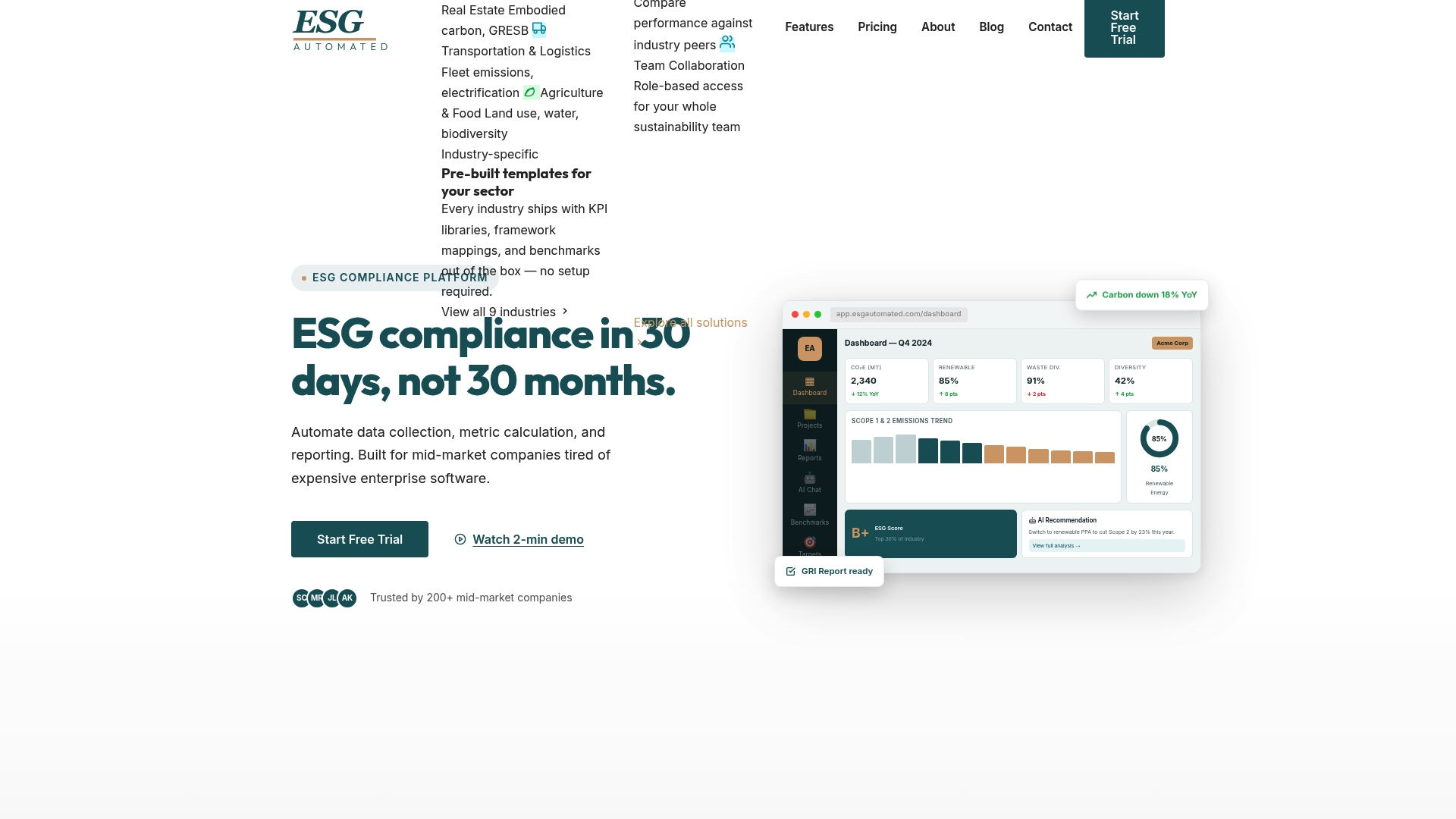
Mid-market companies using Esgautomated produce their first audit-ready ESG report in 30 days. The platform’s data management capabilities directly address the 30–50% of first-year costs tied to data integration, cutting the most expensive line item in your compliance budget. Finance leaders can explore the full platform features or visit Esgautomated to see how automated reporting changes the cost equation for mid-market ESG compliance.
FAQ
What is an ESG compliance budget?
An ESG compliance budget is the structured financial plan covering all costs required to meet ESG regulatory and reporting obligations, including personnel, data systems, advisory fees, assurance, and report production.
How much does ESG compliance cost for mid-market companies?
Mid-market firms with 500–3,000 employees typically spend €400,000–€1.8 million annually on ESG compliance, with manufacturing and energy companies at the higher end due to environmental data complexity.
What is the difference between limited and reasonable assurance in ESG reporting?
Limited assurance involves inquiry and analytical review; reasonable assurance requires full substantive testing. Reasonable assurance costs 150–200% more than limited assurance, making assurance level the single largest variable in ESG budget planning.
How can finance leaders reduce ESG compliance costs?
Unbundling Big 4 advisory contracts and assigning technical tasks to specialist vendors reduces project costs from €2.5–€4 million to €1.2–€1.8 million. Investing in reusable data integration assets also cuts recurring costs in year two and beyond.
How does CSRD affect ESG compliance budgeting?
CSRD sets mandatory reporting and assurance requirements for large listed companies, with one-off compliance costs averaging approximately €400,000 and recurring annual costs around €650,000 at the limited assurance level. Transitioning to reasonable assurance, which CSRD phases in over time, more than doubles those recurring costs.