
ESG regulatory enforcement is defined as the legally mandated process by which governments and regulators compel companies to meet environmental, social, and governance obligations, backed by penalties for non-compliance. This is no longer a voluntary reporting exercise. Frameworks like the EU Corporate Sustainability Reporting Directive (CSRD), the Corporate Sustainability Due Diligence Directive (CSDDD), and Germany’s Supply Chain Due Diligence Act have converted ESG expectations into binding legal requirements. Fines under Germany’s law can reach 2% of global turnover, a figure that concentrates board attention fast. For compliance officers, legal advisors, and sustainability executives, understanding what is ESG regulatory enforcement means understanding where criminal liability begins and voluntary commitment ends.
How does ESG regulatory enforcement work, and what types exist?
ESG enforcement operates through three distinct framework types: mandatory reporting regimes, due diligence laws, and anti-greenwashing statutes. Each carries different obligations and different enforcement teeth. Knowing which type applies to your company determines your compliance architecture.
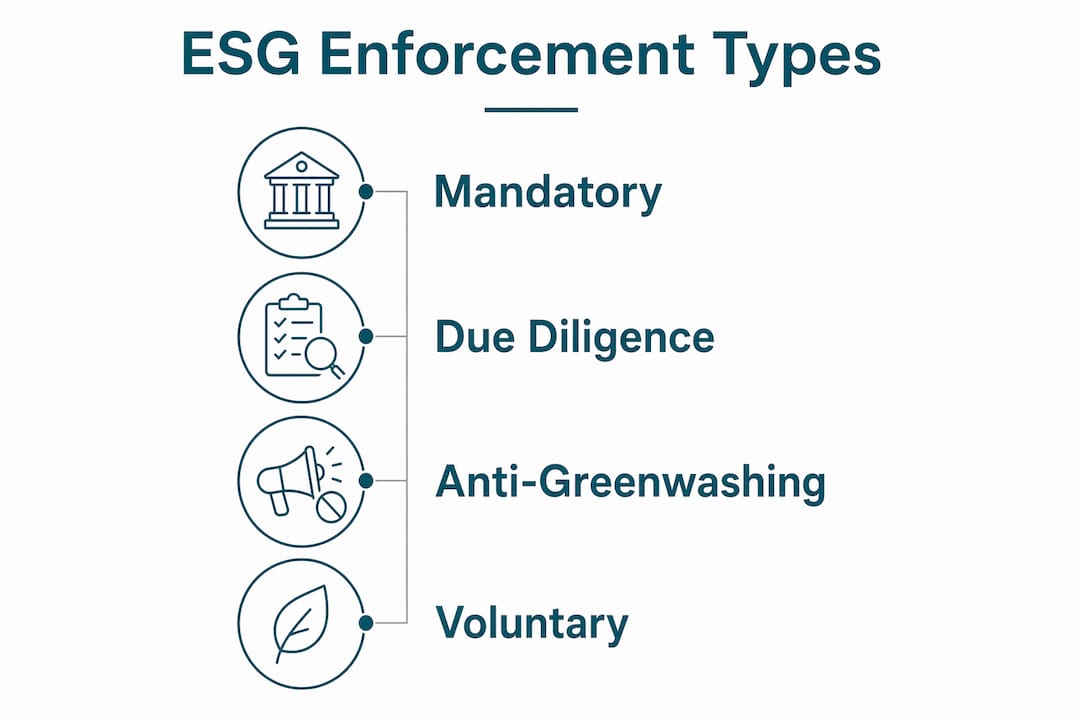
Mandatory reporting frameworks require companies to disclose ESG data against defined standards. The CSRD uses the European Sustainability Reporting Standards (ESRS) as its disclosure backbone. The European Commission is targeting a 57% reduction in mandatory data points under ESRS by mid-2026 to ease the compliance burden while keeping the regime credible. That reduction signals refinement, not retreat.

Due diligence laws go further. They require companies to identify, prevent, and remediate ESG harms across their supply chains, not just report on them. Germany’s Supply Chain Due Diligence Act is the clearest example. France’s Duty of Vigilance Law operates similarly. Both create direct legal accountability for what happens upstream.
Anti-greenwashing laws use consumer protection and securities statutes to penalize misleading ESG claims. These do not require a new ESG-specific statute. Existing criminal and consumer protection laws are the primary enforcement tools, applied to modern ESG disclosure failures.
| Framework type | Primary obligation | Enforcement mechanism |
|---|---|---|
| Mandatory reporting (CSRD, ESRS) | Disclose ESG metrics against defined standards | Regulatory fines, external assurance requirements |
| Due diligence laws (CSDDD, LkSG) | Identify and remediate supply chain harms | Administrative fines up to 2% of global turnover |
| Anti-greenwashing statutes | Avoid misleading ESG claims | Criminal prosecution, civil liability, consumer law |
Voluntary frameworks like GRI, TCFD, SASB, and CDP still matter. They shape disclosure quality and investor expectations. But regulators no longer treat them as substitutes for legal compliance. Companies that map regulatory ESG requirements early avoid the gap between voluntary best practice and mandatory obligation.
Pro Tip: Build your ESG policy framework around the mandatory regime that applies to your jurisdiction first, then layer voluntary standards on top. Reversing that order creates disclosure gaps that regulators notice.
What legal mechanisms and penalties apply to ESG non-compliance?
Regulators do not need new ESG laws to prosecute companies. Existing criminal, securities, and consumer protection laws are the primary enforcement tools in 2026. That means a company can face prosecution under legacy statutes for a modern ESG disclosure failure.
The legal mechanisms in active use include:
- Criminal prosecution for material misstatements in ESG disclosures, treated equivalently to financial misreporting
- Deferred prosecution agreements (DPAs) negotiated between regulators and companies as an alternative to trial
- Civil liability claims from investors or affected communities citing ESG-related harm
- Administrative fines imposed directly by regulatory bodies without court proceedings
- Securities enforcement for ESG claims that constitute material misstatements under existing securities law
France demonstrates how aggressive this can become. French regulators have finalized over 25 environmental DPAs since 2020. That pace reflects a prosecutorial posture, not a compliance advisory one.
The concept of materiality is the critical threshold. Not every ESG inaccuracy triggers criminal liability.
“Materiality distinguishes marginal inaccuracies from legally actionable ESG misstatements. A misstatement is material when it is capable of influencing investor decisions or concealing harm from stakeholders. That threshold legitimizes criminal enforcement while protecting companies from penalties for minor reporting errors.” — ICLG, Materiality as the Threshold for Criminal Liability in ESG Reporting
The U.S. Securities and Exchange Commission (SEC) disbanded its dedicated ESG Task Force in 2024. Enforcement did not stop. The SEC recovered over $110 million in combined penalties applying existing securities rules to ESG claims. The message is clear: material gaps in ESG disclosures carry securities law consequences regardless of political climate.
Board accountability is now a live enforcement question. Regulators in the EU and UK are examining whether boards approved ESG disclosures that were later found to be materially misleading. Compliance officers need documented board sign-off processes, not just internal review.
Pro Tip: Treat every public ESG claim as a potential securities disclosure. Apply the same materiality review process you use for financial statements. If the claim could influence an investor’s decision, it needs evidence behind it.
How do geographic differences shape ESG enforcement risk?
ESG enforcement risk is not uniform across jurisdictions. The EU leads on criminal and administrative enforcement. The U.S. presents a different risk profile: dual risk from regulatory enforcement and political scrutiny of ESG claims simultaneously.
The key regional dynamics compliance teams must track:
- European Union: The CSRD, CSDDD, and national due diligence laws create overlapping mandatory obligations. Criminal enforcement powers exist at member-state level. France and Germany are the most active enforcers.
- United States: The SEC continues enforcement under existing securities law. Simultaneously, state attorneys general in politically conservative states are scrutinizing corporate ESG commitments as potential consumer protection violations. Companies face pressure from both directions.
- United Kingdom: Post-Brexit, the UK is developing its own mandatory climate disclosure regime aligned with TCFD. Enforcement is building but lags the EU in intensity.
- Asia-Pacific: Mandatory ESG disclosure requirements are expanding in Singapore, Hong Kong, and Japan. Enforcement is still maturing but the direction is clear.
Supply chain enforcement adds another layer of complexity. Regulators hold brands accountable for labor and environmental abuses by their suppliers, not just their own operations. A European retailer sourcing from Southeast Asia faces potential liability under the CSDDD for conditions at a third-tier supplier.
Geopolitical tensions compound the risk. U.S.-China trade friction creates conflicts between ESG sourcing requirements and supply chain economics. A company required to audit supplier labor practices may face access restrictions in certain jurisdictions. Multi-jurisdictional companies need a cross-border ESG compliance strategy that accounts for these conflicts explicitly.
NGOs and activist groups now function as informal enforcement agents. They file complaints with regulators, initiate litigation, and publicize ESG failures. The enforcement pipeline is no longer purely governmental.
What best practices reduce ESG enforcement exposure?
Effective ESG risk management requires cross-functional integration. Legal, financial, audit, and sustainability teams must collaborate on every material ESG claim before it reaches a public disclosure. Siloed sustainability teams produce disclosures that legal teams have not stress-tested.
The practices that reduce enforcement exposure most directly:
- Conduct a materiality assessment annually. Identify which ESG topics are material to your business and your stakeholders. This assessment determines what you must disclose and what level of evidence you need to support each claim.
- Document your supply chain due diligence. Regulators expect a risk-based, documented process. Contractual clauses, supplier audits, and corrective action records are the minimum standard under laws like the CSDDD and Germany’s LkSG.
- Establish an ESG investigation protocol. Define how your company responds to whistleblower complaints, NGO allegations, and regulatory inquiries before they arrive. Companies without a protocol improvise under pressure and make it worse.
- Require external assurance. The CSRD mandates limited assurance for ESG disclosures, with reasonable assurance as the eventual standard. Commissioning assurance proactively, before it is required, builds credibility and surfaces errors early.
- Implement board-level approval for ESG disclosures. Document that the board reviewed and approved material ESG claims. This creates a governance record that regulators and courts treat as evidence of good faith.
- Use compliance technology to track regulatory changes. ESG regulations are evolving faster than manual monitoring can handle. An ESG regulatory change tracker reduces the risk of missing a new obligation before its enforcement date.
Pro Tip: Run your ESG disclosures through an adversarial review. Ask your legal team to argue against every material claim as if they were opposing counsel. Claims that cannot survive that review should not be published.
Key Takeaways
ESG regulatory enforcement is a binding legal regime where material misstatements in ESG disclosures trigger criminal, civil, and administrative penalties under existing laws across multiple jurisdictions.
| Point | Details |
|---|---|
| Enforcement is legally binding | ESG obligations now carry criminal and administrative penalties, not just reputational consequences. |
| Materiality is the legal threshold | Only misstatements capable of influencing investor decisions trigger criminal liability under current enforcement doctrine. |
| Existing laws drive prosecution | Regulators use criminal, securities, and consumer protection statutes to enforce ESG compliance without needing new ESG-specific laws. |
| Geographic risk varies significantly | The EU enforces aggressively; the U.S. presents dual risk from both regulatory action and political scrutiny of ESG claims. |
| Cross-functional governance is required | Legal, finance, audit, and sustainability teams must collaborate on every material ESG disclosure to reduce enforcement exposure. |
The enforcement shift compliance teams cannot afford to miss
The most important thing I have observed in ESG enforcement over the past few years is how quickly the conversation moved from “should we report?” to “can we defend what we reported?” That shift is not incremental. It is structural.
Compliance officers who still treat ESG as a communications function are operating with the wrong mental model. The CSRD, the CSDDD, and France’s DPA track record make clear that ESG disclosures are now legal documents. The standard of care is closer to a securities filing than a sustainability brochure.
What concerns me most is the materiality gap. Most companies understand that material misstatements are dangerous. Fewer have a documented, repeatable process for determining what is material in the ESG context. That gap is where enforcement cases are built. Regulators do not need to prove intent in every jurisdiction. They need to show that a disclosure was capable of misleading a reasonable investor or concealing a harm.
The jurisdictional complexity is genuinely difficult. A company operating in the EU, the U.S., and Asia-Pacific faces three different enforcement philosophies simultaneously. The role of compliance in ESG strategy has to include a clear map of which regime takes precedence in which scenario. That is not a job for the sustainability team alone.
Technology will become a competitive advantage in compliance, not just an efficiency tool. Companies that automate data collection, maintain audit trails, and track regulatory changes in real time will be better positioned to defend their disclosures than those relying on annual spreadsheet exercises.
The enforcement intensity will increase before it plateaus. Build your compliance architecture for that reality, not for the environment of three years ago.
— ESG Team
How Esgautomated supports your ESG enforcement readiness
Compliance with ESG regulatory enforcement requires accurate data, documented processes, and audit-ready disclosures across frameworks like CSRD, GRI, TCFD, SASB, and CDP.

Esgautomated is an AI-powered platform built for mid-market companies that need to meet these obligations without the cost of enterprise software or external consultants. The platform automates data collection, metric calculation, and reporting across all major frameworks. Companies produce their first audit-ready ESG report in 30 days. For compliance officers and legal teams managing ESG data management and disclosure accuracy, Esgautomated replaces manual spreadsheets with a defensible, traceable compliance record. Visit esgautomated.com to see how the platform maps to your specific regulatory obligations.
FAQ
What is ESG regulatory enforcement?
ESG regulatory enforcement is the legally mandated process by which governments compel companies to meet environmental, social, and governance obligations, backed by fines, criminal prosecution, and civil liability for non-compliance.
What laws do regulators use to enforce ESG compliance?
Regulators use existing criminal, consumer protection, and securities laws to prosecute ESG violations. No new ESG-specific statute is required for enforcement action.
What penalties can companies face for ESG non-compliance?
Penalties include administrative fines reaching 2% of global annual turnover, deferred prosecution agreements, criminal prosecution for material misstatements, and civil liability from investors or affected communities.
What does materiality mean in ESG enforcement?
A material ESG misstatement is one capable of influencing investor decisions or concealing harm from stakeholders. Minor reporting inaccuracies below this threshold do not typically trigger criminal liability.
How does ESG enforcement differ between the EU and the U.S.?
The EU enforces ESG obligations through criminal and administrative powers under the CSRD and CSDDD. The U.S. applies existing securities laws to material ESG misstatements, while companies also face political and litigation risk from both ESG supporters and opponents.