
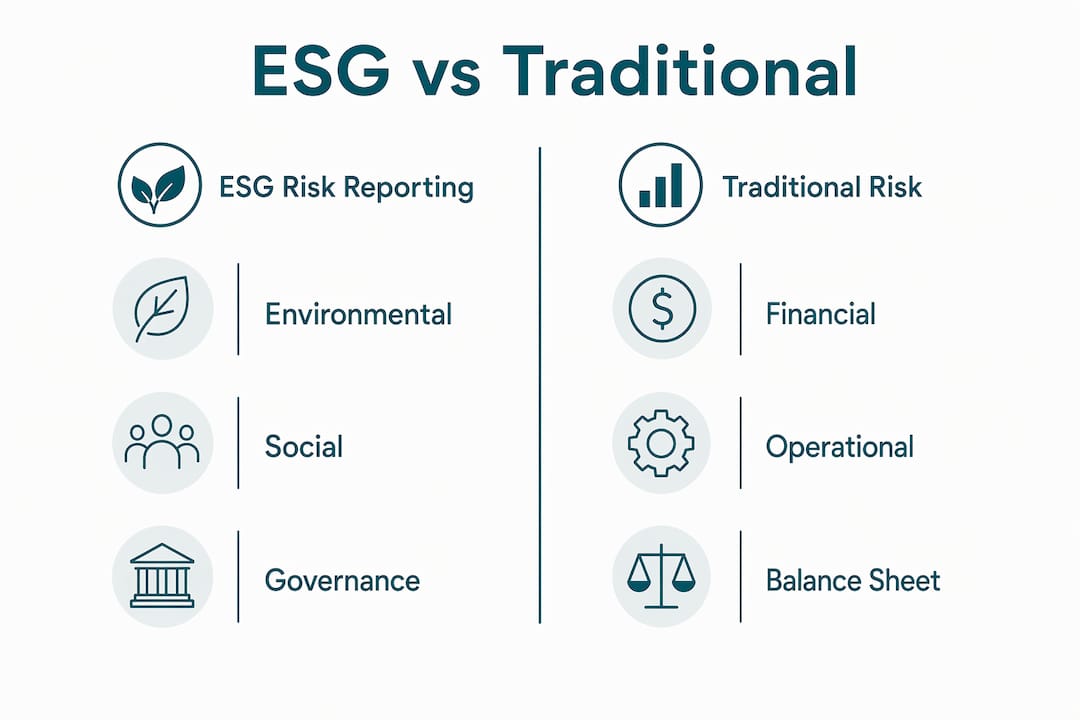
ESG risk reporting is defined as the systematic disclosure of environmental, social, and governance factors alongside financial data to assess a company’s long-term resilience and stakeholder impact. The contrast between ESG versus traditional risk reporting is not a matter of preference. It is a structural shift in how enterprises identify, measure, and communicate risk. Traditional financial statements miss over 80% of value drivers such as brand reputation, intellectual capital, and stakeholder relationships. Frameworks like ISSB, CSRD, and GRI now formalize what many risk managers already suspected: financial data alone cannot capture the full risk picture.
What are the fundamental differences between ESG and traditional risk reporting?
Traditional risk reporting is backward-looking. It focuses on historical financial performance, balance sheet exposure, and operational losses. The primary audience is shareholders, and the primary currency is money. ESG reporting flips that orientation. It is forward-looking and serves a broader stakeholder set including employees, communities, regulators, and the environment.

The scope difference is equally significant. Traditional reports measure what already happened: revenue, debt ratios, and credit risk. ESG reports measure what is likely to happen: climate transition costs, supply chain labor violations, and governance failures that erode trust before they appear on an income statement.
The concept of double materiality defines this distinction most sharply. Under double materiality, companies must assess two separate questions:
- Financial materiality: How do ESG factors affect the company’s financial value?
- Impact materiality: How do the company’s activities affect society and the environment?
CSRD mandates both lenses. ISSB focuses on financial materiality only. GRI focuses on impact materiality. Understanding which framework applies to your reporting obligation determines which lens you prioritize. Most mid-market companies operating across jurisdictions need both.
The stakeholder difference also changes the governance model. Traditional risk committees report to audit committees and boards focused on shareholder returns. ESG risk reporting requires input from legal, operations, HR, and supply chain teams. The data sources multiply. So does the complexity of verification.
Pro Tip: Map your current risk register against a double materiality matrix before selecting a reporting framework. This single step clarifies which ESG risks are financially material to your business and which are material to your stakeholders, preventing costly framework misalignment later.
How do ESG and traditional risk reporting complement each other?
The most effective enterprise risk management frameworks do not treat ESG as a separate discipline. ESG KRIs embedded directly into ERM dashboards alongside financial and operational risks give boards a unified view of exposure. Siloed sustainability reports, by contrast, obscure the financial consequences of ESG risks from the leadership teams who need to act on them.
Regulatory pressure is accelerating this integration. ISSB standards require ESG risks to connect directly to financial reporting. CSRD mandates board-level governance of sustainability risks. California SB 253 and SB 261 require large companies doing business in California to disclose Scope 1, 2, and 3 emissions and climate-related financial risks. These are not sustainability requirements. They are financial disclosure requirements with ESG data at their core.
Practical integration follows a clear sequence:
- Conduct a double materiality assessment. Identify which ESG factors carry financial risk and which carry societal impact risk. This assessment sets the scope of your reporting obligations under CSRD and ISSB.
- Assign ESG Key Risk Indicators. Each material ESG risk needs a measurable KRI. Carbon intensity per unit of revenue, employee turnover in critical roles, and board gender diversity are examples that translate directly into financial exposure.
- Apply consistent risk rating scales. Use the same risk rating approach for ESG risks as for traditional operational and financial risks. Inconsistent scales create governance gaps and make board reporting unreliable.
- Embed ESG data into ERM dashboards. Do not maintain a separate sustainability dashboard. Integrate ESG KRIs into the same risk heat maps and reporting cadences used for financial and operational risks.
- Design for assurance from the start. ESG data faces growing audit scrutiny. Internal controls over sustainability reporting, modeled on COSO frameworks, are now a baseline expectation under CSRD and emerging SEC guidance.
The verifiability gap between ESG and traditional financial data remains the hardest challenge. Financial data has decades of audit infrastructure behind it. ESG data often relies on operational systems, supplier self-reporting, and estimation methodologies that auditors are still learning to assess. Integrated reporting methods that combine financial and non-financial data now account for 41.2% of reporting approaches, compared to 23.5% for traditional financial approaches alone. That gap will widen as regulatory mandates take effect.
Pro Tip: Build your ESG data collection process with audit trails from day one. Retroactively adding documentation for assurance purposes costs significantly more time and money than designing it correctly upfront. Treat every ESG data point as a potential audit exhibit.
What are the key frameworks guiding ESG versus traditional risk reporting?
Traditional financial reporting operates under well-established standards: US GAAP and IFRS govern financial statements, and COSO provides the internal control framework. These standards have mandatory adoption in most jurisdictions and decades of auditor familiarity behind them.
ESG reporting standards are more fragmented, though consolidation is accelerating. The four frameworks risk managers encounter most often are:
- ISSB (IFRS S1 and S2): Focuses on financial materiality. Requires disclosure of climate-related risks and opportunities that affect enterprise value. Increasingly adopted as the baseline for capital markets disclosure.
- CSRD and ESRS: The European Union’s mandatory framework for large companies and listed SMEs. Requires double materiality assessment and third-party assurance. Applies to non-EU companies with significant EU revenue.
- GRI Standards: The most widely adopted voluntary sustainability framework globally, used by approximately 53% of reporting companies. Focuses on impact materiality and stakeholder accountability.
- SASB: Industry-specific standards that identify financially material sustainability topics by sector. Frequently used alongside ISSB disclosures to add sector-specific depth.
The voluntary versus mandatory distinction is shifting fast. GRI adoption at 53% reflects years of voluntary uptake. CSRD and ISSB are mandatory for their respective audiences. Risk managers who treat ESG frameworks as optional are already behind the regulatory curve.
Regional differences matter. EU-based companies face CSRD. Companies listed on US exchanges face SEC climate disclosure rules. Companies operating in California face SB 253 and SB 261. Regulatory frameworks like ISSB and CSRD now require ESG risks to connect directly to board-level financial governance. The practical implication: your reporting framework selection is now a compliance decision, not just a communications choice.
What practical steps can risk managers take to integrate ESG reporting?
Integration works best when it starts with governance, not technology. Assign clear ownership of ESG risk data to specific functions: environmental data to operations, social data to HR, governance data to legal and the board secretary. Without ownership, data quality degrades and assurance fails.
Linking ESG KRIs to financial consequences is the step most organizations skip. Carbon pricing exposure, for example, translates directly into cost-of-goods projections. Water scarcity risk in manufacturing regions translates into supply chain disruption probability. These connections make ESG risks legible to CFOs and audit committees who think in financial terms.
ESG as a risk mitigation tool delivers its primary financial benefit through reduced exposure to regulatory penalties, supply chain disruptions, and reputational damage. It does not reliably generate short-term alpha. Risk managers who frame ESG integration as resilience investment, rather than a profit driver, get faster board buy-in.
Data governance is the unglamorous work that determines whether your ESG report survives assurance. Establish data dictionaries, define calculation methodologies, and document assumptions before your first reporting cycle. The convergence of ISSB, CSRD, and GRI creates multiple reporting obligations that share underlying data. A single well-governed data layer serves all three frameworks more efficiently than three separate data collection processes.
For professionals managing ESG integration in financial reporting, the practical priority is building that shared data infrastructure first, then mapping it to each framework’s disclosure requirements. Technology platforms with ESG modules built into ERM workflows reduce the manual reconciliation burden that consumes most of the reporting cycle time.
Key Takeaways
ESG risk reporting and traditional risk reporting are not competing methodologies. They are complementary layers of a complete enterprise risk picture, and regulatory mandates now require both to connect at the board level.
| Point | Details |
|---|---|
| ESG fills the value gap | Traditional financial statements miss over 80% of modern value drivers, including reputation and stakeholder relationships. |
| Double materiality is non-negotiable | CSRD requires assessment of both financial impact on the company and the company’s impact on society and environment. |
| Embed ESG KRIs in ERM dashboards | Siloed sustainability reports hide ESG risks from leadership; integration into ERM systems creates board-level visibility. |
| Use consistent risk rating scales | Applying the same rating methodology to ESG and financial risks produces reliable governance and audit-ready reporting. |
| Framework selection is now a compliance decision | ISSB, CSRD, GRI, and SASB each serve different obligations; regional mandates determine which frameworks are mandatory for your organization. |
Why siloed ESG reporting is the most expensive mistake risk managers make
The conventional approach treats ESG reporting as a communications exercise. A sustainability team produces an annual report, it goes to the website, and the risk committee never sees it. That model is not just inefficient. It is a governance failure that regulators are beginning to penalize.
The real cost of siloed ESG reporting shows up in three places. First, material ESG risks go unpriced in financial forecasts, creating earnings surprises when climate events or regulatory changes hit. Second, assurance failures emerge when auditors find that ESG data lacks the internal controls that financial data has. Third, board members face personal liability exposure under CSRD and SEC rules when ESG disclosures are inaccurate or incomplete.
The transition to integrated reporting signals a shift from historical financial statements to a connected narrative explaining how governance, strategy, and ESG drive long-term value. Risk managers who understand this shift early become indispensable to their organizations. Those who wait for regulatory deadlines spend their budget on remediation instead of strategy.
My honest view: the risk managers who will lead their organizations through the next decade are the ones who stop asking “how do we comply with ESG reporting?” and start asking “how do we use ESG data to make better risk decisions?” The frameworks are tools. The real work is building the internal culture and data infrastructure that makes those tools useful. That work starts now, not at the next reporting deadline.
— ESG Team
How Esgautomated supports integrated ESG and traditional risk reporting
Risk managers and sustainability professionals who need to connect ESG data with financial reporting workflows face a real infrastructure problem. Manual spreadsheets and disconnected sustainability tools cannot meet the assurance standards that ISSB, CSRD, and GRI now require.
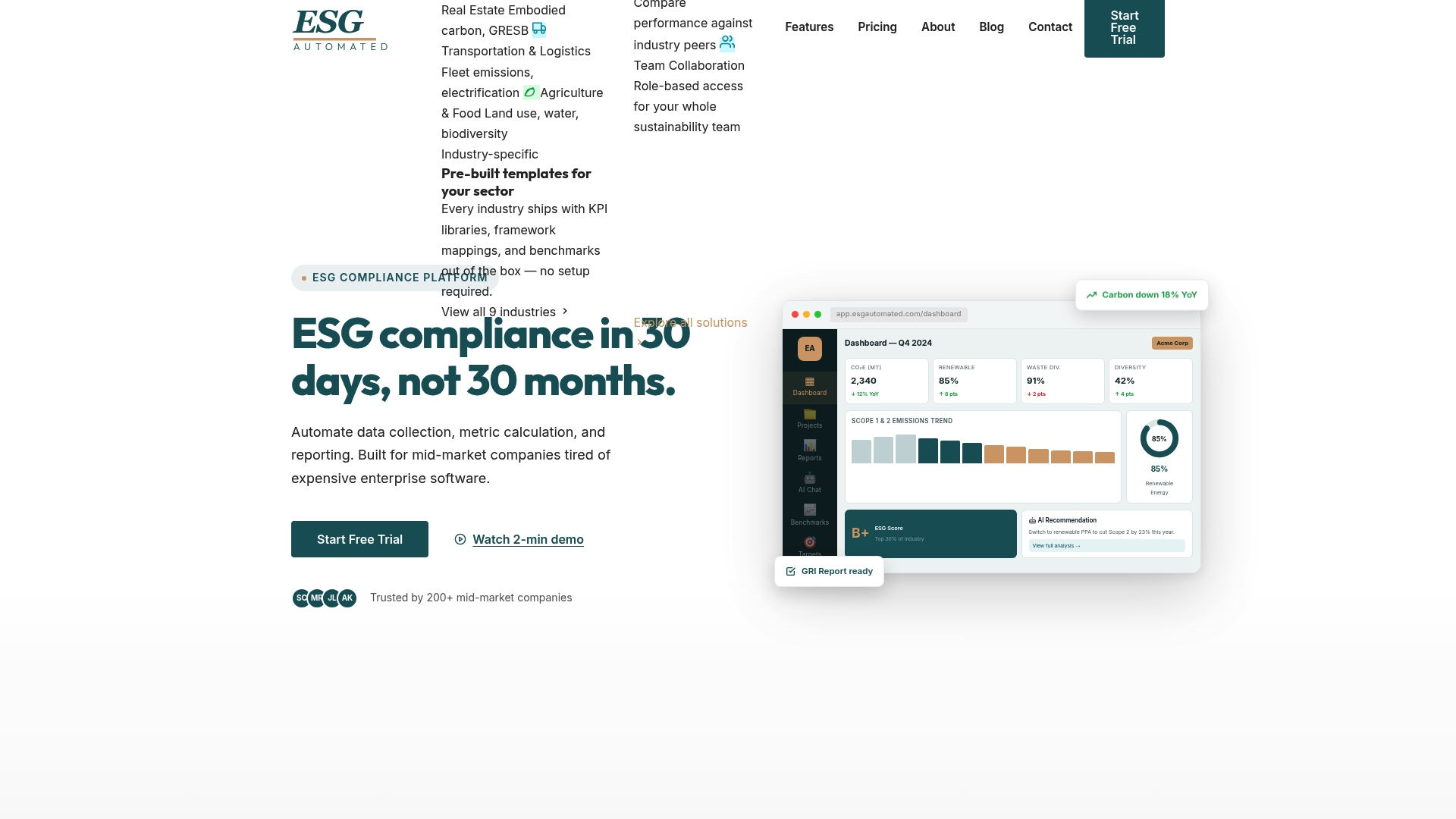
Esgautomated is an AI-powered ESG compliance platform built for mid-market companies. It automates data collection, metric calculation, and reporting across GRI, TCFD, CSRD, SASB, and CDP frameworks. ESG KRIs feed directly into board-ready dashboards, and every data point carries an audit trail designed for third-party assurance. Companies get their first audit-ready ESG report in 30 days. For professionals managing ESG metrics for board reporting, Esgautomated replaces the manual reconciliation work that consumes most of the reporting cycle.
FAQ
What is the main difference between ESG and traditional risk reporting?
Traditional risk reporting focuses on historical financial and operational risks for shareholders. ESG risk reporting is forward-looking and covers environmental, social, and governance factors for a broader stakeholder audience including communities, regulators, and employees.
What is double materiality in ESG reporting?
Double materiality requires companies to assess both how ESG factors affect their financial value and how their activities affect society and the environment. CSRD mandates both assessments, while ISSB focuses on financial materiality only.
Which ESG reporting framework is most widely adopted?
GRI Standards are the most widely adopted voluntary sustainability framework globally, used by approximately 53% of reporting companies. ISSB and CSRD are increasingly mandatory for capital markets and EU-regulated companies respectively.
How should ESG KRIs connect to traditional risk management?
ESG Key Risk Indicators should be embedded directly into enterprise risk management dashboards alongside financial and operational risks, using the same risk rating scales to provide consistent board-level governance oversight.
Is ESG reporting mandatory for mid-market companies?
Mandatory requirements depend on jurisdiction and company size. CSRD applies to large EU companies and non-EU companies with significant EU revenue. California SB 253 applies to companies with over $1 billion in annual revenue doing business in California. Mid-market companies approaching these thresholds should treat compliance preparation as an active risk management priority.