
Cross-border ESG compliance is defined as the practice of meeting multiple, jurisdiction-specific environmental, social, and governance regulations simultaneously across the countries where a company operates. The industry term for this discipline is “multi-jurisdictional ESG compliance,” though the cross-border framing captures the practical challenge most accurately. The regulatory stakes are concrete: the EU’s Corporate Sustainability Reporting Directive (CSRD) applies to approximately 50,000 businesses, while California’s climate disclosure laws cover an estimated 75% of Fortune 1000 companies. Non-compliance carries fines, restricted market access, and reputational damage that can outlast any single reporting cycle. For compliance professionals and business leaders managing global operations, understanding what cross-border ESG compliance requires is no longer optional.
What is cross-border ESG compliance and why does it matter?
Cross-border ESG compliance requires a company to satisfy the distinct reporting and disclosure obligations of every jurisdiction where it operates, sells, or raises capital. These obligations do not align neatly. The EU’s CSRD, California’s SB 253 and SB 261, the International Sustainability Standards Board (ISSB) framework, and Singapore’s forthcoming ISSB-based mandates each define scope, materiality, and assurance differently.
The practical consequence is significant. Non-compliance risks include regulatory fines, loss of access to EU markets, and reputational harm with investors and customers. A company headquartered in the United States with EU revenue or EU-listed subsidiaries may fall under CSRD even if it never considered itself a European business. That is the defining feature of modern cross-border ESG regulations: geographic reach is determined by revenue and presence, not headquarters.

The ISSB framework, developed by the International Financial Reporting Standards (IFRS) Foundation, functions as a global investor baseline. It focuses on climate-related financial disclosures aligned with the Task Force on Climate-related Financial Disclosures (TCFD). Regulators in over 20 jurisdictions have already adopted or are incorporating ISSB standards. That adoption pace signals where the global floor is heading.
What are the main regulatory frameworks shaping cross-border ESG compliance?
The regulatory environment for international ESG standards is fragmented but structured around a small number of dominant frameworks. Understanding each one is the foundation of any compliance program.
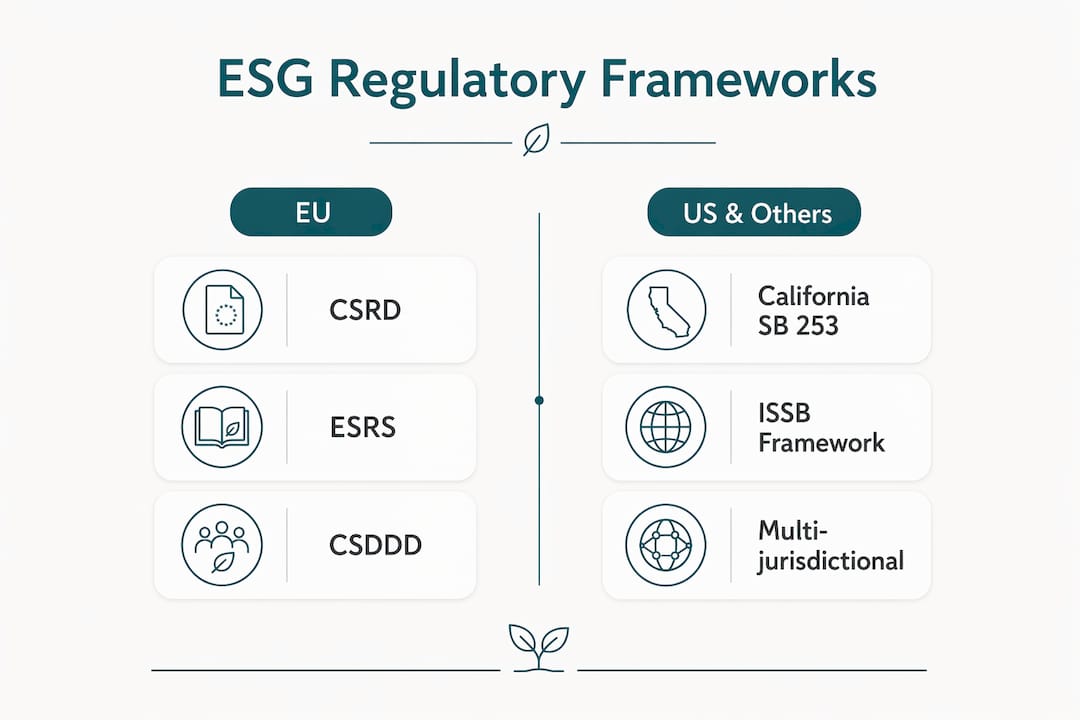
EU Corporate Sustainability Reporting Directive (CSRD) and ESRS
The CSRD requires in-scope companies to report under the European Sustainability Reporting Standards (ESRS). It mandates double materiality, meaning companies must disclose both how sustainability issues affect their finances and how their operations affect people and the planet. The recent EU Omnibus package raised reporting thresholds, reducing the number of in-scope companies by approximately 85–90%. That reduction matters for mid-market firms reassessing their obligations in 2026.
California climate disclosure laws
California’s SB 253 requires large companies doing business in the state to disclose Scope 1, 2, and 3 greenhouse gas emissions. SB 261 requires climate-related financial risk disclosures. Both laws apply based on revenue thresholds and California business activity, regardless of where a company is incorporated.
ISSB framework
The ISSB’s IFRS S1 and IFRS S2 standards set a global baseline for sustainability and climate disclosures focused on financial materiality. Singapore mandates ISSB-based climate disclosures for listed companies with a market capitalization above S$1 billion, starting in 2028. Australia, Canada, and the United Kingdom are at various stages of adopting similar requirements.
EU Corporate Sustainability Due Diligence Directive (CSDDD)
The CSDDD goes beyond reporting. It requires large companies to identify, prevent, and address adverse human rights and environmental impacts across their supply chains. This directive creates legal liability, not just disclosure obligations.
| Framework | Jurisdiction | Materiality type | Assurance required |
|---|---|---|---|
| CSRD / ESRS | EU | Double materiality | Mandatory third-party |
| ISSB (IFRS S1, S2) | Global baseline | Financial materiality | Varies by jurisdiction |
| California SB 253 / SB 261 | United States | Financial materiality | Phased in |
| CSDDD | EU | Due diligence obligations | Internal and external |
| Singapore SGX climate rules | Singapore | Financial materiality | Mandatory for large listed firms |
How do differences in materiality definitions impact cross-border ESG compliance?
Materiality is the single most consequential point of divergence in cross-border ESG regulations. Getting it wrong produces disclosures that satisfy one regulator and fail another.
The EU’s double materiality model requires companies to assess two directions of impact. First, how do climate and social issues create financial risk or opportunity for the company? Second, how does the company’s activity affect the environment and society? Both assessments must appear in CSRD-compliant reports. The U.S. approach, reflected in ISSB and California’s laws, focuses only on the first direction: financial impact on the company.
Many firms mistakenly believe one global ESG report satisfies all jurisdictions. That assumption is incorrect. A company reporting under ISSB for its Singapore listing and under CSRD for its EU subsidiary must produce materially different disclosures. The ISSB report may omit social impact data that CSRD requires. The CSRD report may include disclosures that exceed what U.S. investors consider financially material, creating legal exposure in anti-ESG regulatory environments.
The practical solution is addendums or modular reporting. A company builds a core report aligned with ISSB, then adds jurisdiction-specific modules for CSRD, California, and other requirements. This approach reduces duplication but requires clear documentation of which disclosures satisfy which obligation.
- Double materiality (EU/CSRD): Requires both inward financial impact and outward societal/environmental impact assessments.
- Financial materiality (ISSB, California): Requires only disclosures that affect investor decision-making.
- Addendum approach: Core ISSB report plus jurisdiction-specific supplements for CSRD and other mandates.
- Legal exposure risk: Disclosures exceeding financial materiality thresholds may create liability in U.S. states with anti-ESG legislation.
Pro Tip: Map each jurisdiction’s materiality definition at the start of your compliance planning cycle. A one-page matrix showing which topics are material under CSRD, ISSB, and California law will prevent costly disclosure gaps and over-disclosures.
What strategies and tools help companies manage complex cross-border ESG compliance?
Effective management of ESG compliance requirements across jurisdictions depends on three things: data infrastructure, governance structure, and technology.
Build centralized data infrastructure first
Companies that report across GRI, ISSB, and ESRS simultaneously build centralized data systems that collect metrics once and map them to multiple frameworks. This approach avoids the parallel reporting problem, where separate teams collect overlapping data in incompatible formats. A single data layer feeding multiple reporting outputs is the architecture that scales.
The challenge is that data interoperability is oversold. EU mandatory assurance requirements demand higher data granularity and audit trails than voluntary ISSB reporting. A system built for ISSB will need substantial retuning to meet CSRD’s assurance standards. Build for the most demanding requirement first, then simplify for less demanding frameworks.
Map your legal entity structure early
- Identify all subsidiaries and affiliates with EU revenue, EU employees, or EU-listed securities. CSRD applies based on consolidated group revenue and EU presence, not headquarters location.
- Apply threshold tests for each jurisdiction. CSRD, California SB 253, and CSDDD each use different revenue and employee thresholds to determine scope.
- Document data ownership for each entity. Assign clear responsibility for collecting Scope 1, 2, and 3 emissions data, social metrics, and governance disclosures at the subsidiary level.
- Align internal controls with external reporting obligations. Governance structures that satisfy CSDDD due diligence requirements also support CSRD’s supply chain disclosure standards.
Use technology to automate collection and calculation
Platforms that automate ESG data collection reduce the manual effort that makes multi-framework reporting expensive. Esgautomated, for example, automates data collection, metric calculation, and reporting across GRI, TCFD, CSRD, SASB, and CDP frameworks. That kind of multi-framework reporting capability directly addresses the parallel reporting burden that drives up compliance costs for mid-market companies.
Supply chain due diligence under CSDDD adds another data layer. Companies must collect supplier-level human rights and environmental data, which requires supplier portals, standardized questionnaires, and audit documentation. Manual spreadsheet processes cannot sustain that volume reliably.
Pro Tip: Design your data infrastructure for assurance readiness from day one. EU mandatory third-party assurance requires audit trails, data lineage documentation, and version control. Retrofitting these capabilities after the fact costs significantly more than building them in at the start.
What are the emerging trends in cross-border ESG compliance?
The ESG compliance environment is converging, but not uniformly. Compliance professionals need to track several parallel developments to stay ahead.
- Framework convergence around ISSB and CSRD/ESRS. Regulatory analysts observe that ISSB and CSRD/ESRS are forming a “gold standard” for multinational compliance. Companies that build programs around these two frameworks can adapt to most new jurisdictional requirements with incremental adjustments rather than full rebuilds.
- Mandatory assurance is expanding. The EU requires third-party assurance for CSRD reports. Other jurisdictions are moving in the same direction. Companies that have not yet invested in audit-ready data systems face growing assurance gaps.
- Jurisdictional scope is widening. The CSRD’s extraterritorial reach means non-EU companies with significant EU revenue will face reporting obligations. Early mapping of subsidiaries against CSRD thresholds is the most effective way to avoid last-minute compliance failures.
- Anti-ESG legislation in the United States creates legal tension. Several U.S. states have passed laws restricting ESG-based investment decisions by public pension funds. Companies operating in both the EU and these states must carefully scope their disclosures to avoid creating legal exposure in either direction.
- Asia-Pacific requirements are accelerating. Singapore’s ISSB-based mandate for large listed companies, Australia’s climate disclosure laws, and Hong Kong’s evolving requirements mean that Asia-Pacific can no longer be treated as a low-regulation region for ESG purposes.
The cost of running multiple parallel reports is a documented risk that industry leaders are actively working to reduce through interoperability initiatives. Companies that invest in modular, framework-agnostic reporting architectures now will carry lower compliance costs as new jurisdictions come online.
Key Takeaways
Cross-border ESG compliance requires a centralized data infrastructure, early legal entity mapping, and modular reporting designed for the most demanding jurisdiction first.
| Point | Details |
|---|---|
| Materiality divergence is the core challenge | EU double materiality and U.S. financial materiality require separate disclosure strategies, not one global report. |
| CSRD applies beyond EU headquarters | Revenue and EU presence determine CSRD scope, so non-EU companies must map subsidiaries against thresholds early. |
| Build data infrastructure for assurance | EU mandatory third-party assurance demands audit trails and data granularity that voluntary frameworks do not require. |
| ISSB and CSRD/ESRS are the gold standard pair | Aligning with both frameworks covers the baseline requirements for most jurisdictions globally. |
| Technology reduces parallel reporting costs | Automated multi-framework platforms cut the manual effort that makes cross-border compliance expensive at scale. |
The compliance mistake I see most often in 2026
The most common error I see compliance teams make is treating cross-border ESG obligations as a reporting problem rather than a governance problem. They assign it to the sustainability team, hand over a spreadsheet template, and expect a compliant output. That approach fails at the first assurance audit.
Effective cross-border compliance starts with legal entity mapping, not data collection. Before you collect a single emissions figure, you need to know which entities are in scope under CSRD, which fall under California’s laws, and which face CSDDD supply chain obligations. That mapping exercise requires legal advisory support, not just sustainability expertise. Cross-border legal networks that understand both EU and U.S. regulatory environments are worth the investment.
The second mistake is assuming that framework convergence means the work is getting easier. ISSB and CSRD/ESRS are converging at the conceptual level, but the operational requirements remain distinct. EU assurance standards, CSDDD due diligence documentation, and California’s Scope 3 requirements each demand specific data processes. Convergence reduces the number of frameworks you need to understand. It does not reduce the rigor each framework demands.
My practical advice: treat your ESG compliance program as a living governance structure, not an annual reporting exercise. Build monitoring processes that track regulatory changes in every jurisdiction where you operate. Assign ownership. Review thresholds annually. The companies that will manage cross-border ESG compliance well in 2028 are the ones building that infrastructure now.
— ESG Team
Esgautomated supports multi-jurisdictional ESG reporting
Managing cross-border ESG compliance across CSRD, ISSB, GRI, and California disclosure laws requires more than good intentions. It requires a system that collects data once and maps it across frameworks without manual rework.
Esgautomated is an AI-powered platform built for mid-market companies facing exactly this challenge. It automates data collection, metric calculation, and reporting across GRI, TCFD, CSRD, SASB, and CDP. Companies in financial services, energy, and other regulated industries use it to produce audit-ready reports in 30 days. The platform’s reporting capabilities are designed for assurance readiness from the start, not retrofitted after the fact. For compliance teams managing obligations across multiple jurisdictions, that architecture is the difference between a sustainable program and an annual scramble.
FAQ
What is cross-border ESG compliance?
Cross-border ESG compliance is the practice of meeting multiple, jurisdiction-specific environmental, social, and governance regulations simultaneously across every country where a company operates or raises capital. It requires separate disclosure strategies for frameworks like CSRD, ISSB, and California’s climate laws.
Does CSRD apply to non-EU companies?
Yes. CSRD applies based on consolidated group revenue and EU presence, not headquarters location. Non-EU companies with significant EU revenue or EU-listed subsidiaries must assess their CSRD obligations regardless of where they are incorporated.
What is double materiality and why does it matter?
Double materiality requires companies to disclose both how sustainability issues affect their finances and how their operations affect the environment and society. The EU mandates double materiality under CSRD, while the U.S. and ISSB focus only on financial materiality, creating disclosure gaps for companies operating in both regions.
How do companies report across multiple ESG frameworks efficiently?
The most effective approach is centralized data infrastructure that collects metrics once and maps them to multiple frameworks such as ISSB, GRI, and ESRS. Automated platforms reduce the manual effort of parallel reporting and support the audit trails required for EU mandatory assurance.
What are the risks of non-compliance with cross-border ESG regulations?
Non-compliance risks include regulatory fines, restricted access to EU markets, and reputational damage with investors and customers. Companies that miss CSRD thresholds or fail California’s climate disclosure requirements face both financial penalties and loss of business relationships that depend on verified ESG data.