
ESG regulatory mapping is defined as the process of identifying every applicable sustainability disclosure law, matching it to your organization’s data, and building a unified reporting workflow that satisfies multiple frameworks at once. For compliance officers and sustainability managers, the 2026 ESG regulatory landscape is the most complex it has ever been. ISSB standards (IFRS S1 and S2), the EU’s Corporate Sustainability Reporting Directive (CSRD), and California’s SB 253 now overlap in ways that demand a coordinated, cross-jurisdictional strategy. Getting that strategy right before reporting deadlines arrive is the difference between audit readiness and costly remediation.
What are the major ESG regulatory frameworks companies face in 2026?
The 2026 ESG compliance map starts with ISSB as the global investor baseline. ISSB standards became mandatory in more than 21 jurisdictions covering 60% of global GDP in 2026. Over 40 additional jurisdictions are adopting or endorsing ISSB as of mid-2026. That reach means most multinationals are already inside ISSB’s scope, whether they know it or not.
The EU’s CSRD remains the most demanding mandatory standard, but its scope changed sharply. The EU Omnibus I directive raised reporting thresholds, reducing mandatory companies by approximately 80% and cutting required European Sustainability Reporting Standards (ESRS) data points by 61%. The new thresholds require 1,000 or more employees and €450 million or more in turnover. Companies that fell inside the old scope must verify their position immediately.
Beyond the EU and ISSB, the ESG regulatory framework for 2026 includes:
- California SB 253 and SB 261: Require large companies doing business in California to disclose Scope 1, 2, and 3 greenhouse gas emissions and climate-related financial risks, regardless of where they are incorporated.
- UK Sustainability Reporting Standards (UK SRS): The UK is developing its own ISSB-aligned disclosure rules, expected to apply to listed companies from 2026 onward.
- APAC and Latin American alignment: Australia, Japan, Singapore, and Brazil have each moved to adopt or reference ISSB standards, creating a de facto global baseline across the Asia-Pacific region and South America.
- GRI Standards: The Global Reporting Initiative remains the most widely used voluntary framework globally, and its data points overlap significantly with both CSRD’s ESRS and ISSB disclosures.
- TCFD legacy requirements: The Task Force on Climate-related Financial Disclosures has been formally absorbed into ISSB S2, but many regulators still reference TCFD language in their local rules.
Multinational compliance in 2026 is dictated by the intersection of Brussels, London, and ISSB-aligned APAC jurisdictions. That intersection demands structural reorientation toward global data dependencies, not single-jurisdiction thinking.
What tools and data infrastructure do you need for effective ESG mapping?

Effective ESG mapping requires an enterprise data architecture that collects data once and maps it to multiple frameworks. Companies that build a “report once, map to multiple” infrastructure reduce duplication and cut compliance costs significantly. The alternative, maintaining separate spreadsheets for each framework, creates version-control failures and audit gaps.
The core prerequisites for a working ESG data infrastructure include:
- Unified data model: A single source of truth for Scope 1, 2, and 3 emissions, social metrics, and governance disclosures that feeds every framework simultaneously.
- Automated tagging by jurisdiction: Tools that tag each data point by its regulatory applicability, so a carbon emission figure is automatically flagged for ISSB S2, CSRD ESRS E1, and California SB 253 without manual re-entry.
- Audit-grade internal controls: ESG reporting now requires operational controls matching financial auditing standards. Sustainability has shifted from internal communication to audit compliance, and your data governance must reflect that shift.
- Materiality mapping tools: CSRD uses double materiality (impact on society and financial impact on the company), while ISSB uses financial materiality only. Your system must track which data points satisfy which materiality definition.
- Continuous regulatory monitoring: The EU Omnibus I revision, ISSB updates, and state-level US laws all changed in 2025 and 2026. A static compliance map becomes outdated within months.
Pro Tip: Set a quarterly calendar reminder to review the ISSB Adoption Tracker and your local regulator’s website. Regulatory timelines shift faster than annual planning cycles can absorb.
Assurance requirements add another layer of complexity. India requires reasonable assurance for its top 150 listed firms. Europe currently mandates limited assurance, with plans to move to reasonable assurance by 2028–2030. Your data infrastructure must be built to the higher standard now, because retrofitting audit-grade controls after the fact costs far more than building them correctly from the start.
How do you execute a step-by-step ESG regulatory mapping process?
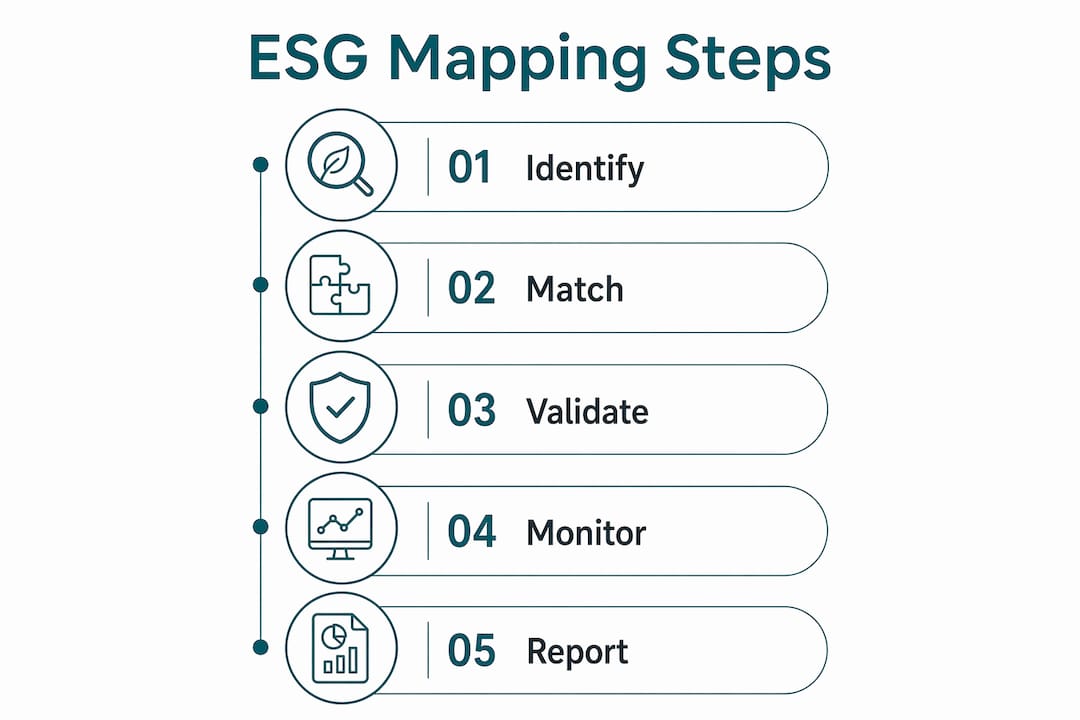
A practical mapping process follows six steps. Each step builds on the previous one, so skipping ahead creates gaps that surface during assurance reviews.
-
Identify applicable regulations by jurisdiction and company size. List every country where you operate, employ staff, or generate revenue above local thresholds. Cross-reference that list against the ISSB adoption tracker, CSRD thresholds, and US state laws. The output is a jurisdiction matrix showing which rules apply and when.
-
Conduct a gap analysis using simplified ESRS and ISSB standards. Compare your current disclosures against the required data points for each applicable framework. The EU Omnibus I revision reduced ESRS data points by 61%, so use the revised list, not the original 2023 version.
-
Build a unified data model. Map Scope 1, 2, and 3 emissions, social metrics (workforce data, human rights due diligence), and governance disclosures into a single data architecture. Every field should carry a tag showing which frameworks require it.
-
Apply regulatory overlays for sector and local law specifics. Energy companies face additional ISSB S2 physical risk disclosures. Financial services firms face TCFD legacy requirements from local regulators. Retail and construction companies face supply chain disclosure rules under CSRD. Sector overlays sit on top of the base framework map.
-
Develop controls for third-party assurance readiness. Assign data owners, document collection methodologies, and establish review sign-off workflows. Auditors will ask for evidence of control, not just the final numbers.
-
Document workflows for ongoing compliance and updates. A compliance map is not a one-time project. Build a living document that assigns responsibility for monitoring regulatory changes and updating the data model when rules shift.
The table below shows how the major 2026 frameworks compare on three critical dimensions:
| Framework | Materiality type | Assurance requirement | Scope |
|---|---|---|---|
| ISSB S1 and S2 | Financial materiality | Varies by jurisdiction | 21+ mandatory jurisdictions |
| CSRD (ESRS) | Double materiality | Limited (reasonable by 2028–2030) | EU companies above revised thresholds |
| GRI Standards | Impact materiality | Voluntary | Global, widely used |
| California SB 253 | Financial and impact | Third-party verification | Companies doing business in California |
What common pitfalls should sustainability managers avoid during ESG mapping?
The most common failure in ESG mapping is misaligning organizational data entities because of differing materiality definitions. Incorrect entity mapping wastes resources on manual spreadsheet cleaning and produces disclosures that fail assurance review. Automated tools that tag data points by jurisdictional applicability prevent this problem before it starts.
Four additional pitfalls appear repeatedly across compliance programs:
- Over-collecting data without assurance focus. Teams gather hundreds of metrics because a framework mentions them, without checking whether those metrics are material or subject to assurance. Audit-ready data for 20 key metrics beats unverified data for 200.
- Ignoring the EU Omnibus I revision. Companies that built their CSRD programs around the original 2023 scope are now either over-reporting or misallocating resources. Verify your threshold position against the revised 1,000-employee and €450 million turnover criteria immediately.
- Treating frameworks as isolated silos. GRI, ISSB, and CSRD share significant data overlap. Companies that build separate reporting tracks for each framework triple their workload for no additional compliance benefit.
- Underestimating assurance complexity. Limited assurance is not a light-touch review. Auditors examine data lineage, control documentation, and methodology consistency. Teams that treat assurance as a final-step sign-off rather than a design constraint routinely fail their first review.
Pro Tip: Run a mock assurance review six months before your first external audit. Ask your internal audit team to challenge data lineage for your top five disclosed metrics. The gaps they find are cheaper to fix internally than externally.
How do global ESG regulations converge and diverge?
The global ESG regulatory landscape is converging around ISSB as the investor-facing baseline, while CSRD and GRI serve broader stakeholder and impact disclosure needs. Understanding where frameworks align and where they diverge is the foundation of a “map once, report many” strategy.
| Dimension | ISSB | CSRD (ESRS) | GRI |
|---|---|---|---|
| Primary audience | Investors | Regulators and stakeholders | Broad stakeholders |
| Materiality | Financial | Double | Impact |
| Mandatory status | 21+ jurisdictions | EU above thresholds | Voluntary globally |
| TCFD alignment | Full (S2 absorbs TCFD) | Partial | Partial |
| Scope 3 requirement | Required under S2 | Required under ESRS E1 | Encouraged |
The practical implication is clear. A company that builds its data model around ISSB S1 and S2 satisfies the investor disclosure requirement in most of the world. Adding CSRD’s double materiality layer covers the EU. Mapping GRI’s impact indicators on top covers voluntary stakeholder reporting. Each layer adds disclosures, but the core data infrastructure is shared. That architecture is what compliance success in 2026 actually requires.
Regional timing differences still matter. Australia’s mandatory climate disclosures began phasing in for large companies in 2024. Japan’s ISSB-aligned rules apply to Tokyo Prime Market companies from fiscal year 2025. Singapore’s mandatory ISSB disclosures apply to listed companies from 2025. Each jurisdiction adds its own effective date and local nuance, which is why a living jurisdiction matrix is not optional.
Key Takeaways
Mapping the 2026 ESG regulatory framework requires a unified data infrastructure, jurisdiction-specific applicability analysis, and audit-grade internal controls built before assurance reviews begin.
| Point | Details |
|---|---|
| ISSB is the global baseline | ISSB S1 and S2 are mandatory in 21+ jurisdictions covering 60% of global GDP. |
| EU Omnibus I changed CSRD scope | Revised thresholds cut mandatory companies by approximately 80%; verify your position now. |
| Build a unified data model | A single data architecture mapped to multiple frameworks eliminates duplication and audit gaps. |
| Assurance readiness is a design constraint | Internal controls must match financial auditing standards before external review begins. |
| Map once, report many | Aligning ISSB as the base layer, then adding CSRD and GRI overlays, reduces total compliance workload. |
The regulatory map is only as good as the infrastructure behind it
Compliance officers often ask me which framework to prioritize. My answer is always the same: build for ISSB first, then layer on CSRD and GRI. The reason is structural. ISSB covers the widest mandatory geography and uses financial materiality, which your finance team already understands. Starting there gives you a foundation your CFO can defend to auditors.
What I have seen trip up even well-resourced teams is the assumption that regulatory mapping is a project with an end date. It is not. The EU Omnibus I revision landed in 2026 and immediately invalidated months of scoping work for companies that had built their CSRD programs around the original thresholds. Teams with living compliance maps adapted in weeks. Teams with static spreadsheets spent months rebuilding.
Senior leadership buy-in is not a soft requirement. When the data governance model requires finance, legal, operations, and sustainability to share a single source of truth, only a C-suite mandate makes that happen. I have watched technically excellent mapping projects stall because no one had authority to enforce data ownership across departments.
The shift toward audit-grade internal controls is the single biggest operational change in ESG compliance right now. Sustainability reporting used to be a communications exercise. It is now an audit exercise. Teams that internalize that shift early build the right controls, assign the right data owners, and pass assurance reviews without emergency remediation.
— Ronnie
How Esgautomated supports your ESG compliance mapping in 2026
Esgautomated is an AI-powered ESG compliance platform built specifically for mid-market companies navigating the 2026 ESG regulatory framework. It automates data collection, metric calculation, and sustainability reporting across GRI, TCFD, CSRD, SASB, and CDP frameworks, replacing expensive consultants and manual spreadsheets.
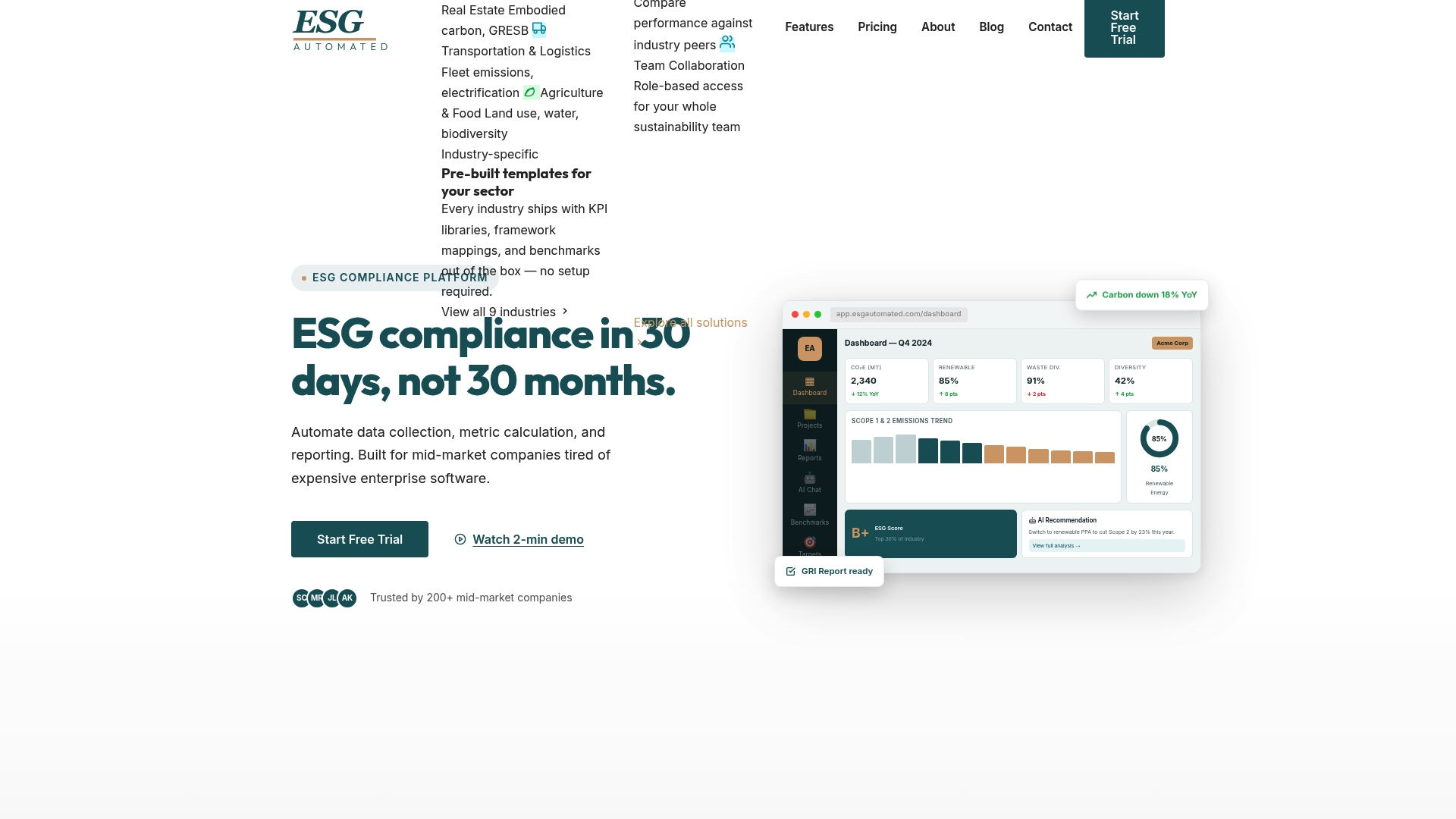
Companies using Esgautomated get their first audit-ready ESG report in 30 days. The platform supports ESG data management with automated tagging by jurisdiction and framework, so your team maps data once and reports across multiple standards without rebuilding from scratch. Esgautomated serves companies across financial services, technology, energy, and other sectors with industry-specific compliance workflows. Visit esgautomated.com to request a demo and see how your organization can reach audit readiness before your next reporting deadline.
FAQ
What is ESG regulatory mapping?
ESG regulatory mapping is the process of identifying every applicable sustainability disclosure requirement for your organization and aligning your data and reporting workflows to satisfy those requirements across multiple frameworks simultaneously.
Which ESG frameworks are mandatory in 2026?
ISSB S1 and S2 are mandatory in more than 21 jurisdictions covering 60% of global GDP. CSRD applies to EU companies above the revised thresholds of 1,000 employees and €450 million in turnover. California SB 253 applies to large companies doing business in California.
How did the EU Omnibus I revision change CSRD requirements?
The EU Omnibus I directive raised CSRD reporting thresholds and reduced the number of mandatory companies by approximately 80%. It also cut required ESRS data points by 61%, meaning companies must re-verify whether they still fall within scope.
What assurance level does ESG reporting require?
Assurance requirements vary by jurisdiction. Europe currently mandates limited assurance for CSRD, with plans to move to reasonable assurance by 2028–2030. India requires reasonable assurance for its top 150 listed firms. Your data controls should be built to the reasonable assurance standard now to avoid costly retrofits later.
What is the “map once, report many” approach?
The “map once, report many” approach means building a single data infrastructure that collects and tags ESG data points once, then maps them to multiple frameworks such as ISSB, CSRD, and GRI automatically. This reduces duplication, lowers compliance costs, and produces consistent disclosures across all required standards.