
The role of ESG in corporate governance is to embed environmental, social, and governance principles into a company’s highest decision-making structures, making the board of directors the ultimate owner of sustainability accountability. ESG governance is not a management initiative you can delegate downward and forget. It is a board-level mandate that shapes strategy, capital allocation, and long-term value creation. Frameworks like ISSB disclosure requirements and the EU’s Corporate Sustainability Reporting Directive (CSRD) now demand that companies demonstrate substantive governance practice, not just formal reporting lines. This guide explains exactly how boards exercise that mandate and how management control systems translate board intent into daily operations.
What is the role of ESG in corporate governance?
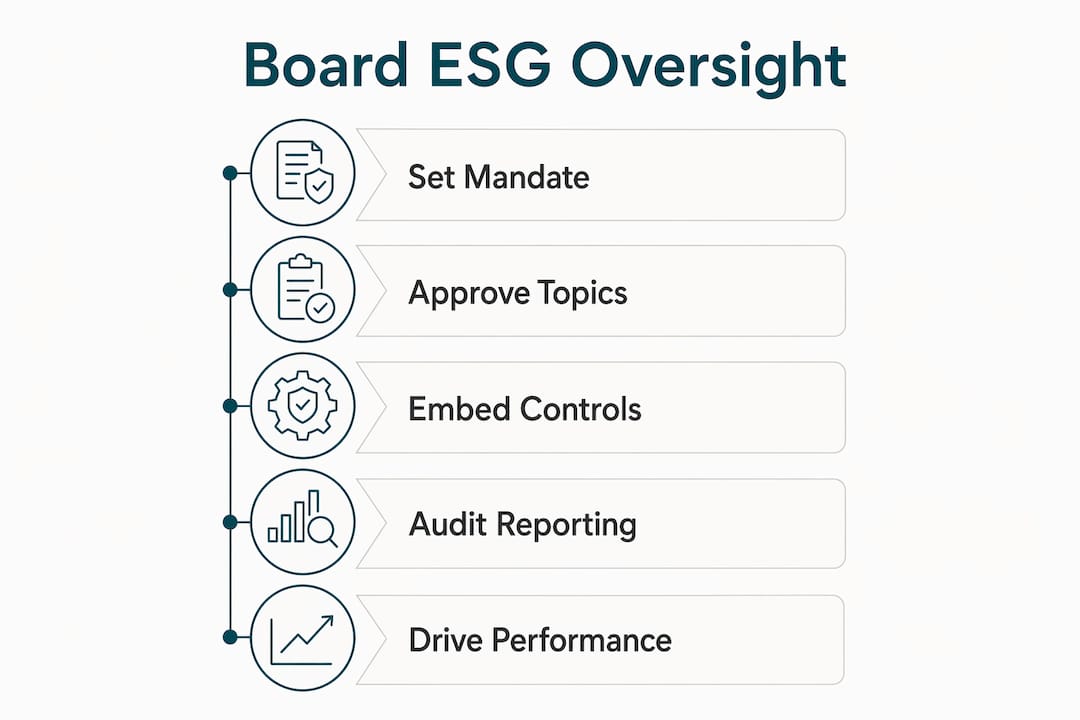
Board-level corporate governance is the primary mechanism for implementing ESG. The board sets the ESG mandate and embeds oversight into corporate strategy rather than delegating ESG solely to management. Management executes and maintains data integrity, but the board retains ultimate accountability, including through audit and sustainability committees. That distinction matters because it determines where accountability sits when ESG performance falls short.
ESG governance extends traditional corporate governance by adding environmental and social dimensions to the existing “G” of governance. A company that treats ESG as a compliance checkbox assigns it to a sustainability manager and moves on. A company that treats ESG as a governance matter assigns it to the board, ties it to strategy, and measures it with the same rigor applied to financial performance. The difference in outcomes is significant.

ISSB disclosure requirements mandate that companies explain how governance oversees sustainability and climate-related risks, demonstrating substance beyond formal charters with timely escalation and integration into strategic decisions. Investor and regulator scrutiny now focuses on actual governance practice. A charter that lists ESG responsibilities without evidence of board engagement will not satisfy ISSB or CSRD reviewers.
How does the board of directors oversee ESG performance?
The board’s ESG oversight role covers four distinct responsibilities: setting the ESG mandate, approving material sustainability topics, monitoring performance against targets, and holding management accountable for execution. Each responsibility requires a different governance mechanism.
Board attributes that drive ESG outcomes
A 2026 empirical study of European listed firms finds board gender diversity, non-executive director presence, meeting attendance, board size, and tenure statistically associated with ESG performance. Compensation was not a significant factor. That finding challenges the common assumption that tying executive pay to ESG metrics is the most effective lever. Active monitoring and engagement, not financial incentives alone, produce stronger ESG outcomes.
Non-executive directors bring independent judgment to ESG oversight. Their presence reduces the risk that management captures the board’s sustainability agenda. Meeting attendance signals genuine engagement rather than nominal oversight. Boards that meet frequently and include diverse, independent members are structurally better positioned to challenge management’s ESG reporting and push for real accountability.
Committee structures and role clarity
Most boards assign ESG oversight to one of two structures: a dedicated ESG or sustainability committee, or an expanded audit committee mandate. Effective committee structures emphasize integration and information flow between audit committees focusing on data integrity and ESG committees driving transition strategy, avoiding split silos that let material issues fall through the cracks.
High-performing ESG governance uses a clearly defined RACI matrix clarifying board accountability, the audit committee’s data scrutiny role, the ESG committee’s strategic integration function, and management’s execution responsibilities. The CFO and finance function typically lead ESG data transformation, with board oversight attracting stakeholder trust.
Pro Tip: Build your ESG RACI matrix before your next board cycle. Assign each material ESG topic a clear owner at the board level, a reviewer at the committee level, and an executor in management. Ambiguity in ownership is the single fastest way to turn board intent into inaction.
How do governance mechanisms translate into operational ESG practices?
Board oversight alone does not automatically produce ESG results. Governance mechanisms alone do not drive ESG practices. Management control systems, including planning, budgeting, and monitoring routines, mediate and activate sustainability priorities at the operational level. Governance shapes authority and strategic intent. Management control systems enable coordination and execution to embed ESG into daily work.
Think of it as two distinct but connected layers. The board layer defines what matters and why. The management control layer determines how ESG priorities show up in quarterly planning cycles, capital expenditure approvals, supplier assessments, and employee performance reviews. Without the second layer, board resolutions on ESG remain aspirational.
Management control routines that institutionalize ESG
Boards can verify that management has built the right control routines by asking four specific questions:
- Planning: Are material ESG topics included in the annual strategic planning process, with targets set at the business unit level?
- Budgeting: Does the capital allocation process require ESG impact assessments for major investments, including in sectors like energy and manufacturing?
- Monitoring: Does management report ESG metrics to the board on a regular cadence, with variance explanations comparable to financial reporting?
- Performance reviews: Are ESG outcomes included in management performance evaluations at levels below the C-suite, where daily decisions actually happen?
If the answer to any of these is no, the board’s ESG mandate has not reached the operational layer.
Pro Tip: Ask management to map one material ESG topic, such as Scope 1 emissions or supply chain labor standards, through each control routine. If they cannot show you where it appears in planning, budgeting, monitoring, and performance reviews, the governance gap is in the management control layer, not the board.
How do audit committees and ESG committees support reporting integrity?
Audit committees increasingly oversee ESG reporting integrity, extending their mandates to sustainability data verification with rigor comparable to financial reporting. Coordination with ESG committees ensures compliance and oversight of ESG assurance processes. Treating ESG data with the same skepticism applied to financial statements is no longer optional. It is a regulatory expectation under CSRD and ISSB.
The CSRD increases governance expectations by requiring sustainability information in management reports with mandatory third-party assurance, emphasizing documented internal controls and early engagement of assurance providers. Governance must support sustainability data quality and assurance readiness. Boards that wait until the reporting deadline to engage assurance providers will face material weaknesses in their first CSRD submissions.
The table below contrasts the distinct but complementary roles of audit and ESG committees in supporting governance integrity.
| Dimension | Audit committee | ESG/sustainability committee |
|---|---|---|
| Primary focus | Data integrity and assurance | Strategy and material topic prioritization |
| ESG reporting role | Verifies data quality and controls | Approves ESG targets and disclosure scope |
| Regulatory interface | CSRD assurance readiness, ISSB controls | Materiality assessment, stakeholder engagement |
| Risk lens | Financial misstatement risk in ESG data | Transition risk, physical risk, reputational risk |
| Management interface | CFO, controller, internal audit | Chief Sustainability Officer, operations leads |
The most common governance failure is treating these two committees as separate silos. Audit committees catch data errors. ESG committees set direction. Without regular joint sessions and shared information flows, a company can have accurate data pointing in the wrong direction, or ambitious targets built on unreliable data.
What practical strategies strengthen board ESG oversight?
Boards should define and refresh their ESG oversight scope, use processes to prioritize critical sustainability topics, and verify management has solid processes for risk identification, measurement, and reporting. Not every ESG issue deserves equal board attention. Materiality assessment is the tool that separates critical topics from background noise.
Concrete strategies that boards can implement now include:
- Conduct a formal materiality refresh annually. Stakeholder expectations and regulatory requirements shift faster than most board calendars. A materiality assessment completed in 2023 does not reflect CSRD or ISSB expectations in 2026.
- Tie ESG criteria to capital allocation decisions. Boards that require ESG impact assessments for investments above a defined threshold create a direct link between governance intent and resource deployment.
- Build board ESG literacy through structured education. Directors cannot oversee what they do not understand. Annual briefings from external advisors on regulatory changes, sector-specific risks, and peer benchmarks close the knowledge gap.
- Use integrated ESG platforms for real-time data visibility. Boards that rely on quarterly PDF reports are always governing on stale data. Platforms that connect data collection, metric calculation, and reporting give boards current information to act on.
- Ask sharper questions in board meetings. Replace “How are we performing on ESG?” with “Which material topics showed variance this quarter, and what is management’s corrective action?” Specificity drives accountability.
Visible governance mechanisms such as charters and committee mandates are preparatory. True ESG governance efficacy shows up in timely escalation of sustainability risks and their integration into strategic and capital decision-making processes. The board’s job is to make sure that escalation actually happens.
Key takeaways
ESG governance works when the board owns the mandate, management control systems embed it operationally, and audit committees verify the data with financial-reporting rigor.
| Point | Details |
|---|---|
| Board owns the ESG mandate | The board sets ESG strategy and retains ultimate accountability; management executes. |
| Board attributes matter | Gender diversity, non-executive presence, and meeting attendance correlate with stronger ESG outcomes. |
| Management controls activate governance | Planning, budgeting, and monitoring routines translate board intent into operational ESG practice. |
| Committee coordination is critical | Audit and ESG committees must share information to prevent data silos and governance gaps. |
| Materiality drives focus | Annual materiality refreshes ensure boards prioritize the ESG topics that actually affect long-term value. |
The box-ticking trap is real, and most boards are still in it
Boards spend considerable time approving ESG charters, forming sustainability committees, and commissioning materiality assessments. Then they present those artifacts to investors as evidence of governance. That is not governance. That is preparation for governance.
The research is clear: board effectiveness in ESG depends less on checking boxes and more on whether oversight translates into operational routines through management controls that embed sustainability. I have seen companies with beautifully designed ESG committee charters where the committee meets twice a year and receives a summary slide deck. That is not oversight. That is theater.
The boards that get this right share one habit: they ask management to show them the control routine, not just the outcome. They want to see where a material ESG topic appears in the planning cycle, the budget, and the performance review process. When management cannot answer that question, the board treats it as a governance failure, not a management communication problem.
The other trap is treating ESG data as inherently less reliable than financial data. PwC’s guidance on ESG assurance is direct: audit committees must apply the same skepticism to sustainability data that they apply to financial statements. That means engaging assurance providers early, not at the end of the reporting cycle. Boards that build this discipline now will be ahead of the regulatory curve when CSRD assurance requirements tighten further.
— Ronnie
How Esgautomated supports board-level ESG governance
Boards need current, reliable ESG data to govern effectively. Quarterly PDF reports and manual spreadsheets create the exact information gaps that undermine board oversight.
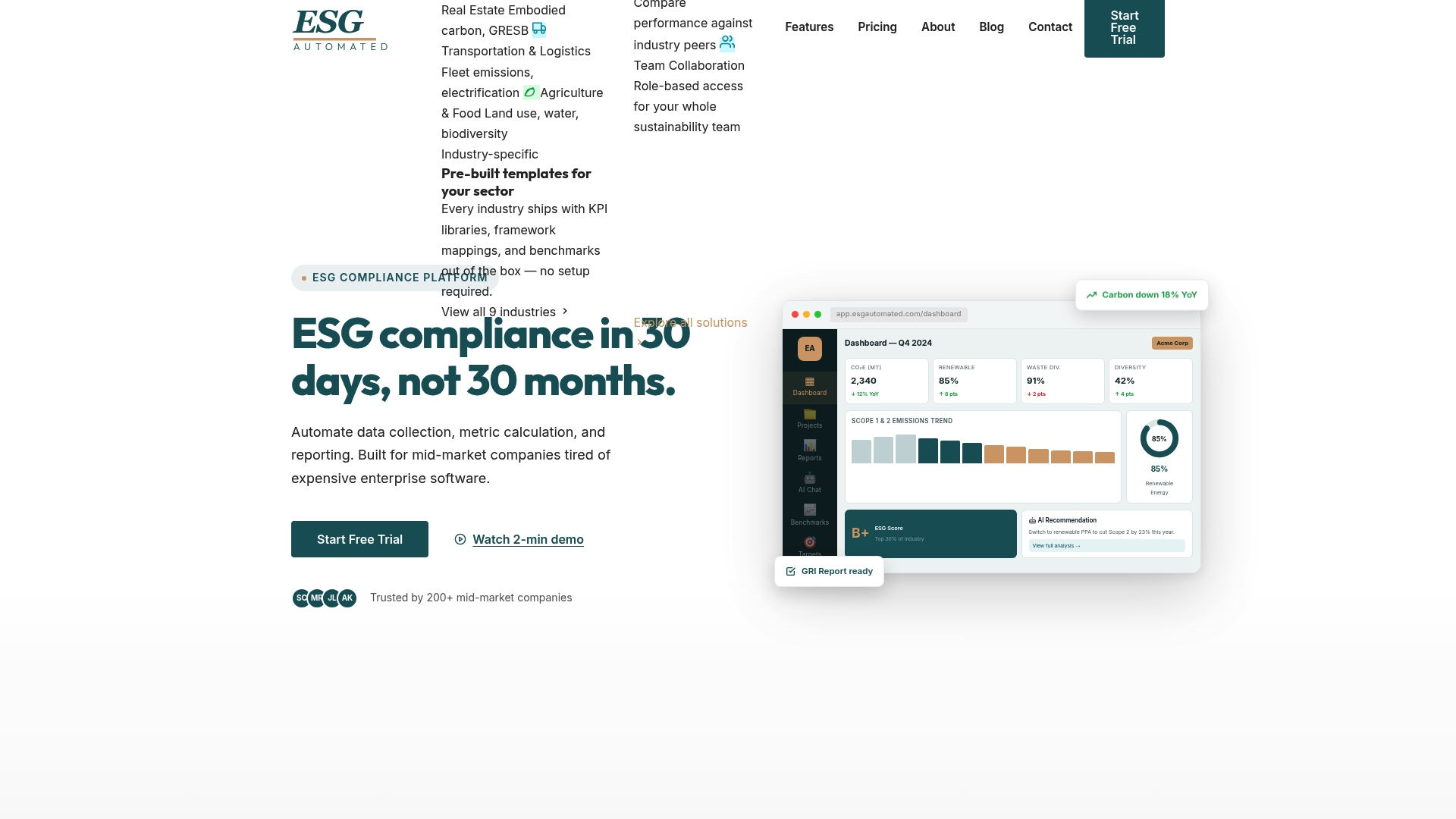
Esgautomated is an AI-powered ESG compliance platform built for mid-market companies. It automates data collection and metric calculation across GRI, TCFD, CSRD, SASB, and CDP frameworks, giving boards and audit committees access to audit-ready data without waiting for a consultant’s report. The platform’s team collaboration tools connect board oversight directly to management execution, closing the gap between governance intent and operational practice. Companies using Esgautomated produce their first audit-ready ESG report in 30 days. Explore Esgautomated’s full platform to see how it supports your board’s oversight responsibilities.
FAQ
What is the board’s primary role in ESG governance?
The board sets the ESG mandate, approves material sustainability topics, and retains ultimate accountability for ESG performance. Management executes the strategy and maintains data integrity.
How do management control systems relate to ESG governance?
Management control systems, including planning, budgeting, and monitoring routines, translate board-level ESG intent into operational practice. Without these systems, governance decisions do not reach daily business operations.
What board attributes are most associated with strong ESG performance?
A 2026 Springer study of European listed firms found that gender diversity, non-executive director presence, meeting attendance, board size, and tenure correlate with stronger ESG outcomes. Executive compensation was not a statistically significant factor.
How should audit committees approach ESG reporting?
Audit committees should treat ESG data verification with the same rigor as financial reporting, engaging assurance providers early and reviewing internal controls for sustainability data quality under CSRD and ISSB requirements.
What is a materiality assessment and why does it matter for boards?
A materiality assessment identifies which ESG topics are most significant to a company’s long-term value and stakeholder relationships. Boards use it to focus oversight on critical issues rather than treating all ESG factors equally.