
ESG reporting requires finance input because sustainability data without financial controls is unauditable, legally exposed, and useless to investors. The finance function brings the internal controls, materiality frameworks, and audit-ready processes that transform raw environmental and social metrics into credible disclosures. Regulatory mandates from the CSRD, ISSB, and SEC climate rules have made this integration non-negotiable. CFOs, controllers, and financial planning teams are now central figures in every GRI, SASB, and TCFD submission. Without their involvement, ESG reports fail the standards that institutional investors and regulators now demand.
Why ESG reporting needs finance input: regulatory and investor pressure
External pressure is the clearest reason finance must lead ESG disclosure. The Corporate Sustainability Reporting Directive (CSRD) requires companies to apply double materiality assessments and submit ESG data under third-party assurance. The ISSB’s IFRS S1 and S2 standards demand climate-related financial disclosures that align directly with financial statement assumptions. California’s climate disclosure laws extend these requirements to large private companies operating in the state.
Investors are equally demanding. 94% of institutional investors require audit-ready ESG data with rigorous governance trails to reduce greenwashing risk. That figure signals a market-wide shift: ESG disclosures are now held to the same evidentiary standard as earnings reports. Companies that cannot produce traceable, validated sustainability data lose credibility with asset managers and pension funds.
The CFO preparedness gap makes this urgent. Only 22% of CFOs feel well-prepared to meet ESG performance measurement and external assurance requirements as of early 2026. That gap is not a knowledge problem. It is a structural one. Finance teams have not yet been formally embedded in ESG workflows at most mid-market companies.
- CSRD: Requires double materiality assessment and third-party assurance for EU-linked companies
- ISSB IFRS S1/S2: Mandates climate risk disclosures connected to financial statement assumptions
- SEC climate rules: Require Scope 1 and Scope 2 emissions disclosure for public companies
- California SB 253/SB 261: Extend climate disclosure to large private companies operating in California
73% of sustainability leaders cite CFOs as key influencers for securing ESG funding and institutional support. Finance is not just a compliance gatekeeper. It is the function that determines whether ESG programs receive the budget and board attention they need.
How does finance ensure ESG data meets audit readiness standards?
Finance ensures ESG data quality by applying the same internal controls used for financial statements. That means documented data sources, version-controlled calculations, segregation of duties, and reconciliation processes. Without these controls, ESG data is anecdotal. With them, it becomes decision-grade.

Double materiality is the central concept here. Under CSRD, double materiality requires companies to assess both how ESG factors affect the business financially and how the business affects the environment and society. Finance owns the financial materiality half of that assessment. Controllers and FP&A teams are best positioned to map ESG risks to cash flow exposure, capital costs, and balance sheet liabilities.
Finance functions must act as gatekeepers for ESG data, applying internal controls similar to financial reporting meeting investor and regulator standards. This is not optional governance hygiene. Auditors now test ESG data with the same skepticism they apply to revenue recognition.
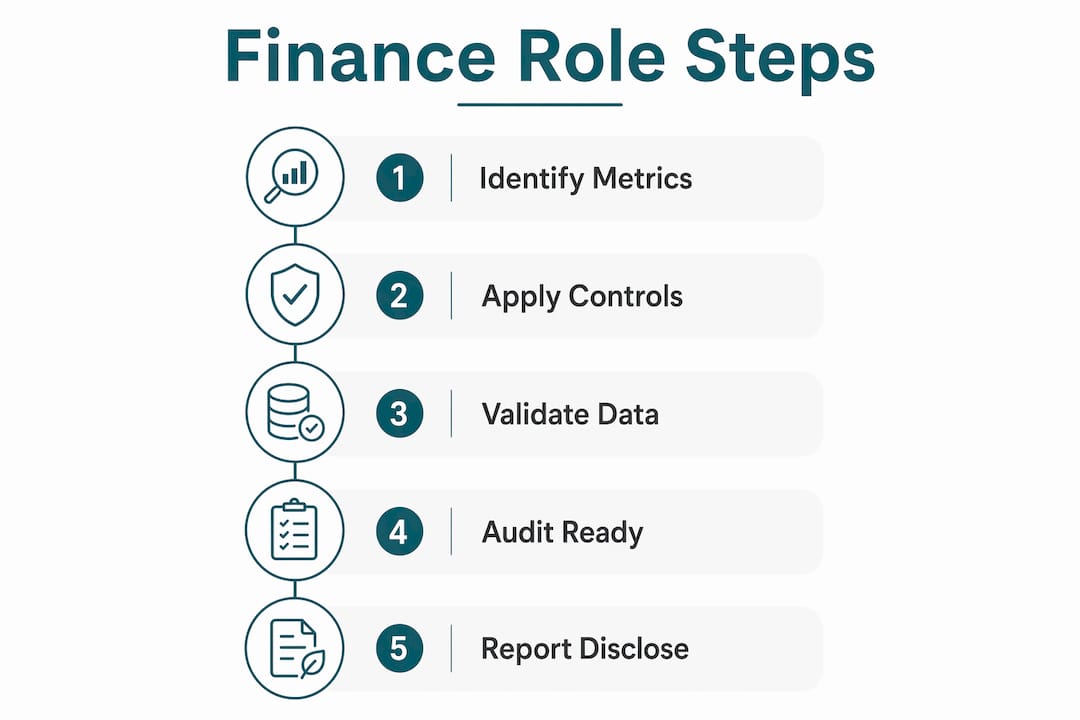
One of the most overlooked failure points is conversion factor governance. Sustainability teams often collect raw activity data, such as kilowatt-hours of electricity or liters of fuel, and apply emissions conversion factors to calculate Scope 1 and Scope 2 figures. Failure to govern those conversion factors turns raw sustainability data into unsupported claims that auditors reject. Finance teams understand version control and source documentation. They must apply that discipline to every ESG calculation.
Pro Tip: Map each ESG metric back to a named data owner in finance or operations before your first external assurance engagement. Auditors will ask who approved the number. “The sustainability team” is not an acceptable answer.
The practical steps for building finance-grade ESG data controls follow a clear sequence:
- Identify every ESG metric required by your chosen frameworks (GRI, SASB, ISSB, or CSRD).
- Assign a data owner in finance or operations for each metric.
- Document the calculation methodology, including all conversion factors and their sources.
- Build reconciliation checkpoints that tie ESG data back to operational records or financial systems.
- Run an internal pre-assurance review before engaging external auditors.
Which ESG metrics matter most to finance teams?
Finance teams prioritize ESG metrics that connect directly to enterprise value. Not every sustainability indicator belongs in a financial analysis. The ones that matter are those with a demonstrated causal link to cost of capital, revenue growth, or operating cost.
Companies succeed by defining 3–5 business-specific ESG super-metrics linked to valuation levers to demonstrate impact on enterprise value. Finance leaders challenge sustainability teams to justify those causal links with data, not narrative. A carbon intensity metric matters to finance if it affects energy costs, regulatory fines, or access to green financing. A workforce safety metric matters if it drives insurance premiums, litigation exposure, or productivity.
| Generic ESG metric | Finance-prioritized equivalent |
|---|---|
| Total Scope 1 emissions (tons CO2e) | Carbon intensity per unit of revenue (linked to energy cost and carbon tax exposure) |
| Employee turnover rate | Cost of turnover as % of payroll (linked to productivity and recruitment spend) |
| Water consumption (cubic meters) | Water cost per unit of output (linked to operational efficiency and regulatory risk) |
| Board diversity percentage | Governance risk score (linked to cost of capital and institutional investor access) |
| Supplier sustainability audits completed | Supply chain disruption risk (linked to revenue continuity and insurance costs) |
The distinction matters because generic ESG metrics generate reports. Finance-prioritized super-metrics generate board decisions. When the CFO can show that a 10% reduction in carbon intensity reduces energy costs by a quantifiable amount, ESG moves from a reporting obligation to a capital allocation input.
ESG reporting is increasingly part of fiduciary duty, requiring CFOs to translate non-financial metrics into financially material risks that affect cash flow and capital costs. That translation work is the core of why ESG is a fiduciary duty, not just a disclosure exercise.
What practical steps integrate ESG into finance workflows?
Integrating ESG into finance workflows requires connecting sustainability data to the systems finance already uses. ERP platforms like SAP and Oracle hold the operational data that feeds most ESG calculations. CPM platforms like Workday Adaptive Planning and Anaplan manage the planning cycles where ESG targets should appear alongside financial targets.
Treating ESG reporting as a compliance checkbox leads to siloed, unauditable data. Embedding ESG metrics into existing CPM workflows and ERP systems is the structural fix. Finance teams that run ESG data through the same close process as financial data produce reports that hold up under scrutiny.
Framework selection is a finance decision, not just a sustainability one. GRI covers broad stakeholder disclosure. SASB provides industry-specific financial materiality guidance. ISSB connects directly to financial statement assumptions. The right choice depends on your investor base, regulatory jurisdiction, and the industry-specific ESG reporting requirements your company faces.
- Connect ESG data sources to ERP systems so activity data flows automatically into reporting tools rather than through manual spreadsheets.
- Include ESG targets in the annual budget cycle so sustainability goals receive the same resource allocation scrutiny as financial targets.
- Establish a cross-functional ESG committee with finance, legal, operations, and sustainability represented, with finance holding sign-off authority on disclosed metrics.
- Select frameworks based on investor and regulator requirements, not on what is easiest to report.
- Run ESG data through the financial close process to catch errors before external assurance begins.
Pro Tip: If your company uses a CPM platform for financial consolidation, add ESG metrics as a parallel data stream in the same tool. Auditors find it far easier to validate ESG figures when they sit alongside the financial data they already trust.
Governance structure matters as much as technology. Finance must hold formal sign-off authority over ESG disclosures. Without that authority, sustainability teams can publish metrics that finance has never reviewed. That creates legal exposure under CSRD and SEC rules, where CFOs and CEOs sign off on the accuracy of disclosed data.
Key takeaways
Finance input transforms ESG reporting from a narrative exercise into a credible, audit-ready disclosure that satisfies regulators and institutional investors.
| Point | Details |
|---|---|
| Finance owns data governance | Apply financial-grade internal controls to every ESG metric before external assurance. |
| CFO preparedness gap is real | Only 22% of CFOs feel prepared for ESG assurance requirements as of early 2026. |
| Super-metrics drive board decisions | Define 3–5 ESG metrics with direct links to cost of capital, revenue, or operating costs. |
| Investor demand is non-negotiable | 94% of institutional investors require audit-ready ESG data with full governance trails. |
| Integration beats standalone reporting | Embedding ESG into ERP and CPM workflows produces auditable, decision-grade disclosures. |
The uncomfortable truth about ESG and finance
Finance professionals tend to underestimate how much ESG reporting has already become their problem. The CSRD does not ask the sustainability team to certify the numbers. It asks the CFO. That shift changes everything about how finance should engage with sustainability data.
The teams I see succeed are the ones that stop treating ESG as a separate reporting track. They pull sustainability metrics into the same governance structure as revenue and cost data. They assign data owners, document methodologies, and run pre-assurance reviews. The teams that struggle are still handing ESG off to a sustainability manager with a spreadsheet and hoping the auditors do not look too closely.
The deeper issue is that ESG metrics are financial variables. Carbon exposure affects energy costs and regulatory fines. Workforce safety affects insurance and litigation. Governance quality affects cost of capital. Finance must lead ESG to meet investor and regulatory standards for comparable, reliable disclosure. That is not a sustainability argument. It is a fiduciary one.
My recommendation for finance professionals in 2026 is direct: claim ownership of ESG data governance now, before your next assurance engagement forces the issue. The financial services sector is already ahead of most industries on this. Mid-market companies in manufacturing, energy, and construction are the ones most at risk of being caught unprepared.
— ESG Team
Esgautomated connects finance and sustainability in one platform
Finance teams need ESG data that behaves like financial data: traceable, validated, and audit-ready. Esgautomated is an AI-powered ESG compliance platform built for mid-market companies that delivers exactly that.
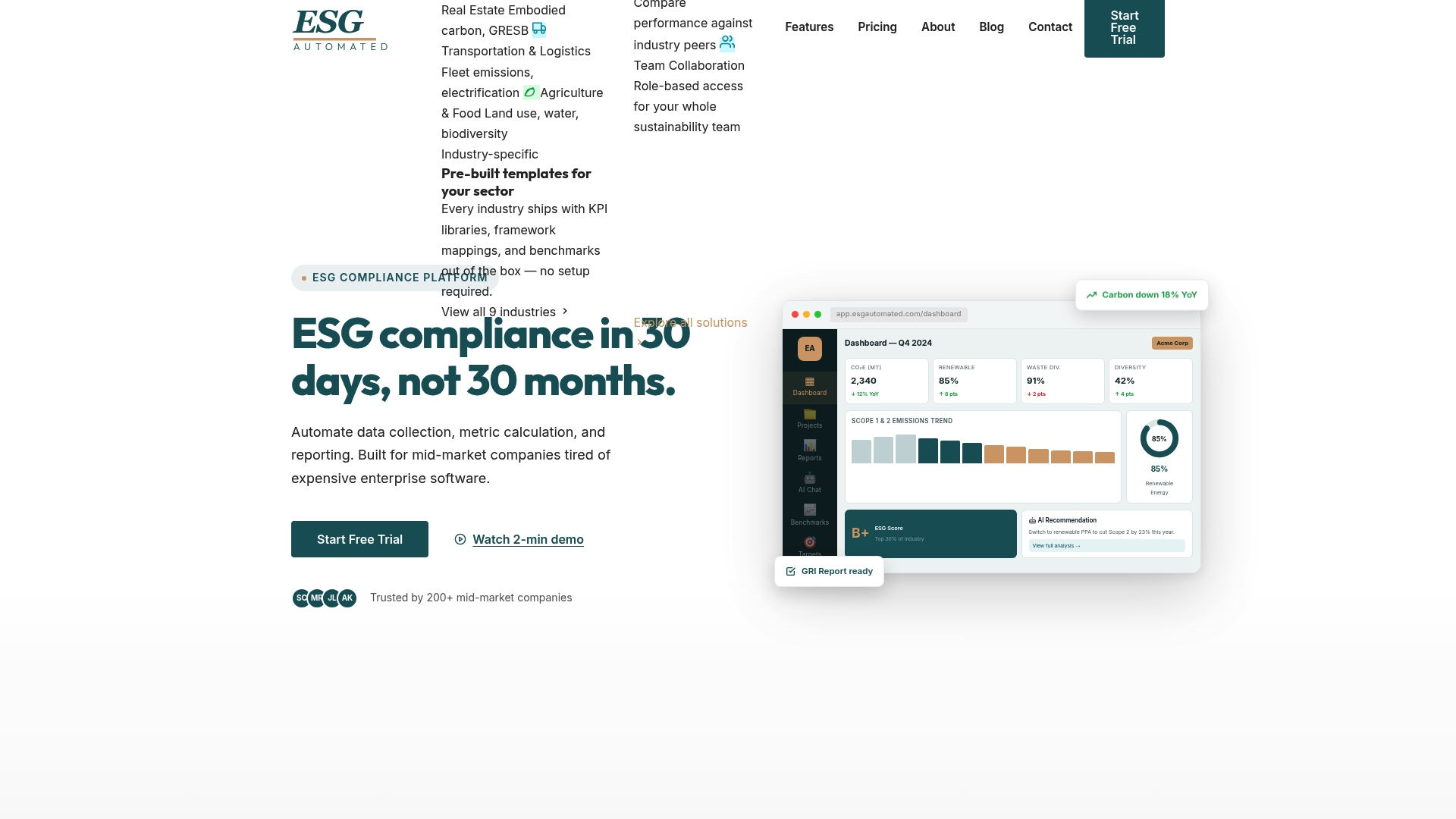
Esgautomated automates data collection, conversion factor validation, and metric calculation across GRI, TCFD, CSRD, SASB, and CDP frameworks. It connects directly to your existing data management workflows so finance teams can review and sign off on ESG figures within the same governance structure they use for financial close. Companies get their first audit-ready ESG report in 30 days. Visit Esgautomated to see how finance-led ESG reporting works in practice.
FAQ
Why does ESG reporting require finance input?
ESG reporting requires finance input because regulators and investors now demand audit-ready disclosures with the same internal controls applied to financial statements. Without finance involvement, ESG data lacks the governance structure needed to pass external assurance.
What is double materiality in ESG reporting?
Double materiality requires companies to assess both how ESG factors affect their financial performance and how their operations affect the environment and society. Finance owns the financial materiality half, mapping ESG risks to cash flow, capital costs, and balance sheet exposure.
Why is ESG a fiduciary duty for CFOs?
Fiduciary duty compels CFOs to translate ESG metrics into financially material risks and returns aligned with shareholder interests. ESG factors like carbon exposure and governance quality directly affect cost of capital and long-term enterprise value.
Which ESG frameworks are most relevant to finance teams?
SASB provides industry-specific financial materiality guidance, making it the most finance-aligned framework. ISSB’s IFRS S1 and S2 standards connect climate risk disclosures directly to financial statement assumptions, which is why they are increasingly required by institutional investors.
How do finance and sustainability teams avoid ESG data errors?
The most common errors come from ungoverned conversion factors and undocumented data sources. Finance teams prevent these by assigning named data owners to each metric, documenting all calculation methodologies, and running ESG data through the same reconciliation process used for financial close.