
Sustainability reporting deadlines are firm submission dates that determine when companies must deliver regulatory disclosures under frameworks such as the EU Corporate Sustainability Reporting Directive (CSRD), California’s SB 253, and SEC climate rules. Missing these dates is not a procedural inconvenience. It creates audit risk, legal exposure, and reputational damage that compounds across reporting cycles. For sustainability professionals and compliance officers managing overlapping regulatory regimes in 2026, understanding why sustainability reporting deadlines matter is the foundation of every governance decision you make this year.
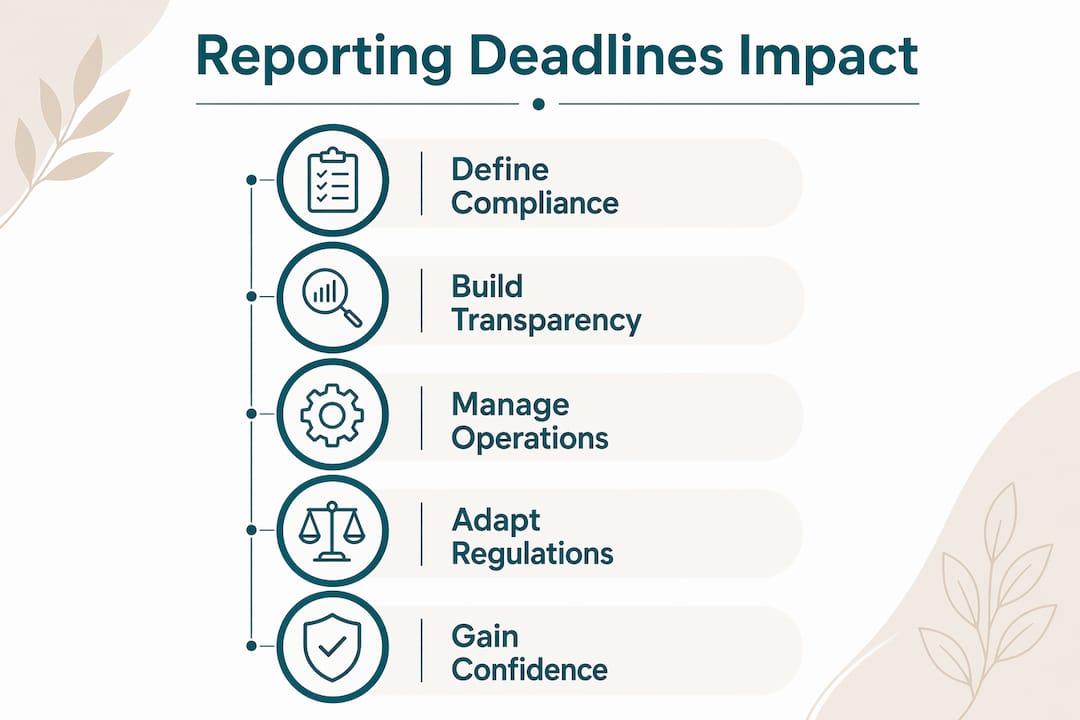
The regulatory environment has shifted sharply. The EU’s Omnibus I Directive has extended some CSRD timelines, the SEC has proposed rescinding its 2024 climate disclosure rules, and California’s CARB has set a firm august 10, 2026 deadline for Scope 1 and 2 GHG reporting under SB 253. These changes do not reduce the pressure on compliance teams. They redistribute it, creating a more complex, multi-regime calendar that demands active management rather than passive monitoring.
Why do sustainability reporting deadlines matter for compliance?
Sustainability reporting deadlines define the legal boundary between compliant and non-compliant disclosure. Cross that line, and the consequences range from increased audit scrutiny to formal regulatory penalties, depending on the jurisdiction and the severity of the gap.

The EU’s CSRD framework is the most demanding regime currently in force. CSRD deadlines require companies to finalize assurance-ready data models and evidence retention well before publication, not just compile narrative text. That distinction matters because assurance providers need time to review, question, and sign off on data. A company that treats the filing date as the data-collection deadline will almost certainly miss both.
The Omnibus I Directive has shifted some of those deadlines. EU member states must transpose the Omnibus I amendments within approximately 12 months, creating staggered enforcement windows across jurisdictions. That staggering means a company operating in Germany faces a different practical compliance calendar than one operating in Poland, even under the same directive.
At the US federal level, the SEC has proposed rescinding its 2024 climate rules, which were never enforced. That proposal does not eliminate federal reporting obligations entirely. It shifts the compliance burden to state-level mandates and investor-driven disclosure expectations, which carry their own deadlines and enforcement mechanisms.
California’s SB 253 is the clearest example of a fixed, non-negotiable deadline in the current US environment. Scope 1 and Scope 2 GHG reporting is due august 10, 2026 under CARB rulemaking. Companies that have been waiting for federal clarity before acting on California obligations are already behind.
| Framework | Original deadline | Current status | Key compliance risk |
|---|---|---|---|
| CSRD (Wave 1) | 2025 reporting year | Omnibus I shifts many to 2028 | Staggered transposition by member state |
| CSRD (Wave 2/3) | 2026–2028 | Extended under Omnibus I | Planning horizon compressed |
| California SB 253 | aug 10, 2026 | Firm, no extension announced | GHG Protocol alignment required |
| SEC climate rules | 2026 onward | Proposed rescission may 2026 | State and market obligations remain |
Pro Tip: Build your compliance calendar around the most demanding deadline in your active jurisdictions, not the most lenient. A company subject to both CSRD and SB 253 should treat the California date as the forcing function for data readiness across all regimes.
How do deadlines affect transparency and investor confidence?
Timely reporting is the mechanism through which sustainability data becomes decision-useful. Investors and lenders cannot allocate capital based on disclosures that arrive late, are incomplete, or lack assurance. The importance of sustainability reporting lies precisely in its ability to provide comparable, reliable data at a predictable cadence.
CSRD’s design centers on investor-grade comparability, requiring digital tagging, documented controls, and third-party assurance. When a company misses its CSRD deadline, it does not just lose a filing date. It breaks the comparability chain that analysts and fund managers depend on for year-over-year assessment. That break increases the cost of capital and reduces access to sustainability-linked financing.
The benefits of timely reporting extend beyond regulatory compliance. Companies that file on schedule consistently demonstrate:
- Governance credibility. On-time disclosure signals that internal controls are functioning and that leadership takes accountability seriously.
- Risk transparency. Investors can assess climate and social risks accurately when data arrives within expected windows.
- Audit efficiency. Assurance providers complete reviews faster when data is organized and submitted on schedule, reducing rework costs.
- Stakeholder trust. Customers, employees, and supply chain partners use sustainability disclosures to make procurement and partnership decisions.
- Capital market access. ESG-linked bonds, green loans, and sustainability-linked credit facilities often require current, audited disclosures as a covenant condition.
“Deadlines matter as much as thresholds, influencing whether 2026 is a planning year or a crunch year for compliance teams.” — Legal experts cited in CSRD and CSDDD analysis, Council Fire, 2026
Delayed disclosures also create a secondary problem: stakeholder uncertainty. When a company that previously reported on time goes silent, analysts and investors fill the gap with assumptions, and those assumptions are rarely favorable.
What operational challenges do organizations face in meeting deadlines?
The operational reality of sustainability reporting compliance is more demanding than most organizations anticipate until they are already behind. Legacy decentralized spreadsheets consistently fail to produce compliant, assurance-ready disclosures on time. That failure is not a technology problem. It is a governance problem that technology exposes.
The most demanding aspect of CSRD compliance is finalizing assurance-ready data models and evidence retention before the publication date. That requires locking data sources, establishing audit trails, and documenting control procedures months before the actual filing. Most organizations underestimate this lead time by at least one full quarter.
Multi-regime synchronization compounds the challenge. Organizations facing overlapping federal, state, investor, and assurance calendars must avoid single-pathway compliance strategies. A company that builds its entire reporting process around CSRD timelines and ignores California SB 253 will face a separate crisis in august 2026.
The following steps build the operational foundation for consistent deadline compliance:
- Map every active reporting obligation. List all frameworks, jurisdictions, and investor requirements that apply to your organization. Include GRI, TCFD, CSRD, SASB, CDP, and any state-level mandates.
- Set internal deadlines 90 days before external ones. Data collection, validation, and internal review must complete well before the regulatory filing date.
- Assign cross-functional ownership. Finance, legal, operations, and sustainability teams each own specific data streams. Clarify ownership before the reporting cycle begins.
- Establish a data governance structure. Define how data is collected, stored, versioned, and approved. This structure is what assurance providers audit.
- Conduct a dry run. Complete a full mock reporting cycle at least one quarter before your first live deadline. Identify gaps while there is still time to close them.
- Monitor regulatory updates continuously. Omnibus I transposition timelines, SEC developments, and CARB rulemaking all affect your compliance calendar in real time.
Pro Tip: Platforms built for ESG data management automate audit trail creation and version control, eliminating the manual governance gaps that cause last-minute reporting failures.
How do evolving deadlines and regulatory changes affect reporting plans?
Regulatory change is now a permanent feature of the sustainability reporting environment, not a temporary disruption. The Omnibus I Directive is the clearest illustration of this reality. Companies must shift from building reporting infrastructure in 2025/26 to collecting data in 2026 for reports due in 2028, which changes the nature of this year’s work from filing preparation to system design.
That shift is not a reprieve. It is a reallocation of effort. Companies that use the extended timeline to delay governance redesign will face the same assurance-readiness crisis in 2028 that early-wave companies faced in 2025.
The SEC’s proposed rescission of its 2024 climate disclosure rules adds a different kind of complexity. The SEC chair’s emphasis on materiality-focused compliance signals that federal climate disclosure obligations are not disappearing. They are being redefined. Companies that depended on a single federal framework to satisfy investor expectations now need to track state-level requirements and voluntary market standards in parallel.
California’s SB 261, which covers climate-related financial risk disclosure, faces its own legal uncertainty due to an ongoing injunction. State-level enforcement discretion can influence how companies approach fixed deadlines, requiring adaptive compliance strategies rather than static annual plans.
| Deadline | Original target | Revised target | Implication for compliance teams |
|---|---|---|---|
| CSRD Wave 2 first report | 2026 | 2028 (post-Omnibus I) | Use 2026 for governance design, not filing prep |
| CSRD Wave 3 first report | 2028 | 2029 or later | Extended planning window, not reduced obligation |
| California SB 253 GHG report | aug 10, 2026 | No change | Immediate action required |
| SEC climate disclosure | 2026 onward | Proposed rescission | Monitor state and investor requirements |
Agile reporting calendars treat deadline changes as inputs, not disruptions. Build your calendar with quarterly review points where you assess regulatory updates and adjust internal milestones accordingly. That practice converts regulatory volatility from a risk into a managed variable.
Key Takeaways
Meeting sustainability reporting deadlines is the single most direct way to protect your organization’s compliance standing, investor relationships, and audit readiness across every active regulatory regime.
| Point | Details |
|---|---|
| Deadlines define legal compliance | Missing a filing date under CSRD or SB 253 creates audit risk and potential regulatory penalties. |
| Assurance readiness precedes filing | Data models and evidence retention must be finalized months before the actual submission date. |
| Multi-regime calendars are mandatory | Organizations must track CSRD, SB 253, SEC developments, and investor requirements simultaneously. |
| Regulatory changes require agile planning | Omnibus I and SEC rescission proposals shift timelines but do not reduce the underlying compliance obligation. |
| Timely disclosure builds investor trust | On-schedule reporting signals governance credibility and supports access to sustainability-linked capital. |
The real cost of treating deadlines as flexible
The sustainability reporting profession has a quiet problem: compliance teams often treat regulatory deadlines as targets rather than boundaries. That mindset works until it does not, and when it fails, the consequences arrive all at once.
Working across multiple reporting cycles, the pattern I see most often is organizations that build their entire compliance process around the narrative report. They focus on what the document says rather than on whether the underlying data can survive an assurance review. By the time the auditors arrive, the data governance gaps are too large to close before the filing date. The result is either a late submission or a qualified assurance opinion, both of which damage credibility with investors and regulators.
The Omnibus I extension is already producing a version of this problem. Some companies are interpreting the 2028 revised deadline as permission to delay governance redesign. That interpretation will produce a 2028 crisis that mirrors the 2025 crisis for Wave 1 companies. The correct interpretation is that 2026 is the year to build the data infrastructure that 2028 reporting will depend on.
The organizations that consistently meet sustainability deadlines share one characteristic: they treat reporting as a continuous process, not an annual event. Data collection, validation, and governance review happen throughout the year. The filing date is simply the point at which a well-maintained system produces its output.
Technology platforms built for ESG reporting compliance make that continuous process achievable without adding headcount. The companies that adopt them early are not just meeting deadlines. They are building the institutional capacity that regulators and investors will increasingly require.
— ESG Team
How Esgautomated supports deadline-driven ESG compliance
Sustainability professionals managing overlapping reporting obligations across CSRD, SB 253, GRI, TCFD, SASB, and CDP need more than a calendar reminder. They need a system that keeps data audit-ready throughout the year.
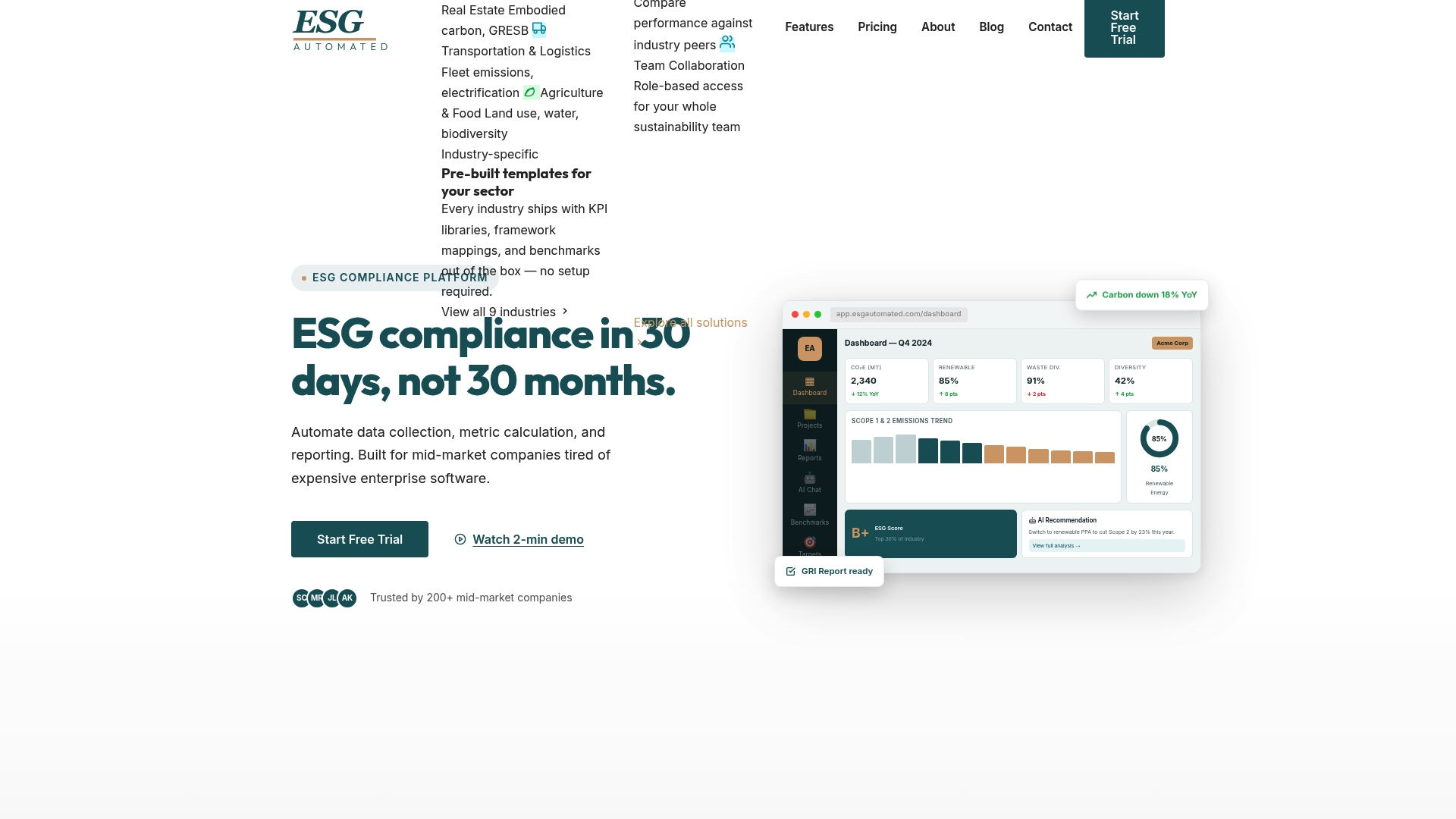
Esgautomated is an AI-powered ESG compliance platform built for mid-market companies. It automates data collection, metric calculation, and audit trail creation across multiple reporting frameworks, replacing manual spreadsheets and fragmented processes. Companies across financial services, energy, manufacturing, and retail use Esgautomated to produce their first audit-ready ESG report in 30 days. The platform supports the governance structures that assurance providers require, so your team is never scrambling when a deadline arrives. See how Esgautomated works and assess whether it fits your compliance calendar for 2026 and beyond.
FAQ
What are sustainability reporting deadlines?
Sustainability reporting deadlines are firm regulatory submission dates by which companies must file ESG disclosures under frameworks such as CSRD, California SB 253, or SEC climate rules. Missing these dates creates legal, audit, and reputational risk.
What happens if a company misses a CSRD deadline?
Missing a CSRD deadline increases audit and assurance rework, degrades data comparability across reporting years, and may trigger regulatory scrutiny depending on member state enforcement. The reputational cost with investors is often immediate.
Is the California SB 253 deadline still in effect for 2026?
Yes. California’s CARB has set august 10, 2026 as the firm deadline for Scope 1 and Scope 2 GHG reporting under SB 253. No extension has been announced, and companies should prepare minimum viable reporting aligned with the GHG Protocol.
How does the Omnibus I Directive change CSRD deadlines?
The Omnibus I Directive postponed first reporting obligations for many CSRD Wave 2 and Wave 3 companies, shifting some deadlines from 2026 to 2028 or later. EU member states must transpose these amendments within approximately 12 months, creating staggered compliance windows by jurisdiction.
Does the SEC’s proposed rescission eliminate US climate reporting obligations?
No. The SEC’s may 2026 proposal to rescind its 2024 climate disclosure rules does not eliminate US reporting obligations. State-level mandates, investor requirements, and voluntary market standards continue to require active deadline tracking and disclosure.