
ESG reporting automation is the use of software to collect, calculate, and publish sustainability data without manual spreadsheet work. For finance teams at mid-market companies, this shift is no longer optional. Over 75 countries now mandate ESG disclosures, and non-compliance fines can exceed $1 million. Manual processes consume 800–2,000 hours annually, a burden that falls squarely on finance. Automation cuts that to roughly 300 hours while shrinking reporting cycles from 28 days to 9. The business case is clear before you even open a spreadsheet.
What does ESG reporting automation require from finance teams?
Finance teams need three things before automation can work: clean data sources, a governance structure, and system integration. Without these, automation simply speeds up bad data.

The biggest barrier is data fragmentation. ESG metrics live across utility invoices, HR systems, travel records, and supplier databases. Fragmented spreadsheet approaches cause audit failures and inefficient reporting cycles. The fix is a central data repository that applies the same governance standards used for financial transactions.
Prerequisites finance teams must address before automating:
- ERP and CPM integration: Connect your enterprise resource planning and corporate performance management systems to ESG data feeds. This creates a single source of truth for both financial and non-financial metrics.
- Data ownership assignment: Assign a named owner to each ESG data category. Scope 1 emissions data needs an owner just as accounts payable does.
- Regulatory framework selection: Decide which frameworks apply to your business. GRI, TCFD, CSRD, SASB, and CDP each have distinct disclosure requirements. Choosing upfront prevents rework.
- Audit trail infrastructure: Build version control and change logs into your data repository from day one. Auditors will ask for them.
- Stakeholder alignment: Finance, operations, and sustainability functions must agree on definitions. A “business travel mile” means different things to different departments.
Finance governance expertise is the foundation here. Teams that treat ESG data with the same rigor as GAAP financials produce reports that hold up under external scrutiny.
How can finance teams implement ESG reporting automation step by step?
A phased approach prevents the most common failure mode: trying to automate everything at once and automating nothing well.
- Assessment and baseline: Audit every ESG data source currently in use. Map where data lives, who owns it, and how often it updates. This step reveals gaps that technology cannot fix on its own.
- KPI definition: Select the specific metrics your frameworks require. CSRD, for example, mandates double materiality disclosures that GRI does not. Defining KPIs before building integrations saves significant rework.
- System integration: Connect your ERP, HR platform, and utility management systems to a central ESG data layer. AI-powered workflows reduce compliance cycle times by up to 70% when data flows automatically from source systems.
- Pilot phase: Run one reporting framework through the automated system before going live across all frameworks. A TCFD pilot, for instance, lets you test anomaly detection and calculation logic on a contained scope.
- Anomaly detection and validation: Configure rules that flag outliers automatically. A sudden 40% spike in Scope 2 emissions should trigger a review, not pass silently into a published report.
- Multi-framework mapping: Map each data point to its corresponding disclosure requirements across GRI, SASB, CSRD, and CDP simultaneously. This is where automation pays for itself. One data input populates multiple framework outputs.
- Automated audit readiness: Generate audit trails, data lineage records, and calculation documentation automatically at each reporting cycle. External auditors receive a complete evidence package without manual assembly.
- Full rollout and training: Expand to all frameworks and train finance staff on exception handling. Automation handles the data. People handle the judgment calls.
Pro Tip: Run your first automated report in parallel with your last manual report. The comparison reveals data gaps and builds internal confidence before you retire the spreadsheets.
What are common challenges in automating ESG reporting for finance?
“Automation does not fix a data governance problem. It amplifies it.” This is the most important thing to understand before you start.
Finance teams that skip the prerequisites phase discover this quickly. Automated systems ingest bad data faster than humans do. The result is a polished report built on unreliable inputs.
The four most common mistakes:
- Treating ESG reporting as an annual project. Continuous integration into ERP or CPM systems reduces resource strain compared to annual data scrambles. Teams that collect data year-round close their reporting cycles in days, not weeks.
- Expecting 100% automation. Narrative and qualitative disclosures still require human synthesis. Automation handles quantitative data integrity. A finance professional must still write the management commentary and assess material risks.
- Underestimating change management. Operations teams resist new data submission processes. Finance teams resist losing control of familiar spreadsheets. Both resistances are predictable and manageable with early stakeholder involvement.
- Ignoring data lineage. Regulators and auditors increasingly require proof of where each number came from. Systems without built-in lineage tracking create compliance risk even when the numbers are correct.
The central repository model solves most of these problems. When non-financial data like utility usage and travel records aligns with financial governance standards, anomaly detection works reliably and audit failures drop.
How can finance teams measure the ROI of ESG reporting automation?
ROI from ESG automation shows up in three places: labor hours, error rates, and financing costs.
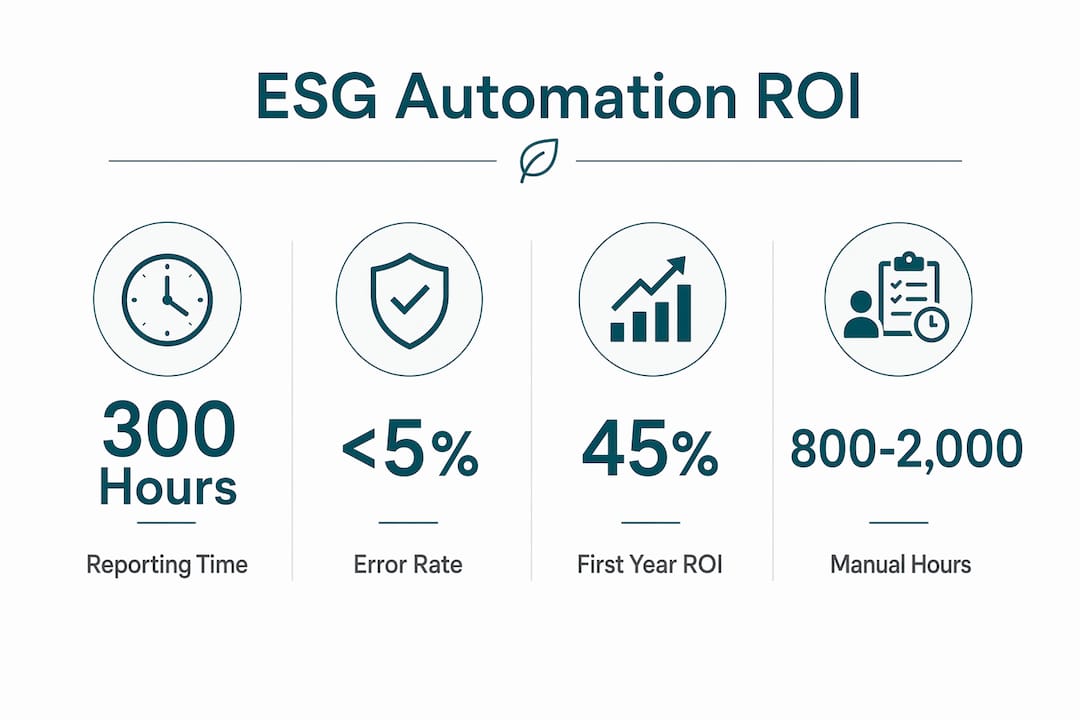
| Metric | Before automation | After automation |
|---|---|---|
| Annual reporting hours | 800–2,000 hours | ~300 hours |
| Reporting cycle length | 28 days | 9 days |
| Manual data error rate | 15% | Less than 5% |
| Audit verification time | Baseline | 40–60% reduction |
| First-year ROI | — | 45% |
Automation reduces manual data errors from 15% to less than 5%. That accuracy improvement cuts external audit verification times by 40–60%, which translates directly into lower professional services fees.
The financing cost angle is less obvious but equally significant. Companies can achieve 45% ROI in year one of ESG automation implementation. Better ESG ratings also reduce financing costs, with each rating improvement linked to a 0.8–1.2 percentage point reduction in borrowing costs. For a mid-market company carrying $50 million in debt, that is a material number.
Track these metrics quarterly: hours spent on ESG data collection, number of data exceptions flagged and resolved, time from data close to report publication, and audit query response time. These four indicators tell you whether your automation investment is performing.
What best practices keep ESG automation running inside finance operations?
Embedding ESG automation into existing finance workflows is what separates teams that sustain the gains from those that revert to spreadsheets after the first reporting cycle.
- Sync with the monthly close. ESG data collection should follow the same calendar as your financial close. When the two processes share a rhythm, finance teams catch discrepancies early and avoid end-of-year data emergencies.
- Update data continuously, not quarterly. Treating ESG as a continuous process rather than a periodic event improves data quality and reduces the resource spike at reporting deadlines.
- Maintain version control on all ESG disclosures. Regulatory bodies and auditors compare current disclosures against prior periods. Version control makes that comparison straightforward and defensible.
- Use dashboards for board and investor communications. Real-time ESG dashboards let finance teams answer investor questions without pulling a new report. This is a direct time saving that finance leadership notices.
Pro Tip: Connect your ESG benchmarking data to your investor relations calendar. When earnings calls approach, your ESG benchmarking metrics should already be current and audit-ready, not assembled under pressure.
Finance teams that own ESG automation as a core function, not a compliance side project, get the most value from it. The finance input to ESG reporting is what gives the data credibility with external stakeholders.
Key takeaways
ESG reporting automation for finance teams delivers the highest returns when governance infrastructure precedes technology deployment.
| Point | Details |
|---|---|
| Build governance first | Establish data ownership and a central repository before deploying any automation tool. |
| Automate quantitative data | Use automation for data collection, calculation, and framework mapping. Keep humans on narrative disclosures. |
| Measure ROI in three areas | Track labor hours, error rates, and financing cost changes to quantify automation value. |
| Embed in the monthly close | Sync ESG data collection with financial close cycles to maintain continuous compliance readiness. |
| Expect 45% first-year ROI | Companies that implement ESG automation correctly recover costs within the first year of deployment. |
Why finance teams are the right owners of ESG automation
Finance teams bring something sustainability consultants rarely do: a proven governance framework. The controls, audit trails, and materiality assessments that finance professionals apply to GAAP reporting translate directly to ESG data management. That is not a coincidence. It is the reason ESG automation works best when finance leads it.
What I have seen consistently is that mid-market companies which assign ESG automation ownership to finance, rather than to a standalone sustainability team, produce cleaner data and faster audit responses. The first reporting cycle is rough for everyone. The second cycle, when the data flows are established and exceptions are handled automatically, is where the efficiency gains become undeniable.
The regulatory pressure is not easing. CSRD, SEC climate disclosure rules, and CDP requirements are all moving toward mandatory, audited disclosures. Finance teams that build automation infrastructure now will not be scrambling to retrofit it when the next regulatory deadline arrives. The teams that wait will pay more, in both consulting fees and compliance risk, than the teams that act in 2026.
One caution: do not let the efficiency gains from automation reduce your investment in qualitative review. The numbers can be perfect and the narrative can still mislead. Finance professionals who understand the business context are the last line of defense against a technically accurate but strategically misleading ESG report.
— ESG Team
How Esgautomated helps finance teams automate ESG reporting
Mid-market finance teams need a platform that handles data collection, metric calculation, and multi-framework reporting without requiring a team of consultants or a year-long implementation.
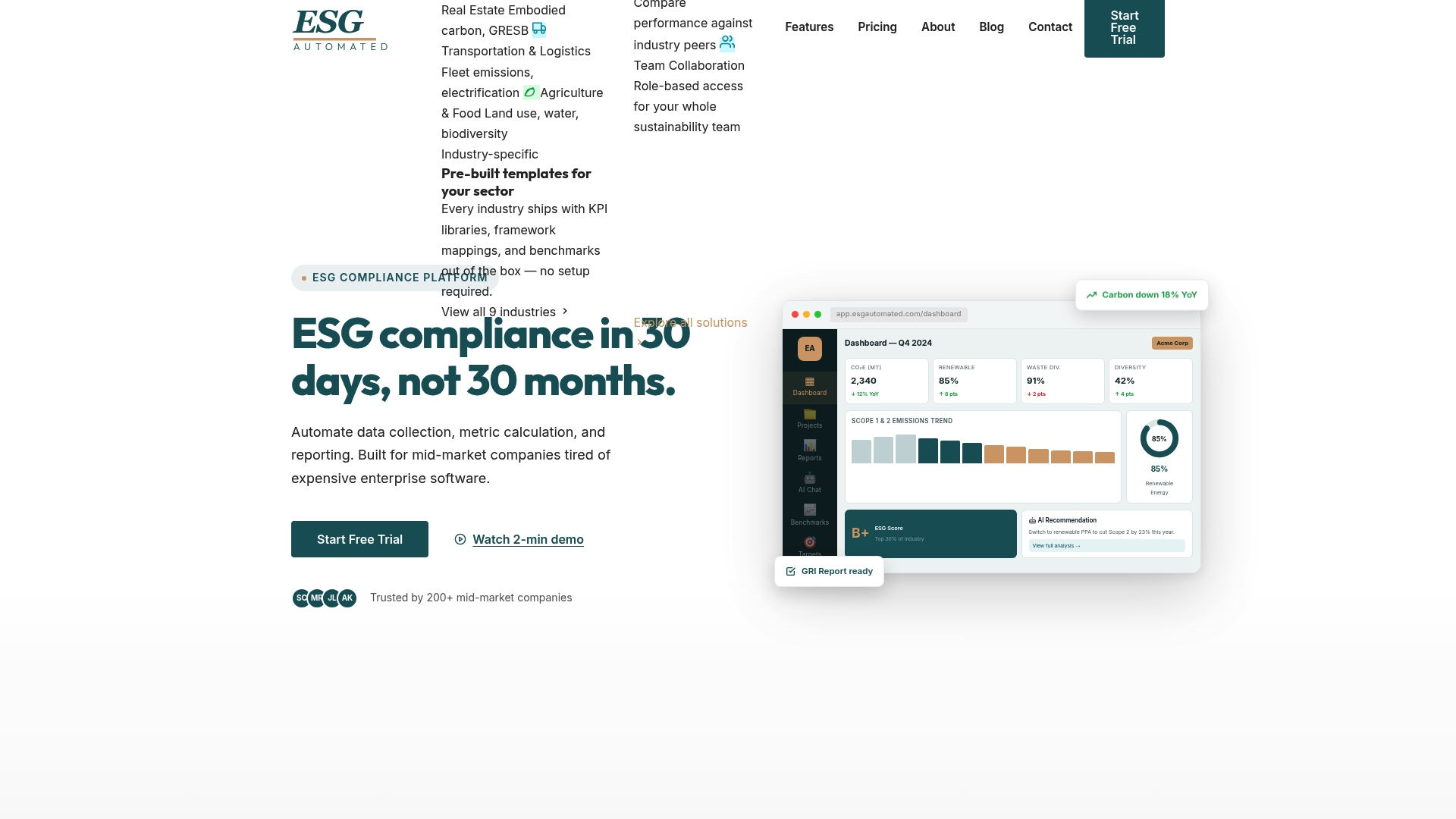
Esgautomated is built for exactly that. The platform automates ESG data collection and maps outputs to GRI, TCFD, CSRD, SASB, and CDP simultaneously. Finance teams get their first audit-ready report in 30 days. The platform features include built-in anomaly detection, audit trail generation, and real-time dashboards for board and investor reporting. For teams in financial services, the financial services solution addresses sector-specific disclosure requirements directly. Explore the full range of ESG automation solutions or visit Esgautomated to see how the platform fits your reporting cycle.
FAQ
How much time does ESG reporting automation save finance teams?
Automation reduces annual ESG reporting labor from 800–2,000 hours to approximately 300 hours and cuts the reporting cycle from 28 days to 9 days.
What frameworks does ESG reporting automation support?
Most enterprise-grade platforms support GRI, TCFD, CSRD, SASB, and CDP simultaneously, mapping a single data input to multiple framework outputs automatically.
Can ESG reporting be fully automated?
Full automation is not realistic. Quantitative data collection and calculation automate well, but narrative disclosures and qualitative assessments still require human review and synthesis.
What is the ROI of ESG reporting automation for mid-market companies?
Companies that implement ESG automation correctly can achieve 45% ROI in the first year, with additional savings from reduced audit fees and lower financing costs tied to improved ESG ratings.
How do finance teams start implementing ESG reporting automation?
Start with a data audit to map all ESG data sources, assign ownership, and select the reporting frameworks that apply to your business before deploying any automation technology.