
ESG compliance cost drivers are the specific operational and regulatory factors that determine how much a mid-market company spends to meet its sustainability reporting obligations. ESG compliance costs for mid-sized B2B firms average 1.2% of annual revenue, and that figure rises sharply when data systems are immature. First-year costs can jump 40–60% for companies still relying on spreadsheets. Internal labor, third-party assurance fees, regulatory penalties, and fragmented reporting standards each add a distinct layer of expense. Understanding which factors drive your budget is the first step toward controlling them.
1. Internal labor: the largest ESG compliance cost driver
Internal labor is the single biggest cost in ESG compliance, and most finance teams never see it on a budget line. First-year CSRD implementation requires roughly 8,500 person-hours for a mid-sized firm. At fully loaded rates of $100–$175 per hour, that translates to $850,000–$1.5 million in internal labor alone.

The problem is structural. Existing staff absorb ESG tasks on top of their regular roles. No new headcount appears in the budget, so the cost stays invisible. Finance directors see consultant invoices but miss the 40 hours a week their sustainability manager and data analyst are spending on manual data pulls.
The opportunity cost compounds the problem. When your CFO’s direct reports spend months on ESG data collection, they are not working on capital allocation, risk modeling, or growth planning. That diversion has a real dollar value that rarely appears in compliance cost estimates.
- ESG data collection and validation consume the largest share of internal hours
- Cross-functional coordination (finance, operations, legal, HR) multiplies person-hours fast
- Reporting and review cycles add a second wave of internal effort after data collection ends
- Audit preparation pulls senior staff away from core responsibilities at the worst possible time
Pro Tip: Build a dedicated ESG function, even if it is just one full-time role. Companies with a named ESG owner cut internal hour estimates by 30% or more because accountability replaces ad hoc coordination.
2. Data integration and system maturity
Data system maturity is the most controllable variable in your ESG compliance budget. Companies with digitized, connected data environments spend 40–60% less on first-year implementation than those working from spreadsheets and disconnected databases. That gap is not a rounding error. It is the difference between a manageable project and a budget crisis.
Manual data extraction and cleaning represent 35–45% of typical consulting project budgets. This is the work of pulling energy bills, water usage records, and supplier data from dozens of sources and reformatting them for disclosure. It is time-consuming, error-prone, and expensive when billed at consulting rates.
The structural fix is unbundling. Data integration work is routinely bundled with consulting methodology fees in large project quotes. Separating the two and using a purpose-built automated platform for integration can reduce total project costs by 50% or more. That is not a marginal saving. It is a fundamental repricing of the project.
| Approach | Data integration cost | Typical outcome |
|---|---|---|
| Spreadsheet-based tracking | High (manual labor intensive) | Frequent errors, slow reporting cycles |
| Bundled consulting engagement | High (methodology + integration combined) | Limited transparency on cost breakdown |
| Automated platform with API connections | Low (system handles extraction) | Faster delivery, audit-ready outputs |
Pro Tip: Before signing a consulting contract, ask for a line-by-line breakdown. If data integration and methodology fees are bundled, negotiate to separate them. Then price the integration work against purpose-built platforms.
3. Third-party assurance fees
Third-party assurance is the fastest-growing line item in ESG compliance budgets. Assurance fees are increasing 25–35% annually due to a supply-demand imbalance. Qualified ESG assurance providers are scarce, and regulatory demand is rising. That combination pushes prices up every year.
The choice between limited assurance and reasonable assurance has a dramatic effect on cost. Limited assurance fees run roughly 30–50% of financial audit fees. Reasonable assurance, which regulators like CSRD increasingly require for larger disclosures, can reach 60–100% of financial audit fees. Choosing the wrong assurance level, or being pushed into reasonable assurance before your data systems are ready, can more than double your annual assurance spend.
For mid-sized firms, assurance costs can reach hundreds of thousands of dollars annually. That figure grows as reporting scope expands to cover Scope 3 emissions, supply chain data, and social metrics.
- Start with limited assurance while your data infrastructure matures
- Invest in audit-ready data documentation before engaging an assurance provider
- Get competitive quotes from multiple accredited providers, not just your financial auditor
- Use automated platforms to generate the evidence trails assurance providers need, cutting their billable hours
4. Regulatory penalties and financial risks from non-compliance
Non-compliance is not a deferred cost. It is an accelerating one. Under CSRD, fines can reach 5% of global turnover, a figure that dwarfs the cost of building a compliant reporting program. For a mid-market firm with $200 million in revenue, that is a $10 million exposure.
The financial risks extend well beyond regulatory fines. Companies that fail ESG due diligence checks face exclusion from supply chains and capital markets. A single lost contract with a large enterprise buyer can eliminate multi-million-dollar revenue streams. Procurement teams at major corporations now run ESG scorecards as standard practice, and failing those checks disqualifies suppliers regardless of price or quality.
“Companies ignoring ESG risks now face higher borrowing costs, lost contracts, and reduced valuations as ESG compliance becomes a financial prerequisite.” — ESG Business Strategy in 2026
Credit markets are applying the same logic. Lenders and bond investors increasingly price ESG risk into borrowing costs. Mid-market firms without credible ESG disclosures pay more for capital, face tighter covenant terms, and find fewer institutional investors willing to participate in their financing rounds.
- CSRD penalties: up to 5% of global annual turnover
- Supply chain exclusion: loss of enterprise contracts worth millions
- Capital market access: higher borrowing costs and reduced investor appetite
- Reputational damage: compounding effect on customer and partner relationships
5. Evolving reporting frameworks and their cost impact
Fragmented global reporting standards are a direct driver of ESG regulatory compliance expenses. GRI, TCFD, CSRD, SASB, and CDP each use different metrics, definitions, and disclosure formats. A mid-market company operating across multiple jurisdictions must map its data to several frameworks simultaneously. That mapping work consumes 15–25% of total disclosure budgets.
The complexity does not stay static. Frameworks update regularly, and regulatory bodies add new requirements each year. Every update triggers a review of existing disclosures, a gap analysis, and often a round of additional data collection. Companies that treat ESG reporting as a one-time project rebuild from scratch with each regulatory cycle, paying full project costs repeatedly.
Data validation and auditing grow more resource-intensive as framework requirements multiply. A single metric like Scope 2 emissions may need to be calculated differently under GRI than under CSRD, requiring separate calculation methodologies and separate evidence trails. That duplication multiplies both internal hours and external consulting fees.
Automating framework alignment is the most direct way to control this cost. Platforms that maintain pre-built mappings across GRI, TCFD, CSRD, SASB, and CDP eliminate the manual reconciliation work that drives up consulting budgets. You can review regulatory ESG requirements for 2026 to understand which frameworks apply to your reporting obligations before scoping your compliance project.
- GRI: broad sustainability disclosure, widely used globally
- CSRD: mandatory for EU-scope companies, includes double materiality assessment
- TCFD: climate-specific, increasingly embedded in national regulations
- SASB: industry-specific metrics, commonly required by institutional investors
- CDP: voluntary but de facto mandatory for supply chain participation
Key takeaways
ESG compliance costs are predictable and controllable once you identify which cost drivers apply to your firm’s data maturity, regulatory scope, and assurance requirements.
| Point | Details |
|---|---|
| Internal labor dominates budgets | First-year CSRD implementation averages 8,500 person-hours, costing up to $1.5M in hidden labor. |
| Data maturity cuts costs by half | Digitized data systems reduce first-year compliance costs by 40–60% compared to spreadsheet-based tracking. |
| Assurance fees grow 25–35% annually | Choosing limited over reasonable assurance controls costs while data infrastructure matures. |
| Non-compliance penalties reach 5% of turnover | CSRD fines plus supply chain exclusion create financial risks that far exceed compliance investment. |
| Framework mapping consumes 15–25% of budgets | Automated multi-framework platforms eliminate manual reconciliation and reduce this cost category significantly. |
The hidden cost most finance leaders miss
The most persistent mistake I see in ESG compliance budgeting is treating internal labor as free. Finance leaders approve consultant invoices without question, then wonder why the project still feels expensive. The consultants are visible. The 8,500 hours your own team is spending are not.
The second mistake is buying a compliance project instead of building a compliance capability. A one-time consulting engagement solves this year’s disclosure. It does nothing for next year’s expanded scope, new framework requirements, or the assurance upgrade your auditors will eventually require. Every year you restart from scratch, you pay full project costs again.
The companies that control ESG compliance costs over time share one characteristic. They treat ESG as an operational function, not a reporting event. They invest in data infrastructure, assign clear ownership, and use automation to handle the work that scales poorly with headcount. That approach converts a variable, unpredictable cost into a manageable operating expense.
The uncomfortable truth is that the cheapest ESG program in year one is often the most expensive program over a five-year horizon. Spreadsheets and ad hoc consulting feel affordable until assurance requirements tighten, regulatory scope expands, and your data quality fails an audit. Building the right foundation costs more upfront and saves significantly more over time.
— ESG Team
How Esgautomated reduces your ESG compliance expenses
Mid-market companies that replace manual spreadsheets and fragmented consulting with a purpose-built platform see the biggest cost reductions in data integration and internal labor.
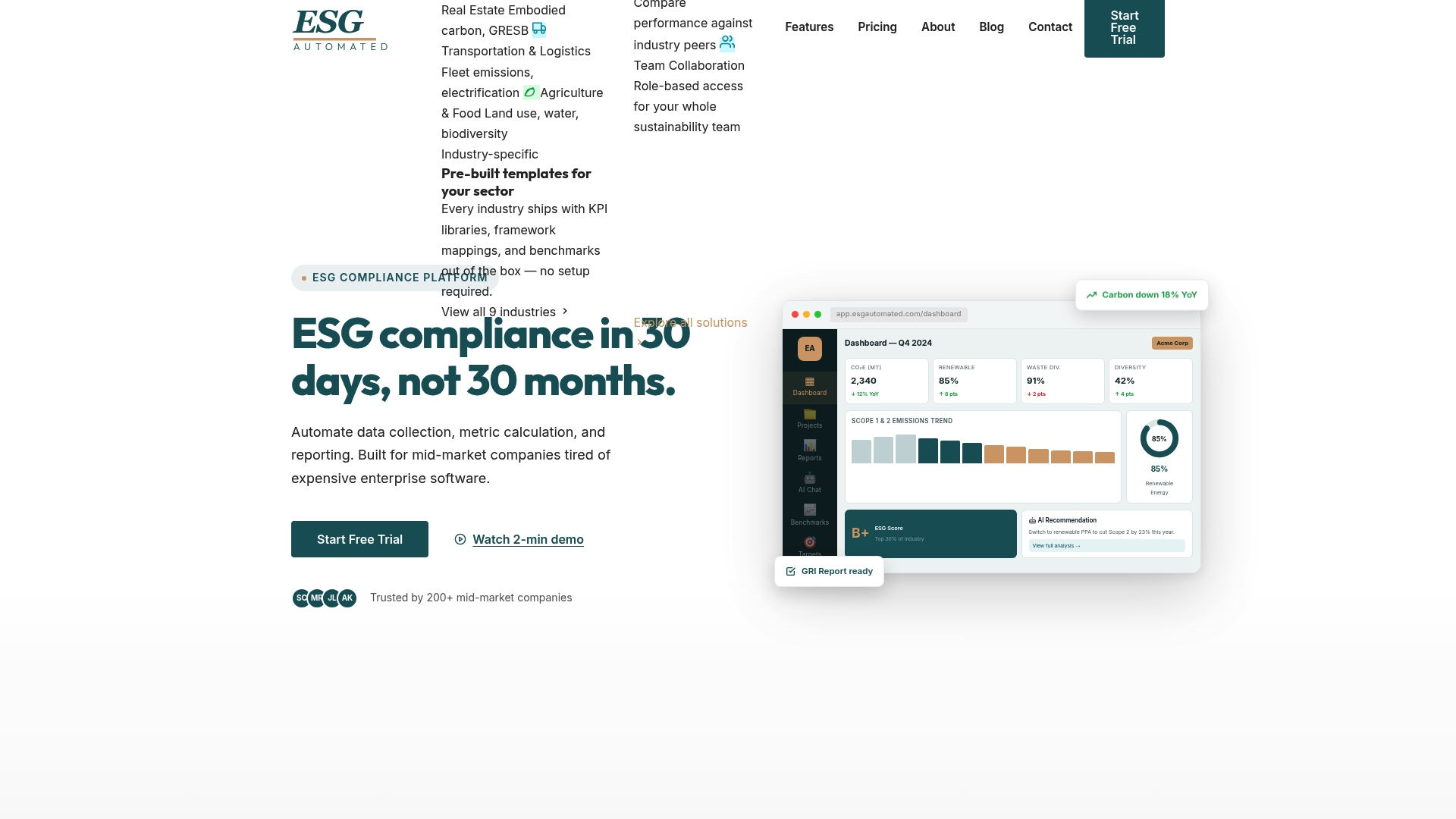
Esgautomated automates data collection, metric calculation, and sustainability reporting across GRI, TCFD, CSRD, SASB, and CDP from a single platform. Pre-built framework mappings eliminate the manual reconciliation work that consumes 15–25% of disclosure budgets. Automated evidence trails reduce assurance provider billable hours. Companies in financial services and technology use Esgautomated to deliver audit-ready reports in 30 days. Explore Esgautomated’s full platform to see how it applies to your compliance scope and reporting obligations.
FAQ
What is the average ESG compliance cost for mid-market companies?
ESG compliance costs for mid-sized B2B firms average 1.2% of annual revenue. Companies with immature data systems pay 40–60% more in their first year.
Why is internal labor the biggest ESG compliance cost driver?
First-year CSRD implementation requires roughly 8,500 person-hours, which existing staff absorb without a dedicated budget line. That hidden labor can cost $850,000–$1.5 million at fully loaded rates.
How fast are third-party assurance fees increasing?
Third-party assurance fees are rising 25–35% annually due to a shortage of qualified providers and growing regulatory demand. Choosing limited assurance over reasonable assurance can cut these fees by more than half.
What are the financial penalties for ESG non-compliance?
Under CSRD, fines can reach 5% of global annual turnover. Non-compliance also risks supply chain exclusion, higher borrowing costs, and loss of investor confidence.
How does automating ESG reporting reduce compliance costs?
Automated platforms handle data integration and framework mapping, which together represent the largest share of consulting and internal labor budgets. Separating integration from consulting methodology work and using a purpose-built platform can reduce total project costs by 50% or more.