
ESG reporting is defined as the structured disclosure of a company’s environmental, social, and governance performance, designed to inform investor and stakeholder decisions about long-term value creation. Sustainability managers and finance leaders now treat this disclosure as a core governance function, not a communications exercise. Frameworks like GRI, ISSB, CSRD, and SASB have formalized what companies must measure, verify, and publish. The shift from voluntary narrative to audit-ready disclosure reflects a fundamental change in how capital markets assess corporate risk.
How does ESG reporting differ from financial reporting?
ESG reporting and financial reporting share one goal: giving decision-makers accurate information. The similarities end there.
Financial reporting is backward-looking. It captures what happened to a legal entity over a defined period, measured in currency, governed by GAAP or IFRS. ESG reporting is forward-looking by design, addressing potential risks and opportunities across multiple time horizons. A carbon liability that will not materialize for a decade still belongs in an ESG disclosure today.

The scope difference is equally significant. Financial reporting stays within the legal entity. ESG frameworks require companies to look outward across the entire value chain, including Scope 3 emissions from suppliers and customers. That boundary expansion creates data collection challenges that financial controllers have never faced.
Materiality is where the two systems diverge most sharply. Financial reporting applies a narrow materiality test: does this information affect an investor’s economic decision? ESG frameworks apply double materiality, asking two questions simultaneously. First, how does a sustainability issue affect the company’s finances? Second, how does the company’s activity affect the environment and society? Both directions matter, and both require evidence.
ESG reporting lacks a universally accepted unit of measurement. It combines qualitative narratives and quantitative data, creating standardization challenges that financial accounting resolved decades ago.
The verifiability gap is real. Financial auditors work with established sampling methods and materiality thresholds. ESG auditors often encounter inconsistent data definitions, decentralized collection processes, and metrics that have no agreed calculation methodology. That gap is closing, but it has not closed yet.
Key structural differences at a glance:
- Time horizon: Financial reporting covers the past fiscal year. ESG reporting addresses current and future risk across 5, 10, and 30-year horizons.
- Boundary: Financial reporting covers the legal entity. ESG reporting covers the full value chain.
- Materiality: Financial reporting uses single materiality. ESG frameworks like CSRD require double materiality.
- Data types: Financial reporting uses monetary units. ESG reporting combines carbon metrics, workforce data, governance scores, and qualitative narratives.
- Verification: Financial audits follow established standards. ESG assurance is still maturing.
What are the key ESG reporting frameworks in 2026?
The regulatory environment has consolidated significantly. Four frameworks dominate corporate ESG disclosure in 2026.
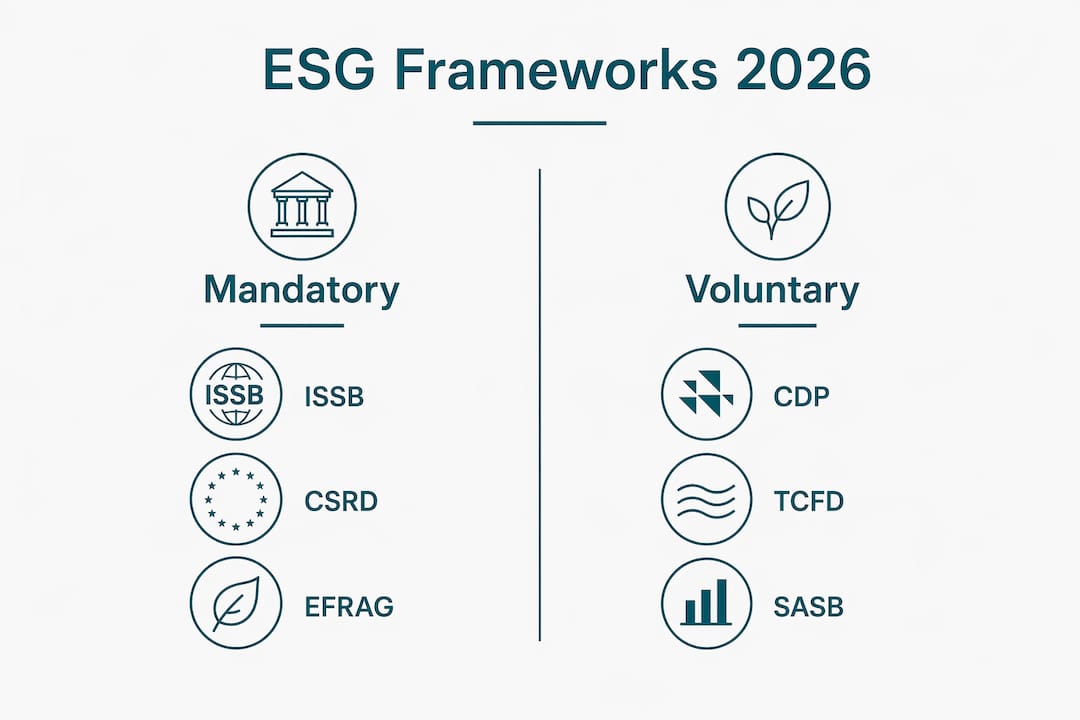
| Framework | Scope | Mandatory or voluntary | Key focus |
|---|---|---|---|
| ISSB (IFRS S1/S2) | Global | Mandatory in adopting jurisdictions | Climate and sustainability-related financial risks |
| CSRD | EU companies and EU-listed firms | Mandatory | Double materiality, value chain, assurance |
| GRI | Global | Voluntary (referenced in many mandates) | Impact on economy, environment, and people |
| SASB | Industry-specific | Voluntary (embedded in ISSB) | Financially material sustainability topics by sector |
The ISSB and CSRD frameworks are the most consequential for finance leaders right now. The ISSB and CSRD mandates close the data connectivity gap between sustainability and financial reporting by requiring detailed disclosures on climate-related risks and their financial impacts. That specificity forces companies to build real data infrastructure, not just publish narrative reports.
CSRD extends beyond EU-headquartered companies. Non-EU companies with significant EU revenue face disclosure obligations too. Finance leaders at US-based multinationals should treat CSRD as a near-term compliance requirement, not a European issue.
Many companies confuse voluntary ESG disclosure with mandatory compliance. The result is audit-readiness failures when regulators or investors request evidence-based data rather than polished sustainability narratives. The distinction matters: a GRI-aligned report is a good start, but a CSRD-compliant report requires third-party assurance.
Pro Tip: Map your current disclosures against ISSB S1 and S2 requirements before your next reporting cycle. The gap analysis will reveal exactly which data collection processes need to be built or upgraded.
CDP remains relevant for companies with significant investor or customer pressure on climate disclosure. TCFD, while not a standalone framework, is embedded in both ISSB S2 and CSRD climate requirements.
What are best practices for preparing and managing ESG reports?
Effective ESG reporting requires cross-departmental coordination that most organizations have not built yet. Finance, operations, HR, legal, and procurement all own pieces of the data. Without a defined governance structure, ESG data collection stays decentralized and inconsistent, which creates material errors in the final report.
-
Conduct a materiality assessment first. Identify which ESG topics are material to your business model and stakeholders before collecting any data. Double materiality requires input from both internal leadership and external stakeholders. Without this step, you collect everything and prove nothing.
-
Assign data ownership by department. Each metric needs a named owner who understands the underlying process. Energy consumption data belongs with facilities. Workforce turnover data belongs with HR. Supplier audit data belongs with procurement. Ownership without accountability produces unreliable numbers.
-
Establish board-level oversight. The quality of ESG data now receives scrutiny comparable to financial data, requiring board-level oversight and strong internal controls. Boards that treat ESG as a communications function will face regulatory and investor pressure as assurance requirements tighten. Review the ESG board reporting process to understand what governance structures auditors now expect.
-
Build an audit trail from day one. Every data point needs a source, a calculation method, and a version history. Auditors ask for evidence, not summaries. Companies that build audit trails during data collection spend far less time preparing for assurance reviews.
-
Align ESG reporting cycles with financial reporting timelines. ESG data collection is often decentralized and runs on different timelines than financial close. Synchronizing these cycles reduces the risk of mismatched data and simplifies integrated reporting.
Pro Tip: Run a parallel dry-run of your ESG report against your target framework before the official reporting period. Gaps discovered in a dry run cost far less to fix than gaps discovered during an assurance review.
A common pitfall is treating the first ESG report as a one-time project. Effective disclosure is a repeating process. Each cycle should improve data quality, expand boundary coverage, and tighten internal controls.
How can technology help with ESG data collection and reporting?
The ESG software market spans a wide range of tools, from specialized carbon accounting platforms to full enterprise suites. Choosing the wrong category creates either cost overruns or capability gaps.
Enterprise platforms cover the full ESG data lifecycle: collection, calculation, framework mapping, and disclosure. They support multiple frameworks simultaneously, including GRI, CSRD, SASB, and TCFD. The tradeoff is cost and implementation time. High-end enterprise suites can cost around $60,000 per year, with implementation timelines that stretch months before a single report is produced.
SME-focused and mid-market tools offer framework coverage at a fraction of that cost. Entry-level platforms start at around $3,800 per year. That price difference reflects a real capability gap in some cases, but not always. Mid-market companies often need GRI and CSRD compliance without the complexity of a global enterprise deployment.
The critical features to evaluate when selecting any ESG platform:
- Framework coverage: Does the platform support the specific frameworks your regulators and investors require?
- Audit trail functionality: Does it log data sources, calculation methods, and version history automatically?
- Data integration: Can it pull data from existing ERP, HR, and energy management systems without manual re-entry?
- Assurance support: Does it generate the documentation format that third-party auditors expect?
Spreadsheets remain the default tool for many mid-market companies. They fail at scale because they have no audit trail, no version control, and no framework-specific calculation logic. A single formula error in a spreadsheet can misstate a material metric across an entire report. Purpose-built ESG data management platforms eliminate that class of error by design.
Esgautomated automates data collection, metric calculation, and framework mapping across GRI, TCFD, CSRD, SASB, and CDP. Mid-market companies using Esgautomated produce their first audit-ready ESG report in 30 days. For technology sector companies, the ESG technology solutions page outlines how the platform handles sector-specific metrics and disclosure requirements.
Key Takeaways
ESG reporting is a structured, evidence-based disclosure process that requires board oversight, cross-departmental data governance, and framework-specific technology to meet 2026 regulatory standards.
| Point | Details |
|---|---|
| ESG differs from financial reporting | ESG uses double materiality and covers the full value chain, not just the legal entity. |
| Framework selection drives compliance | ISSB, CSRD, GRI, and SASB each have distinct scope and assurance requirements. |
| Governance is non-negotiable | Board-level oversight and internal controls are now required for audit-ready ESG data. |
| Technology replaces spreadsheets | Purpose-built platforms eliminate manual errors and generate audit-trail documentation automatically. |
| First report in 30 days is achievable | Mid-market companies with the right platform can produce a compliant ESG report without a multi-year implementation. |
ESG reporting is becoming a financial discipline, not a sustainability exercise
After working with mid-market companies on ESG disclosure, the pattern I see most often is this: finance leaders treat ESG as someone else’s problem until it lands on their desk as a regulatory requirement. By then, the data infrastructure does not exist, the board has not been briefed, and the first report is built on spreadsheets that no auditor will accept.
The companies that get this right treat ESG integration with financial reporting as a capital allocation question, not a compliance checkbox. When ESG data is linked directly to corporate strategy, it informs decisions about where to invest, which suppliers to retain, and which risks to disclose to investors. That is where ESG reporting adds real value: not in the published report, but in the decisions the data supports.
The uncomfortable truth is that most ESG reports published today would not survive a rigorous assurance review. The data is incomplete, the methodology is inconsistent, and the boundary assumptions are undocumented. That is not a criticism of sustainability teams. It reflects the fact that ESG reporting is a new discipline being held to financial-reporting standards without the decades of infrastructure that financial reporting has built.
The solution is not to wait for standards to stabilize. The solution is to build the governance, data ownership, and technology infrastructure now, while the regulatory grace periods still exist. Companies that build this infrastructure in 2026 will report with confidence in 2027. Companies that wait will scramble.
— ESG Team
Esgautomated: ESG reporting built for mid-market companies
Mid-market companies face the same regulatory requirements as large enterprises but rarely have the budget or staff for a multi-year ESG implementation.
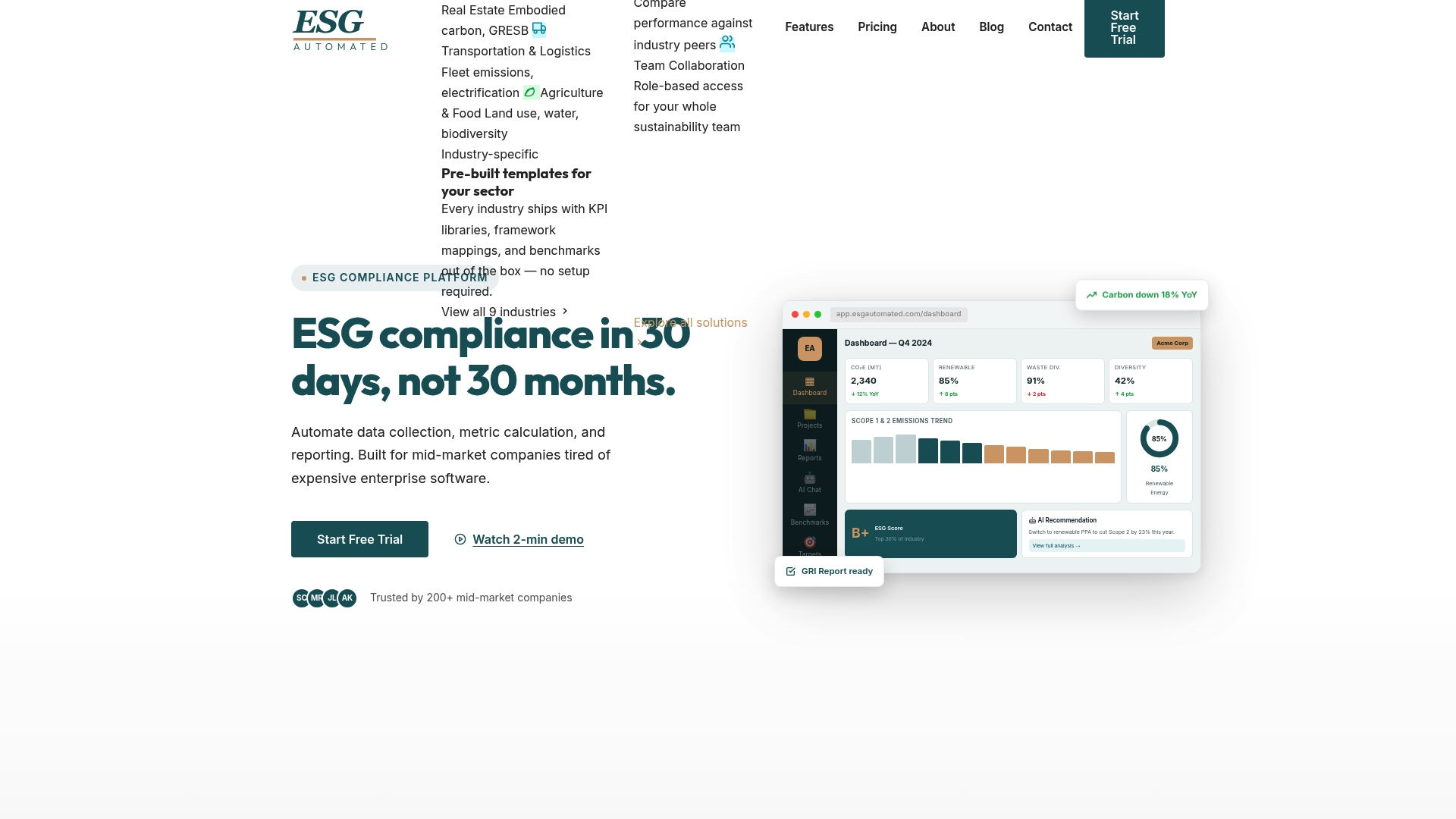
Esgautomated is an AI-powered ESG compliance platform that automates data collection, metric calculation, and disclosure across GRI, TCFD, CSRD, SASB, and CDP frameworks. Companies produce their first audit-ready ESG report in 30 days, replacing expensive consultants and error-prone spreadsheets. The platform is built specifically for mid-market scale, which means faster deployment and lower cost without sacrificing framework coverage or audit-trail quality. Financial services firms can review ESG solutions for financial services for sector-specific guidance. To see the full platform, visit Esgautomated.
FAQ
What is ESG reporting in simple terms?
ESG reporting is the structured disclosure of a company’s environmental, social, and governance performance. It gives investors and stakeholders evidence-based data about how a company manages risk and creates long-term value.
Is ESG reporting mandatory in 2026?
Mandatory requirements depend on jurisdiction and company size. CSRD makes ESG disclosure mandatory for large EU companies and many non-EU multinationals with significant EU revenue, while ISSB standards are being adopted across multiple jurisdictions globally.
How does ESG reporting differ from a sustainability report?
A sustainability report is often a voluntary, narrative-driven document. ESG reporting under frameworks like CSRD or ISSB requires quantitative data, double materiality assessments, and third-party assurance, making it far more rigorous than a traditional sustainability narrative.
How long does it take to prepare a first ESG report?
With purpose-built software, mid-market companies can produce a first audit-ready ESG report in 30 days. Without dedicated technology, the process typically takes several months due to decentralized data collection and manual consolidation.
What is double materiality in ESG reporting?
Double materiality requires companies to assess both how sustainability issues affect the company’s finances and how the company’s activities affect the environment and society. CSRD mandates this dual assessment for all in-scope companies.