
ESG metrics for investor relations are quantitative and qualitative measures that link a company’s environmental, social, and governance performance to its financial outcomes and investor appeal. Institutional investors in 2026 expect TCFD-aligned climate data, Scope 1–3 emissions disclosures, workforce diversity statistics, and governance indicators as standard inputs to capital allocation decisions. Companies with strong ESG practices outperform peers over 3–5 year horizons and carry a lower cost of capital. That financial linkage is what separates ESG investor relations from sustainability marketing. The frameworks investors rely on most include TCFD, SASB, ISSB, and GRI, and each demands a different level of data discipline.
1. What are the core ESG metrics for investor relations?
ESG metrics for investor relations are the specific data points investors use to assess non-financial risk and long-term value creation. They fall into three pillars: environmental, social, and governance. Each pillar contains metrics that carry direct financial consequences, from operating cost exposure to regulatory liability to talent retention costs. Investors prioritize metrics that statistically correlate with long-term financial performance and reduce tail risk. The goal is not to report everything. The goal is to report what is material to your business model and your investors’ thesis.

2. What environmental metrics should investors prioritize?
Environmental metrics are the most regulated and the most scrutinized by institutional capital. Scope 1 (direct emissions), Scope 2 (purchased energy), and Scope 3 (value chain emissions) form the baseline. Scope 3 now carries the most weight with sophisticated investors because it reveals supply chain exposure and product lifecycle risk.
Key environmental metrics investors assess:
- Scope 1 and 2 greenhouse gas emissions (metric tons CO2e, year-over-year reduction trajectory)
- Scope 3 emissions across upstream and downstream categories
- Energy consumption and renewable energy percentage (total MWh, renewable share)
- Water withdrawal and recycling rates (especially for manufacturing, agriculture, and mining)
- Waste generation and diversion rates (landfill avoidance, circular economy progress)
- Climate scenario analysis outputs aligned with TCFD guidance
Scope 3 and climate scenario data are key 2026 topics. IR teams that cannot speak to value chain emissions or physical climate risk scenarios lose credibility in institutional meetings. The financial stakes are real: companies with unmitigated carbon exposure face higher insurance costs, stranded asset risk, and regulatory penalties under frameworks like the SEC’s climate disclosure rules and the EU’s CSRD.
Pro Tip: Set a verified baseline year for all emissions data before publishing targets. Investors treat targets without baselines as greenwashing, not commitment.
3. Which social metrics have growing importance in investor relations?
Social metrics have moved from reputational considerations to financial risk factors. Workforce stability, pay equity, and supply chain labor practices now appear in proxy voting guidelines from major institutional investors. A company with high voluntary turnover pays a measurable recruitment and training premium. A company with supply chain forced labor exposure faces import bans and brand damage that show up in revenue.
Investors assess these social indicators most closely:
- Workforce diversity data (gender, race, and ethnicity at board, executive, and workforce levels)
- Employee retention and voluntary turnover rates
- Pay equity ratios (gender pay gap, CEO-to-median-worker pay ratio)
- Health and safety incident rates (TRIR, LTIR, fatalities)
- Supply chain labor audits and forced labor risk assessments
- Community investment and social impact spending
Transparency matters as much as the numbers. Investors who respond to ESG investor questionnaires from companies routinely flag incomplete social disclosures as a governance concern, not just a data gap. A company that discloses a 15% gender pay gap with a remediation plan earns more trust than one that reports no gap without methodology.
Pro Tip: Link social metrics to financial outcomes in your IR materials. Show how a 10-point improvement in employee retention reduced recruiting costs by a specific dollar amount. Investors respond to that translation.
4. How do governance metrics affect investor confidence and valuation?
Governance is the signal of control. Investors assess board oversight, executive pay alignment, and risk governance maturity before they evaluate any other metric. A company with weak governance structures raises the question of whether any other reported metric can be trusted.
The governance metrics that move institutional capital:
- Board composition: independence percentage, diversity (gender, race, skills), and average tenure
- ESG committee oversight: documented mandate, meeting frequency, and board-level accountability
- Executive compensation tied to ESG targets: specific, measurable, and disclosed
- Audit committee independence and financial expertise
- Regulatory compliance record: material violations, fines, and remediation actions
- Shareholder rights: voting structures, say-on-pay results, and engagement responsiveness
Governance-focused investor meetings increasingly expect Lead Independent Director participation and committee-level transparency. That expectation reflects a broader shift: investors want to see that ESG is governed, not just reported. Executive compensation tied to ESG performance is a particularly strong signal because it demonstrates that leadership has skin in the game on sustainability outcomes.
5. How should companies integrate ESG metrics into investor communications?
Integration means ESG data appears in earnings calls, annual reports, investor presentations, and capital markets days, not just in a standalone sustainability PDF. Material ESG factors vary by industry and must be linked to financial valuation factors to engage investors effectively. A mining company’s water management metrics are as material as its production costs. A software company’s data center energy intensity and AI governance practices carry equivalent weight.
The integration process follows a clear sequence:
- Conduct a materiality assessment using SASB industry standards to identify which ESG factors drive financial risk and opportunity in your sector.
- Map ESG KPIs to financial outcomes: connect emissions reduction to operating cost savings, safety improvements to insurance premiums, and diversity to talent acquisition costs.
- Establish baselines and set public targets with defined reduction trajectories and investment plans. ESG credibility requires baselines, trajectories, and progress updates. Generic slogans damage trust.
- Align disclosures across SASB, TCFD, and ISSB to avoid fragmented reporting. Fragmented or inconsistent reporting reduces investor trust and increases litigation risk.
- Reconcile ESG data with financial records to achieve audit-grade quality. Non-financial metrics must be reconciled with audit-grade financial controls to maintain credibility and reduce litigation risk.
- Integrate ESG into the existing IR cadence rather than siloing it in annual reports. Integrating ESG into the IR cadence enhances dialogue and investor trust.
Schneider Electric is a recognized example of this approach. The company links its electrification business directly to sustainability outcomes, a connection the UK Investor Relations Society has recognized as credible ESG communication that demonstrates how sustainability initiatives impact capex, margins, and competitive positioning.
Pro Tip: Avoid KPI overload. Investors reject long lists of metrics without explanation. Present five to seven metrics that are material to your margins and risks, then explain the financial connection explicitly.
6. What emerging ESG data is shaping investor relations in 2026?
The frontier of sustainable investing metrics has moved well beyond basic emissions and diversity reporting. Institutional investors now probe areas that most IR teams are not yet prepared to address. ESG IR conversations have matured. Integrating IR with sustainability, climate risk, and governance creates structured transparency that increases investor confidence.
Emerging metrics gaining traction in 2026:
- Scope 3 category-level detail: investors want upstream and downstream breakdowns, not aggregate totals
- Climate scenario analysis: physical and transition risk under 1.5°C and 2°C pathways
- Workforce investment metrics: training spend per employee, internal mobility rates, and reskilling program outcomes
- Supply chain forced labor risk: third-party audit coverage, remediation rates, and supplier code compliance
- Cybersecurity governance: board-level oversight, incident response protocols, and disclosure practices
- Political activity and lobbying transparency: alignment between public ESG commitments and political spending
These metrics reflect a deeper shift in how investors think about impact investment indicators. The question is no longer “Do you have an ESG program?” The question is “How does your ESG program affect your cost structure, your risk profile, and your competitive position over the next decade?”
Key Takeaways
The most effective ESG metrics for investor relations are those tied directly to financial materiality, disclosed consistently across TCFD, SASB, and ISSB frameworks, and supported by audit-grade data controls.
| Point | Details |
|---|---|
| Financial materiality drives selection | Choose ESG metrics that connect to operating costs, regulatory risk, or capital allocation decisions. |
| Scope 3 is now non-negotiable | Institutional investors expect value chain emissions data and climate scenario analysis, not just Scope 1 and 2. |
| Governance signals control | Board ESG oversight, executive pay tied to ESG targets, and audit independence determine investor confidence. |
| Consistency across frameworks | Align disclosures across SASB, TCFD, and ISSB to avoid fragmented reporting that raises litigation risk. |
| Integration beats isolation | ESG metrics embedded in earnings calls and investor presentations outperform standalone sustainability reports. |
The real gap in ESG investor relations is not data. It’s translation.
Most IR teams I work with have more ESG data than they know what to do with. The problem is not collection. The problem is that they cannot explain why any of it matters to a portfolio manager running a discounted cash flow model.
The companies that win institutional investor confidence do one thing differently: they translate ESG performance into financial language before the investor has to ask. They say “our 18% reduction in Scope 1 emissions cut energy costs by $4.2 million last year and reduces our exposure to carbon pricing by an estimated $12 million under a $50-per-ton scenario.” That is an investment thesis, not a sustainability report.
The other mistake I see constantly is treating ESG investor relations as a disclosure exercise rather than a capital markets conversation. Investor alignment requires structural synchronization, integrating metrics with governance, capital allocation, and risk management. That means sustainability data needs to appear in investment committee materials and capex documents, not just in the annual ESG report that gets published in april and forgotten by june.
The companies that get this right are not necessarily the ones with the best ESG scores. They are the ones whose CFO and Chief Sustainability Officer are aligned on what to say, why it matters, and how it connects to the equity story. That alignment is structural, and it cannot be faked in a one-page ESG summary.
— ESG Team
How Esgautomated helps IR teams build credible ESG disclosures
IR teams that want to move from fragmented ESG data to audit-ready investor disclosures need a platform that handles data collection, metric calculation, and framework alignment in one place.
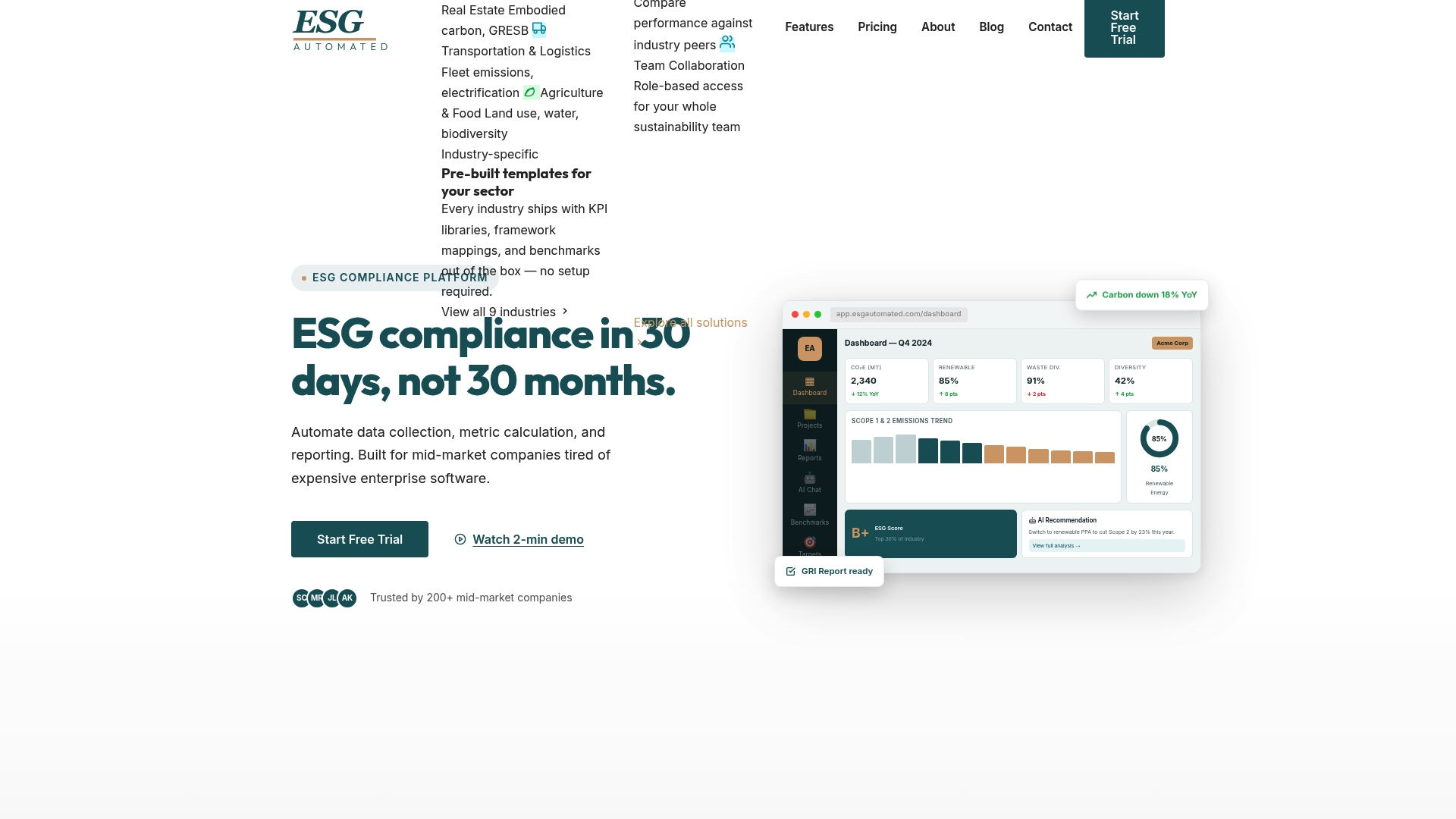
Esgautomated automates ESG data collection and reporting across GRI, TCFD, CSRD, SASB, and CDP frameworks. Mid-market companies get their first audit-ready ESG report in 30 days, with metrics reconciled to financial records and aligned to the frameworks institutional investors expect. The platform replaces manual spreadsheets and expensive consultants with a process that produces consistent, investor-grade disclosures at a fraction of enterprise software costs. For IR teams managing ESG integration in financial reporting, Esgautomated provides the data discipline and framework alignment that investors require.
FAQ
What are the most important ESG metrics for investor relations?
The most important metrics are those material to your industry’s financial risk profile, including Scope 1–3 emissions, board diversity, executive pay tied to ESG targets, and workforce retention rates. Investors prioritize metrics that connect directly to operating costs, regulatory exposure, and long-term competitive position.
How do investors use ESG data in capital allocation decisions?
Investors use ESG data to assess tail risk, cost of capital, and long-term financial performance. Companies with credible ESG disclosures aligned to TCFD and SASB frameworks demonstrate management control, which supports more favorable capital terms.
What frameworks should companies use for ESG disclosures to investors?
TCFD, SASB, and ISSB are the frameworks most demanded by institutional investors in 2026. Aligning disclosures across all three and reconciling ESG data with financial records reduces litigation risk and increases investor trust.
How do you respond to ESG investor questionnaires effectively?
Respond with specific, quantified data tied to baselines and reduction targets. Avoid generic statements. Investors treat incomplete or vague questionnaire responses as a governance concern, not just a data gap.
What is the difference between ESG reporting and ESG investor relations?
ESG reporting is the disclosure of non-financial data. ESG investor relations is the active communication of how that data affects financial performance, risk, and capital allocation. The distinction matters because investors make decisions based on financial translation, not raw sustainability metrics.