
An ESG performance investor reporting workflow is a structured sequence of stages that ensures accurate, timely, and transparent disclosure of corporate ESG metrics to investors and stakeholders. Investment professionals and ESG analysts increasingly treat this workflow, formally called the ESG reporting cycle, as a discipline equal in rigor to financial reporting. Frameworks like CSRD, ISSB, and GRI now require audit-ready ESG disclosures aligned with financial reporting schedules. Getting the workflow right from the start determines whether your data holds up under assurance, satisfies investor due diligence, and meets regulatory deadlines without costly rework.
What core stages comprise an ESG performance investor reporting workflow?
A mature ESG reporting cycle follows eight structured stages aligned with financial reporting schedules to meet rigorous standards of accuracy, traceability, and timeliness. Each stage builds on the previous one. Skipping or compressing any stage creates compounding errors that surface during assurance or investor review.
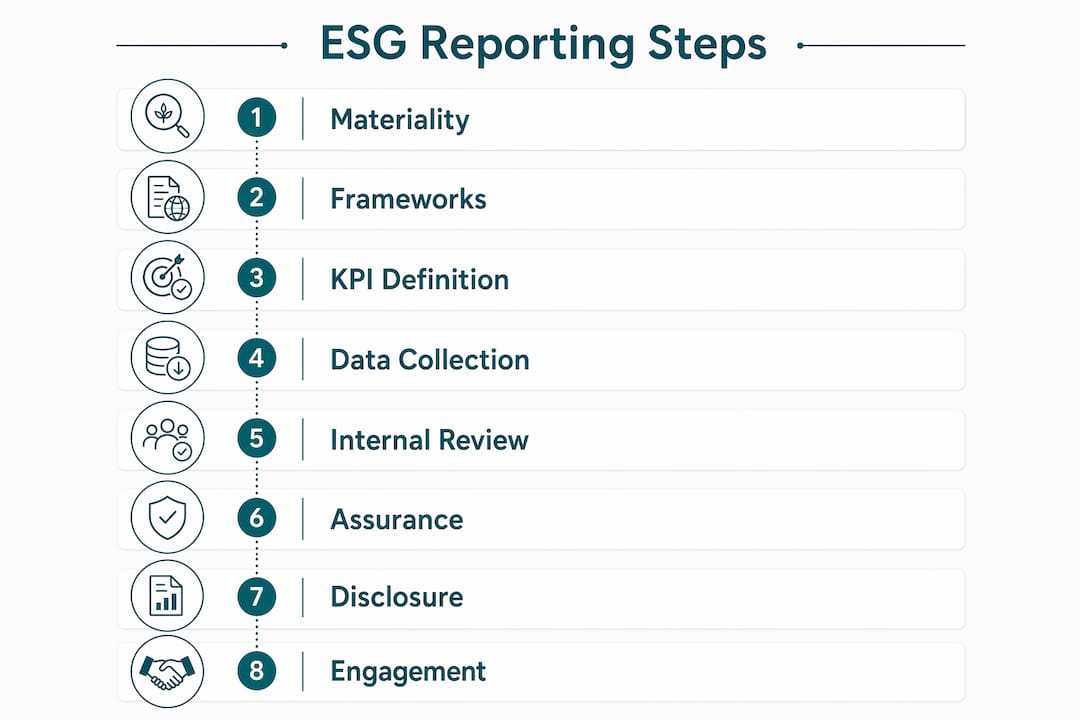
The eight stages are:
- Materiality assessment. Identify which ESG topics are financially and strategically significant to your investors and business. Conduct structured interviews with institutional investors and use double materiality analysis where CSRD applies.
- Framework selection. Choose the reporting standards that match your regulatory obligations and investor expectations. EU companies report under ESRS; firms in ISSB-adopting regions use IFRS S1 and S2; most large firms satisfy multiple frameworks from a single underlying data system.
- KPI definition. Map each material topic to specific, measurable investor ESG metrics. Define the calculation methodology, data source, and responsible owner for every KPI before data collection begins.
- Data collection and validation. Gather activity data from operational systems, suppliers, and finance platforms. Run automated variance checks and flag anomalies before they enter the reporting pipeline.
- Internal review. Finance, legal, and sustainability teams verify data against source documents. This stage requires clear audit trails and documented controls.
- Third-party assurance. An independent auditor reviews data and methodology. Limited assurance is the current standard; reasonable assurance is the direction CSRD is moving.
- Publication. Produce investor-grade disclosures in the required formats, including iXBRL tagging where mandated.
- Stakeholder engagement. Collect feedback from investors, analysts, and regulators. Use that input to refine the next cycle’s materiality assessment.
| Stage | Primary output | Key risk if skipped |
|---|---|---|
| Materiality assessment | Confirmed topic list | Reporting on irrelevant metrics |
| KPI definition | Metric register with owners | Inconsistent calculations across periods |
| Data validation | Verified data set | Assurance failures and restatements |
| Third-party assurance | Assurance statement | Investor credibility loss |
| Stakeholder engagement | Feedback log | Misaligned disclosures in next cycle |
Pro Tip: Align your ESG reporting calendar with your financial close schedule. ESG data collection that runs parallel to the financial close reduces the lag between operational data and published disclosures.
What tools and frameworks support efficient ESG reporting workflows?
The right infrastructure separates teams that produce audit-ready reports from those stuck in spreadsheet revision cycles. Three elements define that infrastructure: framework alignment, centralized ESG data management, and AI-driven automation.
Framework alignment is the starting point. CSRD requires reporting under ESRS, which covers environmental, social, and governance topics with mandatory data points. GRI remains the most widely used voluntary standard globally. SASB aligns disclosures to industry-specific investor ESG metrics. Most investment-grade reports satisfy two or more frameworks simultaneously, which is only practical with a centralized data platform that maps a single data point to multiple framework requirements.
Centralized ESG data management eliminates the version-control failures that plague spreadsheet-based workflows. Structured ESG data platforms integrate plant-level activity data, carbon accounting, supplier inputs, dashboards, and audit-ready reporting. Manual reporting risks include formula errors, evidence gaps, unclear ownership, and delayed cycles. A centralized system removes all four risks by design.
AI-driven automation is now the standard for high-volume ESG data management. Automated ESG workflows reduce manual reporting time by integrating AI systems that automate variance analysis, structured data ingestion including iXBRL, and audit-ready evidence management. That reduction in manual effort directly cuts revision cycles. Embedding ESG metrics into existing control systems with AI also enables continuous validation and early detection of inconsistencies, replacing retrospective checks.
Governance foundations complete the infrastructure picture. A data dictionary that defines every metric, its calculation methodology, its data source, and its owner is not optional. Without it, teams cannot reproduce results across reporting periods or defend methodology to auditors.
Pro Tip: Build your data dictionary before you collect a single data point. Define the metric name, unit, calculation formula, data source, and responsible owner in one document. Every team member and every system references the same definitions.
- Assign a named data owner for every KPI, not just a team or department.
- Set update frequency rules: monthly for operational data, quarterly for supplier data.
- Document methodology changes with effective dates so year-over-year comparisons remain valid.
- Require finance sign-off on any metric that feeds into investor communications.
Finance leadership in ESG data infrastructure is the factor most often missing in mid-market reporting programs. Treating sustainability data with the same rigor as financial data creates a reliable single source of truth.
How to execute each stage of the ESG reporting workflow for investor transparency
Execution quality determines whether your disclosures build investor confidence or invite scrutiny. Each stage has specific practices that separate adequate from audit-ready.
Materiality assessment execution. Invite institutional investors into the process directly. Survey your top 10 investors on which ESG topics they weight most heavily in their analysis. Cross-reference those responses with regulatory requirements and sector-specific risk factors. The output is a ranked topic list with documented investor input, which strengthens the credibility of your disclosure scope.
Framework and KPI alignment. Once you select your frameworks, map every material topic to a specific KPI with a named calculation methodology. For climate metrics, align with TCFD recommendations and IFRS S2 requirements simultaneously. For social metrics, use GRI 400 series disclosures as the baseline. The goal is one KPI register that satisfies multiple frameworks without duplicating data collection.
Automated data collection and validation. Manual data entry is the single largest source of ESG reporting errors. Connect operational systems, energy management platforms, HR systems, and supplier portals directly to your ESG data management platform. Set automated variance rules: flag any data point that deviates more than a defined threshold from the prior period. Resolve flags before data moves to the internal review stage.

Internal review with traceability. Every data point in the investor report must trace back to a source document. Finance teams should apply the same control standards they use for financial statements. Document who reviewed each metric, when, and what evidence they examined. This audit trail is what assurance providers rely on.
Third-party assurance coordination. Engage your assurance provider early, ideally at the KPI definition stage. Share your data dictionary and methodology documentation before fieldwork begins. Early engagement reduces the number of queries during assurance and prevents last-minute data corrections that delay publication.
Investor-grade disclosure drafting. Write disclosures that pair quantitative data with concise narrative context. Effective ESG reporting integrates the analytical foundation of frameworks, data, and assurance with narrative and visual communication to build stakeholder confidence. Premature narrative focus before data is finalized leads to costly rework. Finalize numbers first, then write the narrative.
Continuous stakeholder engagement. Do not treat stakeholder engagement as a post-publication checkbox. Advanced ESG portfolio management reads every investee document as soon as it arrives, scoring ESG risk quarterly for immediate detection of emerging issues. Apply the same principle internally: monitor investor feedback channels continuously, not just during annual reporting cycles.
What are common pitfalls in ESG investor reporting workflows?
Most ESG reporting failures trace back to governance gaps, not data gaps. Governance deficits are the root cause of workflow breakdowns, with teams spending 60–70% of reporting cycles on manual reconciliation and error correction when a data dictionary is absent. That is time that should go toward analysis and investor communication.
The most common pitfalls are:
- No data dictionary. Teams use different calculation methods for the same metric across business units. Assurance providers flag inconsistencies. Restatements follow.
- Unclear data ownership. When no named individual owns a KPI, data arrives late, incomplete, or in the wrong format. Workflow stages stall.
- Quarterly upload traps. Collecting ESG data only at quarter-end means emerging risks go undetected for weeks. Continuous data ingestion is the standard for investment-grade programs.
- Narrative before data. Writing the sustainability story before the underlying data is validated locks teams into defending inaccurate numbers. Always validate data first.
- Siloed finance and ESG teams. ESG data that does not go through financial controls lacks the credibility investors expect. Finance must be a co-owner of the ESG reporting process, not a reviewer at the end.
“The data dictionary is the governance document that makes everything else possible. Without it, every reporting cycle starts from scratch.”
Pro Tip: Run a mock assurance review six weeks before your actual assurance engagement. Have an internal team member play the role of the auditor and request source documentation for 10 randomly selected data points. The gaps you find will be exactly what your external assurance provider finds.
Key takeaways
A reliable ESG performance investor reporting workflow requires governance, automation, and finance integration working together from the materiality stage through stakeholder engagement.
| Point | Details |
|---|---|
| Build governance first | Create a data dictionary with named owners before collecting any ESG data. |
| Align with financial reporting | Run the ESG cycle parallel to financial close to reduce disclosure lag. |
| Automate validation | Use AI-driven platforms to flag data anomalies before they reach internal review. |
| Engage assurance providers early | Share methodology documentation at the KPI definition stage, not during fieldwork. |
| Finance must co-own ESG data | Applying financial control standards to ESG metrics is what makes disclosures investor-grade. |
The uncomfortable truth about ESG reporting maturity
Most ESG reporting programs I have seen fail at the same point: the handoff between data collection and internal review. Teams invest heavily in framework selection and materiality assessments, then lose weeks to manual reconciliation because no one defined data ownership clearly at the start.
The finance integration question is where I see the sharpest divide between programs that produce credible investor disclosures and those that produce polished documents with weak foundations. When finance leads the ESG data infrastructure build, the controls are already there. The audit trail exists by default. The variance analysis runs automatically. When ESG teams build the infrastructure in isolation, they recreate financial controls from scratch, badly, and under deadline pressure.
AI changes the economics of this significantly. Automated data ingestion, continuous variance monitoring, and structured output for iXBRL tagging are no longer enterprise-only capabilities. Mid-market companies can now run the same workflow rigor as large-cap firms at a fraction of the cost. The barrier is not technology. The barrier is the willingness to treat ESG data with the same discipline as financial data from day one.
The future of sustainable investment reporting is not more frameworks. It is better data infrastructure. The teams that build that infrastructure now will spend their time on analysis and investor communication. Everyone else will keep spending it on reconciliation.
— ESG Team
How Esgautomated supports your ESG investor reporting cycle
Investment professionals and ESG analysts who need audit-ready disclosures without the overhead of manual processes use Esgautomated’s AI-powered reporting platform to automate the full reporting cycle.
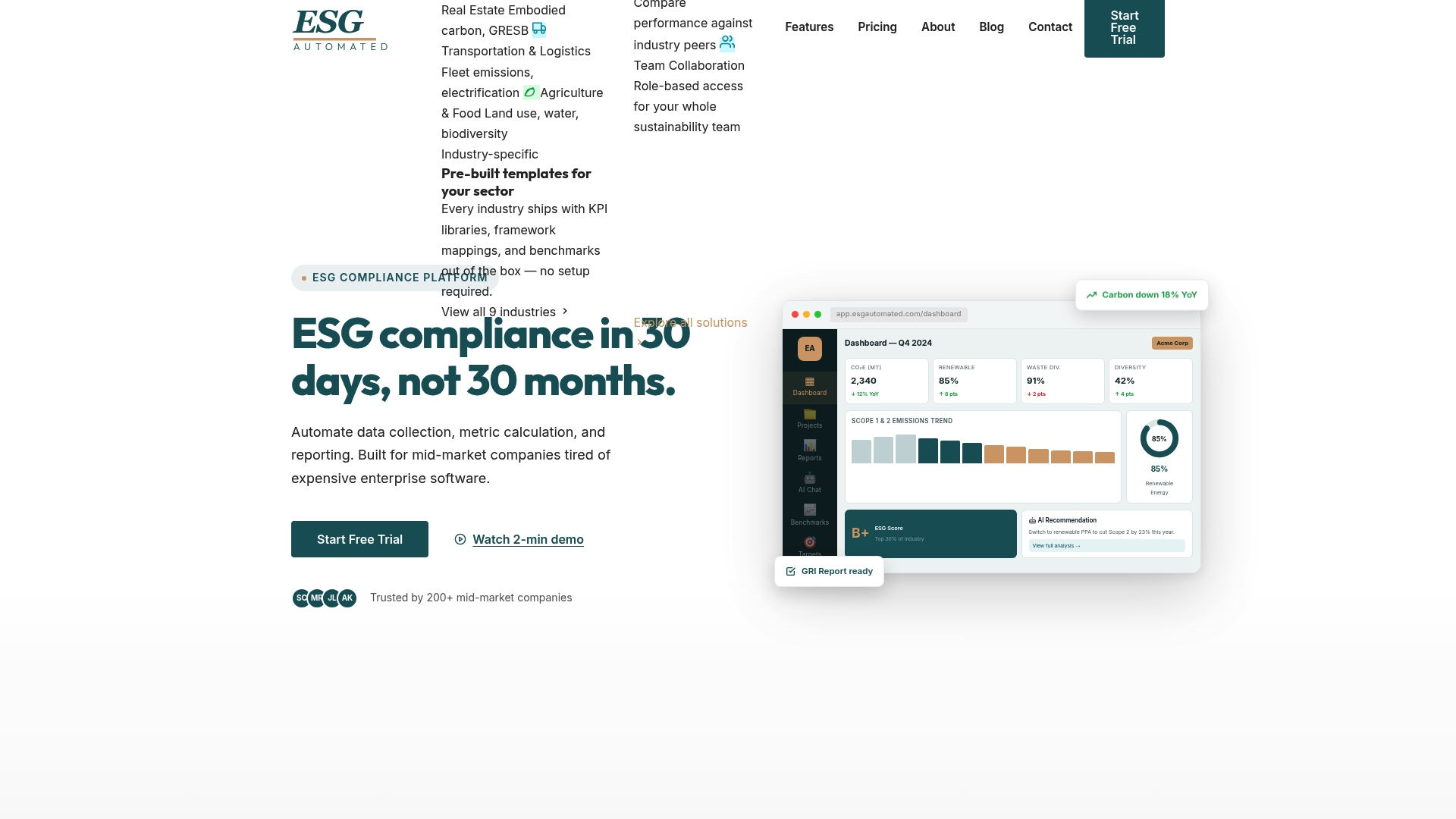
Esgautomated automates data collection, variance validation, and audit trail management across GRI, TCFD, CSRD, SASB, and CDP frameworks. The platform maps a single data point to multiple framework requirements, eliminating duplicate collection. Real-time dashboards give finance and ESG teams a shared view of data status at every workflow stage. For financial services teams managing investor-grade ESG disclosures, Esgautomated delivers the first audit-ready report in 30 days. The platform replaces spreadsheet workflows and expensive consultants at a fraction of enterprise software costs.
FAQ
What is an ESG performance investor reporting workflow?
An ESG performance investor reporting workflow is a structured cycle of stages, from materiality assessment through stakeholder engagement, that produces accurate, audit-ready ESG disclosures for investors. It aligns sustainability data collection and validation with financial reporting schedules and standards like CSRD, GRI, and ISSB.
How many stages does a standard ESG reporting cycle include?
A mature ESG reporting cycle follows eight stages: materiality assessment, framework selection, KPI definition, data collection and validation, internal review, third-party assurance, publication, and stakeholder engagement.
Why does ESG reporting require finance team involvement?
Finance teams apply the internal controls, audit trails, and variance analysis that make ESG data credible to investors and assurance providers. Finance-led ESG infrastructure creates a single source of truth that meets the same rigor as financial statements.
What is the most common cause of ESG reporting workflow failures?
Governance deficits, specifically the absence of a data dictionary with defined metrics, methodologies, and named owners, cause most workflow failures. Without that foundation, teams spend the majority of reporting cycles on manual reconciliation rather than analysis.
How does automation improve the ESG reporting process for investors?
AI-driven automation replaces manual data entry and retrospective checks with continuous validation and structured data ingestion, including iXBRL formatting. This reduces revision cycles and produces investor-grade outputs faster and with fewer errors.