
ESG reporting cost breakdown is the detailed accounting of expenses associated with producing sustainability disclosures, spanning software licensing, internal labor, external consulting, and third-party assurance. Mid-cap companies face first-year capital expenditures from $525,000 to $1.5M, with recurring annual operating costs between $200,000 and $500,000. Large enterprises subject to CSRD average €400,000 in one-off implementation costs and €650,000 in annual recurring expenses. Accurate cost analysis for ESG reporting is no longer optional in 2026. Regulatory pressure from CSRD, GRI, TCFD, SASB, and CDP frameworks makes precise budgeting a compliance requirement, not a finance exercise.
What are the major cost components in ESG reporting?
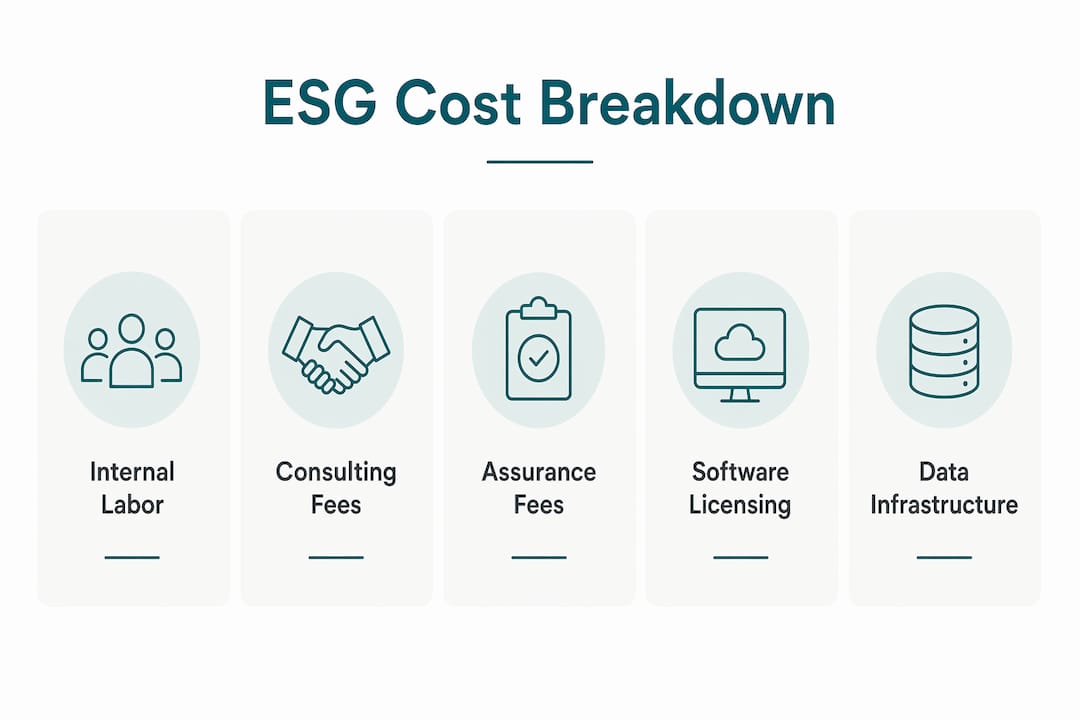
ESG reporting expenses fall into five distinct categories, each with its own cost structure and growth trajectory.
Software licensing and maintenance covers platform subscriptions, integration fees, and annual renewal costs. Entry-level platforms charge far less than enterprise solutions, but the license fee is rarely the largest line item. The real cost driver is the labor required to feed, reconcile, and maintain data inside those systems.

Data infrastructure includes the systems, APIs, and internal databases that collect raw ESG metrics across business units. For companies with distributed operations, building reliable data pipelines is a significant capital investment. This cost is often misclassified as an IT expense rather than an ESG reporting expense, which distorts budget planning.
External consulting and advisory fees cover materiality assessments, framework alignment, gap analyses, and report drafting. Fees vary widely by firm tier and project scope. A Big 4 engagement for full CSRD readiness can reach several million dollars, while a boutique specialist may charge a fraction of that for a narrower scope.
Internal personnel costs represent the most underestimated line item in any ESG reporting budget. Internal labor frequently exceeds external consulting spend in both time and total cost. Finance and sustainability teams spend hundreds of hours each cycle on data collection, validation, and formatting tasks that add no strategic value.
Third-party assurance fees apply when an independent auditor verifies the accuracy of reported data. These fees scale with the scope of assurance and the level of rigor required. Limited assurance costs less than reasonable assurance, but regulatory mandates are pushing companies toward the more expensive option.
| Cost Category | Typical Annual Range | Nature |
|---|---|---|
| Software licensing | $20,000–$200,000+ | Recurring (opex) |
| Data infrastructure | $100,000–$500,000 | Mixed (capex + opex) |
| External consulting | $50,000–$3,000,000+ | Project-based |
| Internal labor | $50,000–$450,000+ | Recurring (opex) |
| Third-party assurance | $75,000–$750,000+ | Recurring (opex) |
Pro Tip: Track internal labor hours by department for at least one full reporting cycle before setting your ESG budget. Most finance teams discover their actual internal cost is double their initial estimate.
How does manual ESG reporting increase costs compared to automated solutions?
Manual sustainability reporting demands 500–1,000 internal hours per reporting cycle, costing $50,000–$150,000 annually in staff time alone. That figure does not include the cost of fixing errors. Manual data entry error rates run between 1% and 4%, and each error that reaches an auditor triggers remediation work that multiplies the original cost.
The esg cost versus manual reporting comparison reveals a pattern that surprises most finance teams. Software license fees get scrutinized in procurement. Internal labor hours do not. A team spending 800 hours per cycle on spreadsheet consolidation is burning budget invisibly, with no line item to challenge in a budget review.
The risks compound at audit time. Auditors flag inconsistencies in manually compiled data sets, requiring additional documentation, explanations, and sometimes restatements. Each audit finding adds cost and delays the reporting timeline. ESG audit readiness cost reduction starts with eliminating the manual processes that create audit risk in the first place.
Selecting software for automation capabilities results in better long-term budget control than focusing on upfront license prices. Labor to integrate and feed ESG data systems dominates total cost of ownership, not software license fees. Automation reduces ongoing labor and overall costs.
Automation addresses this directly. Platforms that connect to source systems and pull data automatically eliminate the reconciliation hours that consume internal teams. The upfront investment in automation pays back through labor savings within the first one to two reporting cycles for most mid-market companies.
- Manual processes create audit risk through inconsistent data trails
- Error remediation costs compound across multiple departments
- Delayed data collection extends the reporting timeline and increases consulting fees
- Internal teams lose time that could go toward sustainability strategy
- Automated pipelines reduce recurring labor costs year over year
Pro Tip: When evaluating ESG platforms, ask vendors specifically how data flows from source systems into the reporting engine. If the answer involves manual exports or spreadsheet uploads, the labor cost problem does not go away.
What impact do consulting and assurance fees have on overall ESG reporting budgets?
Consulting fees represent one of the most variable and controllable costs in the ESG reporting cost breakdown. The range is enormous because scope varies enormously. A company hiring a Big 4 firm for end-to-end CSRD implementation pays for brand, liability coverage, and broad capability. A company hiring a specialist boutique for a specific deliverable, such as a double materiality assessment, pays a fraction of that rate for the same output quality.
Internal personnel effort for compliance-ready ESG reports often requires 1.5–3 times the external consulting costs. This is the figure that consistently surprises finance teams. The consultant delivers a framework or a report shell. The internal team then spends months populating it with verified data. That internal time is real cost, and it rarely appears in the consulting contract.
Assurance fees follow a different logic. For a company with $5B in revenue, limited assurance on Scope 1 and 2 emissions costs $75,000–$200,000 annually. Reasonable assurance across all scopes can reach $300,000–$750,000 or more. That is not a marginal difference. It is a budget category that can double or triple depending on regulatory requirements.
The cost escalation from limited to reasonable assurance is not just about auditor hours. Reasonable assurance under CSRD will increase audit fees by 150–200% due to extensive testing, sample sizes, and liability requirements. Post-2028 mandatory reasonable assurance timelines mean companies need to budget for this escalation now, not when the invoice arrives.
Strategies to manage consulting and assurance costs:
- Separate strategic advisory work from implementation work. Use senior consultants for materiality assessments and audit readiness. Use lower-cost specialists for data collection and formatting.
- Negotiate assurance scope before the engagement begins. Agreeing on which metrics require assurance and which do not controls the fee significantly.
- Build internal capability for recurring tasks. Training an internal analyst to manage data validation reduces the hours billed by external consultants each cycle.
- Avoid bundled consulting packages. Unbundling consulting scopes can save 40–60% of total project costs by replacing generalist hours with targeted specialist work.
Pro Tip: Request an itemized breakdown of any consulting proposal before signing. Line-item visibility reveals where you are paying premium rates for work that a lower-cost provider or internal team could handle.
How can organizations optimize ESG reporting costs effectively?
The most effective ESG reporting cost reduction strategies share one principle: treat reporting as permanent data infrastructure, not an annual project. Companies with automated real-time data pipelines report substantially lower recurring reporting expenses. The first year costs more to build. Every subsequent year costs less to run.
Finance professionals who apply ESG reporting automation early in the budget cycle gain a structural cost advantage. Automated data collection eliminates the reconciliation hours that drive internal labor costs. It also reduces audit risk by creating consistent, traceable data trails that auditors can verify without extensive manual review.
Practical cost optimization follows a clear sequence:
- Audit your current internal hours. Map every task performed by internal staff during the last reporting cycle. Identify which tasks are data collection, which are validation, and which are actual analysis. Collection and validation are automation candidates.
- Invest in integrated data infrastructure. Platforms that connect directly to HR systems, utility providers, and financial databases eliminate manual data entry at the source. This is the single highest-return investment in ESG reporting timeline cost optimization.
- Unbundle your consulting spend. Retain strategic advisors for materiality and framework decisions. Use specialty vendors or internal staff for implementation and data management.
- Negotiate assurance scope early. Decide which metrics require third-party verification before engaging an auditor. Scope creep during an assurance engagement is expensive and avoidable.
- Budget by maturity stage. A company in its first year of CSRD compliance has different cost drivers than one in year three. Mid-market ESG reporting challenges differ from enterprise challenges. Budget accordingly.
Understanding the common ESG compliance cost drivers specific to your company size and sector prevents the budget gaps that force emergency consulting engagements mid-cycle.
Pro Tip: Set a three-year ESG budget, not a one-year budget. Year one costs are high because of setup. Years two and three drop significantly if you build the right infrastructure in year one. A single-year budget view makes ESG reporting look more expensive than it actually is over time.
Key Takeaways
The total cost of ESG reporting is dominated by internal labor and assurance fees, not software licenses, and automation is the most reliable way to reduce both over time.
| Point | Details |
|---|---|
| Internal labor is the largest cost | Internal effort often runs 1.5–3 times external consulting fees due to manual data tasks. |
| Assurance fees escalate with scope | Moving from limited to reasonable assurance can increase audit costs by 150–200%. |
| Automation reduces recurring costs | Automated data pipelines cut labor hours and audit risk across every reporting cycle. |
| Unbundling consulting saves 40–60% | Separating strategic advisory from implementation work eliminates premium billing for routine tasks. |
| Budget across three years, not one | First-year setup costs are high; years two and three drop sharply with the right infrastructure in place. |
The cost conversation most finance teams are having too late
The finance professionals I work with consistently make the same mistake: they budget for ESG software and consulting, then discover mid-cycle that internal labor is consuming twice what they planned. The spreadsheet hours, the email chains chasing data from facilities managers, the three rounds of corrections before the auditor sees the file. None of that shows up in the vendor quote.
The trend I watch most closely is the shift toward mandatory reasonable assurance under CSRD. Companies that have only experienced limited assurance are not prepared for the fee increase. A $150,000 assurance engagement becoming a $400,000 engagement is not unusual. Finance teams that have not modeled this scenario will face a budget crisis, not a budget adjustment.
My practical advice is to stop treating ESG reporting as a compliance cost and start treating it as a data infrastructure investment. The companies that build clean, automated data pipelines in 2026 will spend significantly less on reporting in 2028 and 2029. The companies that rely on manual processes and annual consulting engagements will spend more each year, not less.
The best ESG software cost reduction strategy is not finding cheaper software. It is reducing the labor that feeds the software. That distinction changes every procurement decision you make.
— ESG Team
How Esgautomated helps control ESG reporting costs
Finance teams and sustainability managers who need audit-ready reports without the enterprise price tag have a direct path forward with Esgautomated.
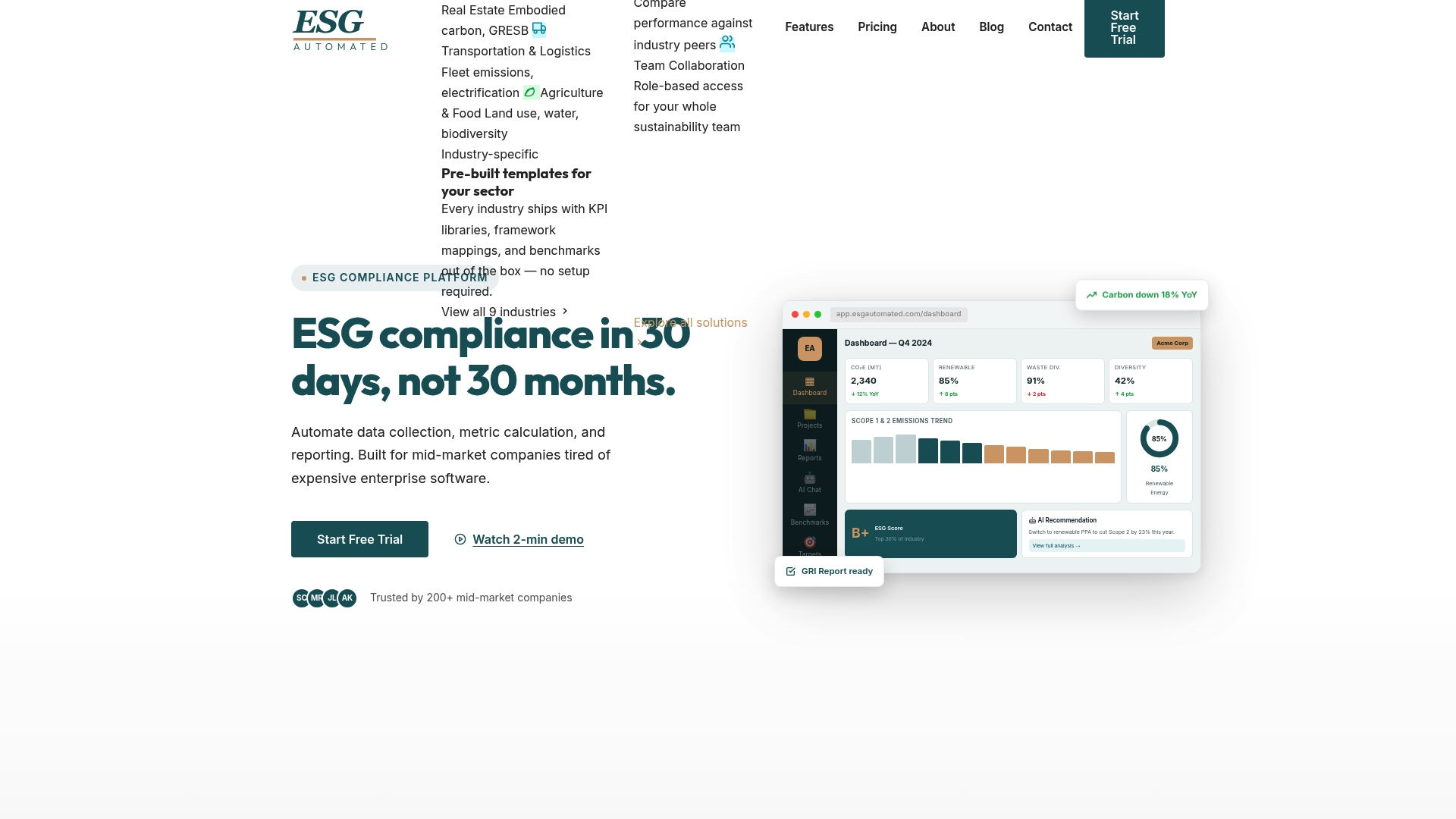
Esgautomated is an AI-powered ESG compliance platform built for mid-market companies. It automates data collection, metric calculation, and reporting across GRI, TCFD, CSRD, SASB, and CDP frameworks. That automation directly targets the internal labor costs that consume most ESG budgets. Teams that previously spent hundreds of hours on manual data consolidation get that time back. The platform’s data management capabilities replace spreadsheet-based workflows with traceable, audit-ready data pipelines. Companies using Esgautomated produce their first compliant ESG report in 30 days. Explore the full platform solutions to see how it fits your reporting requirements and budget.
FAQ
What is included in an ESG reporting cost breakdown?
An ESG reporting cost breakdown covers software licensing, data infrastructure, external consulting fees, internal labor hours, and third-party assurance costs. Each category contributes differently depending on company size, reporting framework, and maturity stage.
How much does ESG reporting cost for a mid-market company?
Mid-cap companies typically face first-year capital expenditures from $525,000 to $1.5M and recurring annual operating costs between $200,000 and $500,000, depending on framework scope and automation level.
Why does manual ESG reporting cost more than automated reporting?
Manual reporting requires 500–1,000 internal hours per cycle and carries error rates of 1–4%, both of which increase audit remediation costs. Automation eliminates most of those hours and reduces audit risk.
How can I reduce ESG consulting fees?
Unbundling consulting scopes by using strategic advisors for materiality and audit readiness while employing specialty vendors for data implementation can reduce total project costs by 40–60%.
How much will assurance fees increase under CSRD reasonable assurance?
Reasonable assurance under CSRD is projected to increase audit fees by 150–200% compared to limited assurance, due to greater testing requirements, larger sample sizes, and higher auditor liability.