
Mid-market ESG reporting challenges are defined by a structural gap: companies large enough to face regulatory scrutiny but too lean to absorb the compliance burden of enterprise-scale frameworks. Reporting gaps persist even as ESG awareness rises, with mid-market firms typically managing 150–300 material data points compared to 1,000+ for large firms. Standards like ESRS, ISSB, GRI, and CSRD were built with large organizations in mind. That mismatch creates real risk for compliance professionals who must deliver credible disclosures without dedicated sustainability departments or enterprise software budgets.
1. What are the main mid-market ESG reporting challenges in 2026?
Mid-market sustainability reporting sits at an awkward intersection. Regulators expect the rigor of large-firm disclosure. Budgets and headcount reflect something closer to a small business. The result is a compliance program that stretches internal resources past their natural limits.
The core problem is not a lack of intent. Most mid-market leaders understand why ESG reporting matters. The problem is execution: collecting reliable data, mapping it to the right framework, and producing a report that holds up under third-party assurance. Each of those steps requires skills, systems, and time that most mid-market teams do not have in surplus.
Three structural gaps drive most of the difficulty:
- Resource scarcity. No dedicated ESG team means sustainability tasks fall to finance, legal, or operations staff who already carry full workloads.
- Data fragmentation. ESG data lives in ERP systems, spreadsheets, supplier portals, and utility bills. Pulling it together manually is slow and error-prone.
- Framework overload. ESRS, GRI, TCFD, SASB, CDP, and ISSB each have different disclosure requirements. Choosing the wrong one wastes months of work.
2. What are the resource and expertise challenges in mid-market ESG reporting?
The scarcity of specialized ESG expertise is the single most cited obstacle for mid-market firms. External consultant dependency inhibits organizational learning and drives up long-term costs without building internal capability. A consultant can produce your first report. They cannot build the institutional knowledge your team needs to sustain reporting year after year.

Mid-market companies that rely entirely on external consultants face a predictable cycle. Each reporting period restarts from scratch. Data collection methods are not documented. Staff turnover erases whatever informal knowledge existed. The next report costs as much as the first.
The alternative is incremental capability building. Assign one internal owner for ESG data, even part-time. Document every data source, collection method, and calculation assumption. That documentation becomes the foundation for audit readiness and reduces consultant scope over time.
- Assign clear ownership. One named person per data category (energy, waste, headcount) prevents gaps and duplication.
- Document processes, not just outputs. A report without a process behind it cannot be reproduced or audited.
- Train finance and operations staff. ESG data is mostly operational data. The people who already manage it are your best internal resource.
- Phase out consultant dependency. Use external help to build frameworks, not to run them indefinitely.
Pro Tip: Start with a single framework, such as GRI or SASB, and master its data requirements before adding a second. Trying to report against three frameworks simultaneously in year one is the fastest route to burnout and inaccurate disclosures.
3. How does Scope 3 data complexity challenge mid-market ESG reporting?
Scope 3 emissions are the indirect greenhouse gas emissions that occur across a company’s value chain, covering everything from purchased goods to employee commuting to end-of-life product disposal. They are also the hardest category to measure. Only about 10% of suppliers provide reliable emissions data, which forces companies to rely on estimates for the rest.
That estimation problem compounds quickly. A mid-market manufacturer sourcing from 200 suppliers may have verified data for 20 of them. The other 180 require spend-based or activity-based estimation models, each carrying its own uncertainty range. When an auditor asks how you calculated Scope 3 Category 1 (purchased goods), “we estimated it” is not a sufficient answer without documented methodology.
The Excel trap makes this worse. Spreadsheets are flexible but fragile. They do not record who changed a number, when, or why. They do not link a data point back to its source document. Failure to document the link between data, sources, and verification dates leads directly to non-compliance findings.
A practical approach to Scope 3 data management:
- Categorize your emissions sources. List all 15 Scope 3 categories and identify which are material to your business model.
- Prioritize the top three categories. For most mid-market firms, Categories 1, 11, and 15 (purchased goods, use of sold products, investments) represent the majority of impact.
- Request primary data from top-spend suppliers. Focus on the 20% of suppliers that represent 80% of your procurement spend.
- Use spend-based estimates for the rest. Apply published emission factors from databases like EXIOBASE or EPA supply chain factors, and document the methodology.
- Label every data point. Mark each figure as measured, derived, or estimated. Auditors need this distinction to assess data quality.
Pro Tip: Distinguishing measured vs. estimated data in your reporting system is not just good practice. It is the difference between passing and failing a third-party assurance review.
4. Why do evolving ESG frameworks create compliance risk for mid-market companies?
Mid-sized companies face a structural mismatch when they apply large-cap frameworks to their operations. ESRS, for example, contains over 1,000 potential disclosure fields. A mid-market firm reporting 150–300 material data points does not need most of them. Applying the full framework wastes resources and creates disclosure noise that obscures the metrics investors actually want.
The VSME (Voluntary Sustainability Reporting Standard for SMEs) was designed to address this gap, but it lacks the materiality granularity that investors and lenders expect. The simplified ESRS, expected to reduce mandatory data points by 60–70%, offers a more practical middle ground for mid-market firms caught between VSME’s limitations and full ESRS complexity.
| Framework | Designed for | Key strength | Mid-market fit |
|---|---|---|---|
| Full ESRS | Large listed companies | Comprehensive double materiality | Low. Too many fields for most mid-market firms |
| Simplified ESRS | Mid-market and listed SMEs | Reduced mandatory fields, investor-aligned | High. Expected to cut data points by 60–70% |
| VSME | Micro and small firms | Low administrative burden | Partial. Lacks decision-useful granularity |
| GRI Standards | All organizations | Widely recognized, modular | Moderate. Requires careful topic selection |
| SASB | Industry-specific disclosure | Investor-focused, sector-relevant | High for single-industry firms |
Rapid regulatory change adds another layer of risk. A company that builds its reporting program around one framework may find that its key customer or lender requires a different one within 18 months. Prioritizing material topics over exhaustive disclosure reduces this risk. A report built on well-documented, material data points translates across frameworks more easily than one built on volume.
5. What practical strategies help mid-market firms overcome ESG reporting difficulties?
The most effective approach to mid-market sustainability reporting is not to replicate what large firms do at smaller scale. It is to build a proportionate program that matches your actual data capabilities and regulatory exposure. ESG reporting best practices for mid-market firms follow a clear sequence.
- Run a materiality assessment first. Identify the ESG topics that genuinely affect your business model and stakeholders. This narrows your disclosure scope from hundreds of potential metrics to a manageable set.
- Embed ESG data collection into existing systems. Finance teams already collect most of the data ESG reporting requires. Finance input is not optional. It is the fastest path to reliable, audit-ready data.
- Replace spreadsheets with a purpose-built data management system. Even a mid-tier platform with version control and source linking eliminates the audit failures that spreadsheets cause.
- Build an evidence trail for every data point. Record the source document, collection date, calculation method, and responsible person for each metric.
- Prepare for assurance before you need it. Third-party assurance is becoming standard for CSRD-adjacent reporting. Companies that build assurance-ready processes from the start avoid expensive remediation later.
- Reassess materiality annually. Materiality must be ongoing and structurally embedded. A one-off exercise from year one will not reflect your business three years later.
Pro Tip: A phased approach to ESG technology works better than a big-bang implementation. Start with data collection and evidence management in year one. Add automated calculation and framework mapping in year two. By year three, you have a system that runs with minimal external support.
6. How can mid-market companies align ESG reporting with business strategy?
ESG reporting that is disconnected from business strategy produces disclosures that satisfy regulators but create no value. The companies that get the most from their ESG programs treat material topics as genuine business risks and opportunities, not compliance checkboxes.
The starting point is anchoring ESG metrics to your business model. A logistics company’s most material ESG topic is likely fleet safety and fuel efficiency. A food manufacturer’s is water usage and supply chain traceability. Chasing every disclosure trend dilutes focus and increases greenwashing risk. Reporting on 40 ESG topics with thin data is less credible than reporting on 10 topics with deep, verified evidence.
Strategic ESG alignment also pays off in stakeholder relations. Transparent, credible disclosure strengthens refinancing conversations, satisfies customer due diligence requirements, and supports investor relations. These are concrete business outcomes, not soft benefits.
- Link ESG KPIs to existing business performance reviews. If a metric does not appear in your quarterly management reporting, it will not get the attention it needs.
- Use ESG data in risk management frameworks. Climate-related financial risks, supply chain disruption, and labor issues are material business risks. TCFD provides a structured way to disclose them.
- Communicate ESG performance to customers and lenders proactively. Mid-market firms that wait to be asked are always behind. Those that disclose proactively set the terms of the conversation.
- Treat materiality assessment as a structural foundation. Revisit it when your business model changes, when new regulations take effect, or when major customers update their supplier requirements.
Key takeaways
Mid-market ESG reporting succeeds when companies build proportionate programs grounded in materiality, internal data ownership, and documented evidence trails rather than copying large-firm frameworks at reduced scale.
| Point | Details |
|---|---|
| Scope 3 data is the hardest gap | Only about 10% of suppliers provide reliable data; document estimation methods for the rest. |
| Framework mismatch creates risk | Simplified ESRS is expected to cut mandatory data points by 60–70%, making it the best fit for most mid-market firms. |
| Internal ownership beats consultant dependency | Assigning named data owners and documenting processes reduces long-term costs and audit failures. |
| Materiality must be ongoing | Annual reassessment keeps your disclosure scope aligned with actual business risks and regulatory changes. |
| Finance integration is non-negotiable | Embedding ESG data collection into ERP and finance systems produces audit-ready figures faster than any standalone approach. |
The uncomfortable truth about mid-market ESG programs
Most mid-market ESG programs fail quietly. They produce a report, file it, and then scramble to rebuild the process from scratch twelve months later. The root cause is almost never a lack of ambition. It is a lack of process infrastructure.
Working with mid-market compliance teams, the pattern is consistent. The first report takes six months and costs more than expected. The second report takes five months and costs the same. Nothing improves because nothing was documented. The consultant who built the first report is the only one who understands the methodology.
The fix is unglamorous: documentation, ownership, and repetition. Assign one person to own each data category. Write down exactly how each metric is calculated. Store the source documents in a place everyone can find. Do that for two reporting cycles and your third cycle will take half the time.
The other thing I have seen mid-market leaders get wrong is framework selection. They pick the most prestigious framework, usually full ESRS or GRI Universal Standards, because it signals seriousness. Then they spend 80% of their time on disclosures that no investor or customer actually reads. Start with the framework your most important stakeholder requires. Master that. Add others only when there is a clear business reason.
ESG reporting is not a one-time project. It is a business capability. The companies that treat it that way are the ones that stop paying consultants to rebuild their programs every year.
— ESG Team
How Esgautomated helps mid-market firms tackle ESG reporting
Mid-market compliance professionals need a reporting system that fits their actual resources, not a scaled-down version of enterprise software built for 10,000-person organizations.
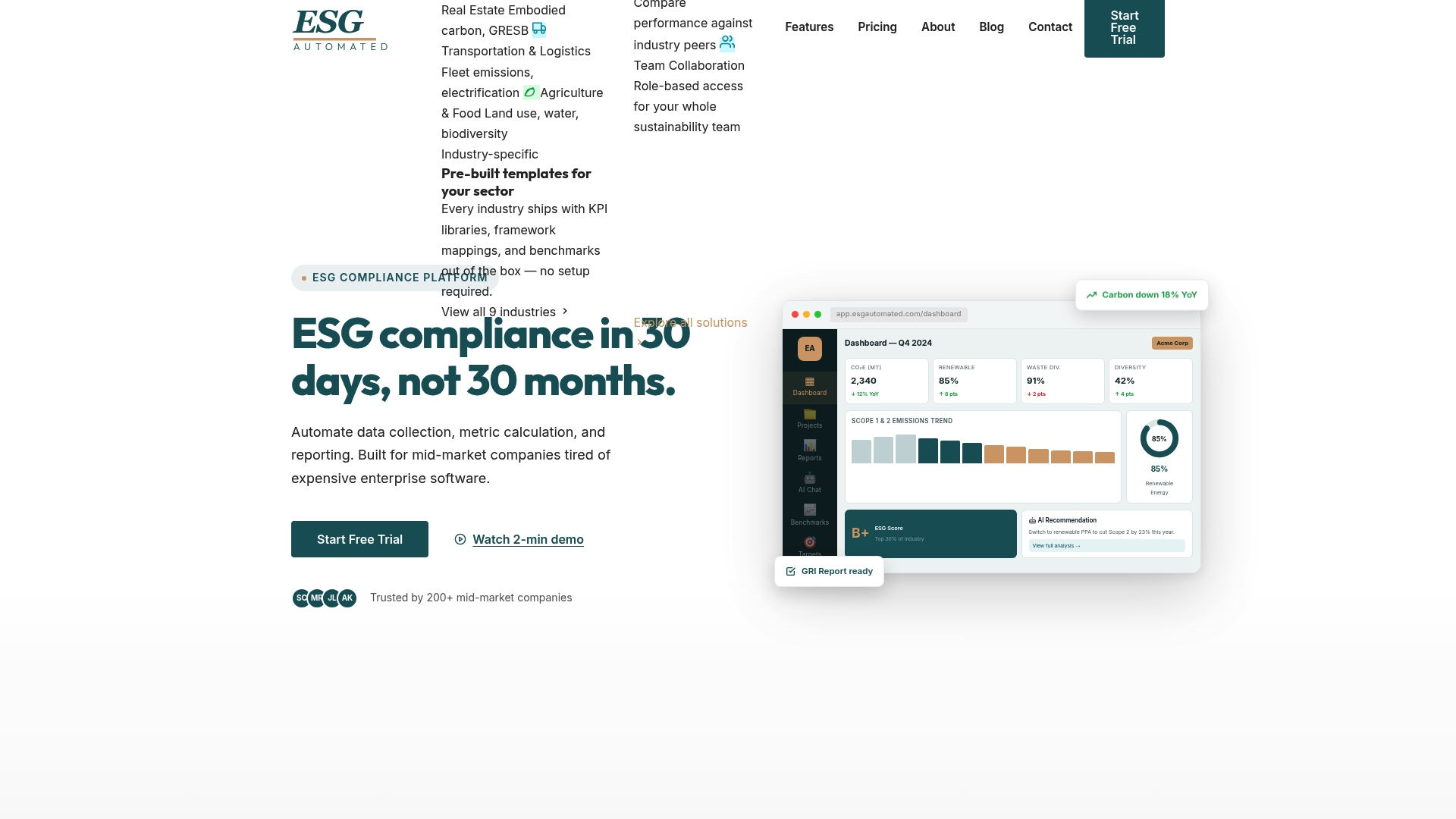
Esgautomated is built specifically for mid-market companies. It automates data collection, metric calculation, and framework mapping across GRI, TCFD, CSRD, SASB, and CDP. It connects directly to existing ERP and finance systems, so your data does not live in spreadsheets. Companies using Esgautomated produce their first audit-ready ESG report in 30 days. Industry-specific solutions cover financial services, technology, energy, and retail, so the platform reflects the material topics that actually matter for your sector. Visit Esgautomated to see how it fits your reporting program.
FAQ
What are the biggest ESG reporting challenges for mid-market companies?
The three biggest challenges are lack of internal ESG expertise, fragmented data systems, and framework complexity. Mid-market firms typically manage 150–300 material data points without the dedicated sustainability departments that large firms rely on.
Why is Scope 3 emissions data so difficult for mid-market firms?
Only about 10% of suppliers provide reliable emissions data, forcing mid-market companies to estimate the rest using spend-based or activity-based models. Without documented methodology, those estimates fail third-party assurance reviews.
Which ESG framework is best suited for mid-market companies?
The simplified ESRS is expected to be the most practical option, reducing mandatory data points by 60–70% compared to the full standard. SASB is also a strong choice for single-industry firms because its disclosures are investor-focused and sector-specific.
How can mid-market firms build ESG reporting capability without large budgets?
Assign named internal owners for each data category, document every calculation method, and embed data collection into existing finance and ERP systems. This approach builds audit-ready processes without requiring a dedicated sustainability department.
What is the risk of using a large-firm ESG framework as a mid-market company?
Applying full ESRS or similar large-cap frameworks creates a structural mismatch. Mid-market firms end up reporting on hundreds of irrelevant fields, straining resources and producing disclosures that obscure the metrics stakeholders actually need.