
ESG incident reporting is the systematic process of identifying, documenting, and analyzing adverse environmental, social, and governance events to prevent recurrence and support regulatory compliance. Sustainability officers and compliance managers who understand this process gain a direct advantage in ESG risk management and stakeholder disclosure. Key performance metrics include Mean Time to Detect (MTTD), Mean Time to Respond (MTTR), and recurring incident rates. Frameworks like CSRD and ISSB now require that documentation be audit-ready, making a structured incident reporting framework non-negotiable for mid-market companies in 2026.
What is ESG incident reporting and why does it matter?
ESG incident reporting is defined as the systematic identification, documentation, and analysis of adverse events such as chemical spills, labor disputes, data breaches, and governance failures. The goal is twofold: prevent the same event from happening again, and satisfy the disclosure requirements set by regulators and investors.
The scope is broader than most compliance managers initially expect. Environmental incidents include spills, emissions violations, and habitat damage. Social incidents cover workplace injuries, discrimination claims, and supply chain labor abuses. Governance incidents range from board conflicts of interest to financial misstatements. Each category carries its own regulatory exposure and reputational risk.

MTTD and MTTR are the two metrics that tell you whether your process actually works. A low MTTD means your detection systems catch problems fast. A low MTTR means your response teams contain damage before it compounds. Tracking the recurring incident rate tells you whether root cause analysis is producing real fixes or just paperwork.
Understanding ESG reporting at this level of specificity matters because regulators are no longer accepting vague disclosures. CSRD mandates detailed incident-level data for companies operating in the EU. ISSB standards push for material sustainability risks to be disclosed with the same rigor as financial risks. Companies that treat incident reporting as a checkbox exercise face fines, investor scrutiny, and reputational damage.
What are the key stages in an ESG incident reporting process?
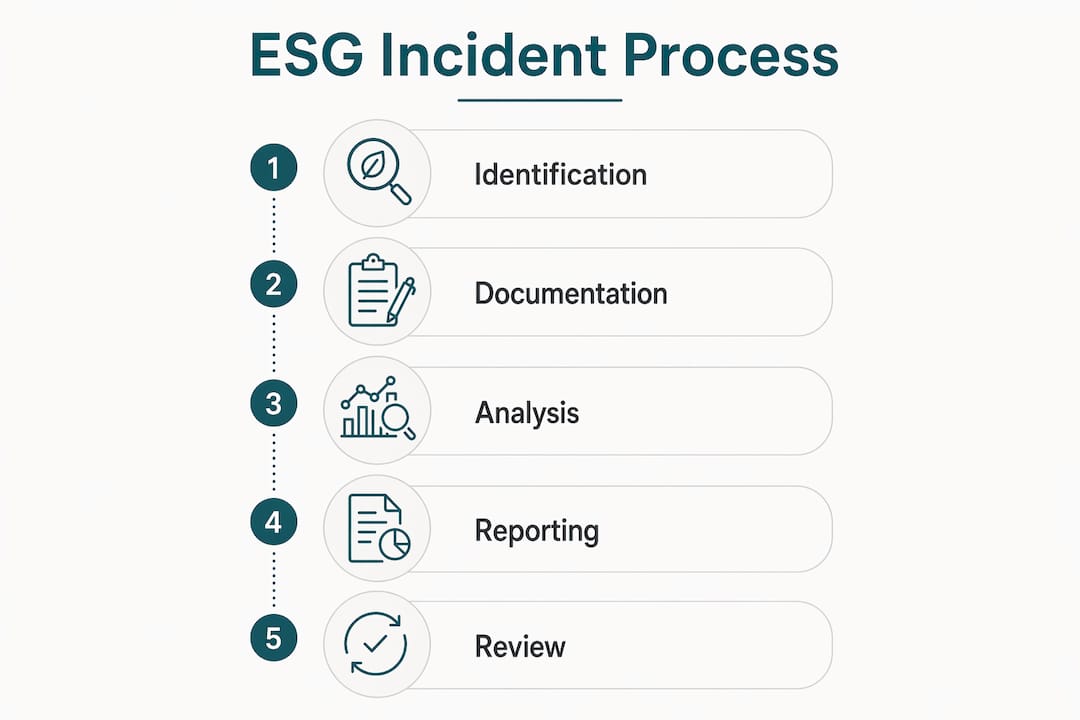
The incident reporting lifecycle has five critical stages. Each stage builds on the previous one, and skipping any step creates gaps that regulators and auditors will find.
-
Identification and logging. The incident is detected and entered into a central system with a timestamp, location, and initial description. Speed matters here. A high MTTD signals that detection systems, whether sensor networks, employee hotlines, or automated monitoring, are underperforming.
-
Severity classification. Each incident is rated by its actual and potential impact across environmental, social, and governance dimensions. Classification drives resource allocation. A minor near-miss and a reportable spill require very different response teams and timelines.
-
Containment and remediation. The immediate threat is stopped and damage is limited. For an environmental incident, this means physical containment. For a social incident, it may mean suspending a process or personnel. Remediation follows with corrective actions documented in detail.
-
Post-incident root cause analysis. This stage separates organizations that learn from those that repeat mistakes. Root cause analysis asks why the incident happened, not just what happened. The findings feed directly into updated protocols, training programs, and control improvements.
-
Stakeholder disclosure. Formal reporting to regulators and investors follows a defined timeline. Documentation is regularly audited against standards such as CSRD or ISSB. Disclosure must be accurate, timely, and traceable to source data.
Pro Tip: Build your incident log template around the five stages from day one. Retrofitting a reporting structure onto unstructured data before an audit costs far more time than getting the format right upfront.
How does ESG incident reporting integrate with enterprise risk management?
Sustainability experts stress that ESG incident reporting should not stand alone. It belongs inside the broader enterprise risk management (ERM) framework, where it receives the same board-level attention as financial and operational risks.
The practical tool for this integration is the Risk and Control Matrix (RCM). An RCM maps each ESG incident type to its likelihood, potential impact, and existing controls. When ESG risks sit inside the same RCM as credit risk or supply chain risk, the board sees a unified picture. That unified view is what COSO’s Internal Control framework and major assurance standards now expect from well-governed organizations.
The alternative, keeping ESG incidents in a separate sustainability database, creates a silo. Siloed reporting means the CFO does not see the financial exposure from a labor dispute, and the board does not connect a pattern of environmental near-misses to capital expenditure decisions. Integrating ESG into ERM allows sustainability risks to be managed with the same rigor as financial risks, which directly improves strategic decisions.
The “one view of risk” approach also reduces survey fatigue. When ESG incident data feeds into existing ERM software rather than a separate platform, teams spend less time on duplicate data entry and more time on analysis. The board gets a single dashboard showing financial, operational, and sustainability risks side by side.
Pro Tip: When mapping ESG incidents to your RCM, assign a financial impact estimate to each incident type. Boards respond faster to a $2M remediation exposure than to an abstract environmental severity score.
The ESG metrics board reporting process becomes significantly more credible when incident data is embedded in the same risk register that finance and operations teams already use.
What challenges and best practices ensure effective ESG incident reporting?
Effective ESG incident reporting fails most often not because of missing technology, but because of cultural and structural problems inside the organization.
-
Under-reporting is the biggest hidden risk. Employees who fear blame will not report near-misses or minor errors. Those unreported events are exactly the early warning signals that prevent major incidents. Fostering psychological safety means building a non-punitive reporting culture where the focus is on learning, not assigning blame.
-
Data silos produce inaccurate disclosures. When environmental data lives in one system, HR data in another, and governance records in a third, cross-referencing becomes manual and error-prone. Accurate ESG reporting depends on data validation processes that pull from multiple sources and flag inconsistencies before they reach a regulator.
-
Unclear governance creates accountability gaps. Every incident type needs a named owner, a defined escalation path, and a board-level sponsor. Without that structure, incidents get logged but not resolved, and disclosure timelines slip.
-
Near-misses are systematically undervalued. Tracking near-misses provides early warning signals of governance or operational weaknesses. Ignoring them risks higher remediation costs and reputational damage when the actual incident eventually occurs.
-
Protocols go stale. An incident reporting framework written in 2022 does not reflect CSRD requirements effective in 2026. Regular audits of the reporting protocol itself, not just the incidents, keep the process compliant and current.
The ESG regulatory change tracker is a practical starting point for compliance managers who need to align their incident protocols with 2026 mandates.
What are the practical implications of ESG incident reporting for business resilience?
ESG incident data is one of the most underused sources of operational intelligence available to a mid-market company. Most organizations collect it for compliance. The ones that use it for continuous improvement gain a measurable competitive advantage.
The table below shows how incident reporting data translates into specific business outcomes across four dimensions.
| Business dimension | How incident data drives improvement |
|---|---|
| Operational resilience | Root cause findings update procedures and reduce recurring incident rates |
| Regulatory compliance | Audit-ready documentation reduces fine exposure under CSRD and ISSB mandates |
| Investor and stakeholder trust | Transparent disclosure signals governance maturity and reduces cost of capital |
| Capital allocation | Incident patterns reveal where infrastructure or training investment is most needed |
Clear board-level oversight in ESG incident response directly reduces financial and legal liabilities. Transparency in disclosure, especially for environmental damage or labor incidents, is not optional under current regulatory expectations. It is the baseline.
The impact of ESG on business extends beyond compliance costs. Investors now use incident frequency and response quality as proxies for management competence. A company with a low recurring incident rate and fast MTTR signals operational discipline. A company with repeated incidents and delayed disclosures signals governance risk, which shows up in valuation multiples and credit ratings.
Incident data also informs training investment. If a pattern of near-misses clusters around a specific facility or process, that is where training budgets should go. This connection between incident reporting and capital allocation is what separates a compliance function from a strategic risk function.
Key Takeaways
ESG incident reporting is the foundation of credible sustainability governance, and organizations that integrate it into enterprise risk management outperform those that treat it as a standalone compliance task.
| Point | Details |
|---|---|
| Definition and scope | ESG incident reporting covers environmental, social, and governance adverse events requiring systematic documentation and analysis. |
| Five-stage lifecycle | Effective reporting follows identification, classification, containment, root cause analysis, and stakeholder disclosure in sequence. |
| ERM integration | Embedding ESG incidents in a Risk and Control Matrix gives boards a unified view of financial and sustainability risks. |
| Culture drives accuracy | Psychological safety and non-punitive reporting cultures are the primary drivers of complete and reliable incident data. |
| Business value | Incident data informs training investment, capital allocation, regulatory compliance, and investor confidence simultaneously. |
The case for treating ESG incidents as strategic intelligence
Most organizations I work with treat ESG incident reporting as a compliance obligation. They log the incident, file the report, and move on. That approach satisfies the minimum regulatory requirement, but it leaves the most valuable part of the process unused.
The real value of incident data is predictive. A cluster of near-misses in a specific supply chain segment is a leading indicator of a future material incident. A pattern of minor governance exceptions in one business unit often precedes a significant disclosure failure. Organizations that analyze incident data at this level of depth make better capital allocation decisions, catch systemic risks before they escalate, and build the kind of governance track record that institutional investors reward.
The regulatory environment in 2026 is pushing companies in this direction whether they are ready or not. CSRD and ISSB are not asking for narrative descriptions of good intentions. They require incident-level data, response timelines, and evidence of corrective action. Companies that have been running a disciplined incident reporting process for two or three years will meet those requirements with minimal additional effort. Companies that are starting now face a steep catch-up curve.
My strongest advice for sustainability officers is this: stop treating the incident log as a compliance archive and start treating it as a risk intelligence feed. The data is already there. The question is whether your governance structure is set up to act on it.
— ESG Team
Esgautomated makes ESG incident reporting audit-ready
Compliance managers at mid-market companies face a specific problem: incident data sits in spreadsheets, email threads, and disconnected systems. Pulling it together for a CSRD or ISSB disclosure takes weeks of manual work and still produces gaps that auditors flag.
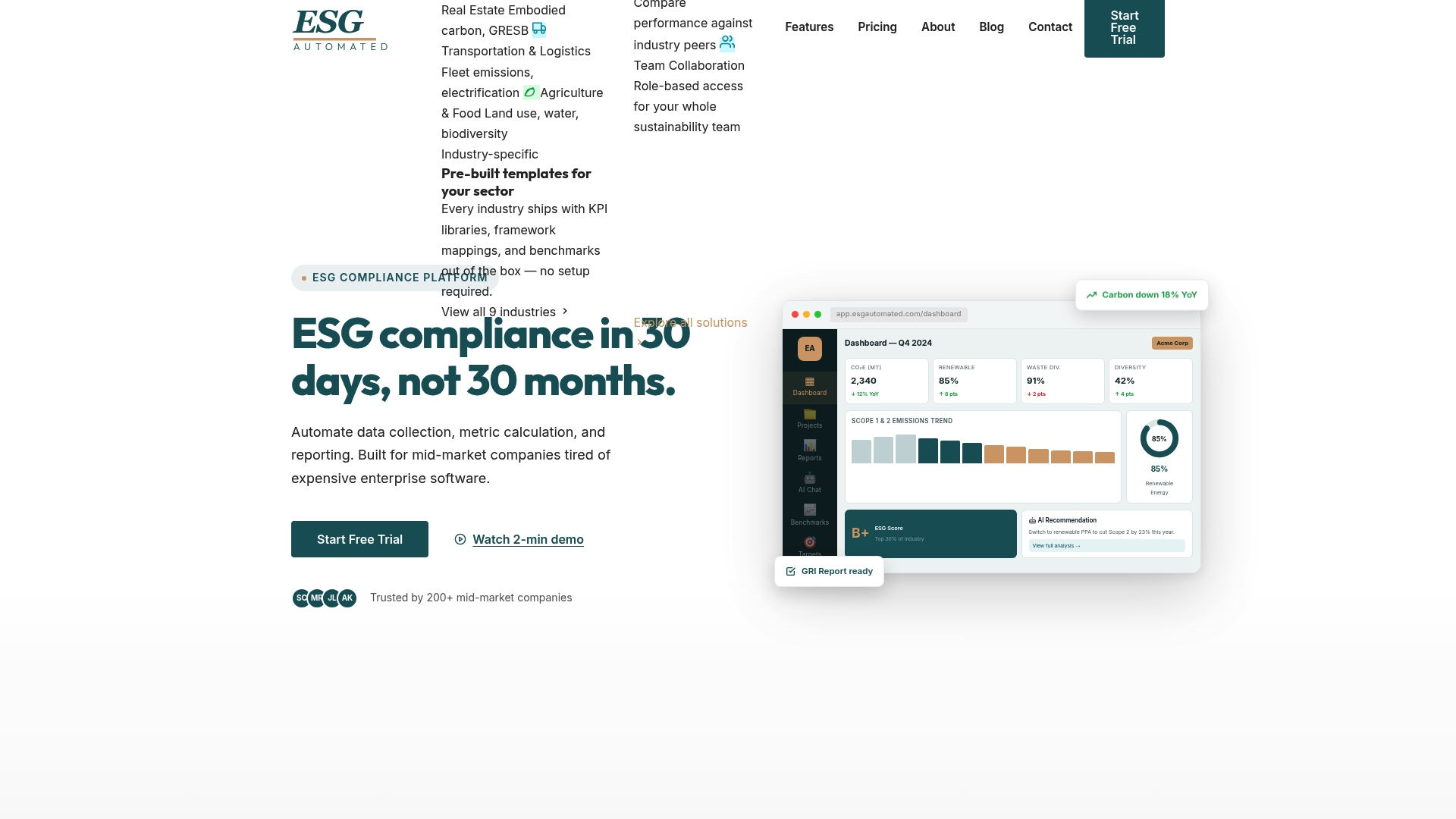
Esgautomated automates data collection, incident documentation, and metric calculation across GRI, TCFD, CSRD, SASB, and CDP frameworks. The platform connects your incident log directly to your ESG reporting workflow, so MTTD, MTTR, and recurring incident rates are always current and audit-ready. Companies using Esgautomated produce their first compliant ESG report in 30 days. Explore the full platform features to see how incident reporting fits into a complete ESG compliance program.
FAQ
What is ESG incident reporting in simple terms?
ESG incident reporting is the structured process of recording, analyzing, and disclosing adverse environmental, social, and governance events within a company. The goal is to prevent recurrence and meet regulatory disclosure requirements under frameworks like CSRD and ISSB.
What are MTTD and MTTR in ESG incident reporting?
Mean Time to Detect (MTTD) measures how quickly an organization identifies an incident after it occurs. Mean Time to Respond (MTTR) measures how quickly the organization contains and begins resolving it. Both are key performance metrics for evaluating the effectiveness of an incident reporting framework.
Why should ESG incidents be included in enterprise risk management?
Integrating ESG incidents into enterprise risk management gives boards a unified view of financial and sustainability risks in one place. This approach, supported by Risk and Control Matrices, ensures ESG risks receive the same governance rigor as operational and financial risks.
What is the biggest cause of ESG incident under-reporting?
The primary cause is a punitive reporting culture where employees fear blame for disclosing near-misses or minor errors. Organizations that build psychological safety and focus on learning rather than blame capture far more complete incident data, which reduces systemic risk over time.
How does ESG incident reporting support regulatory compliance?
Audit-ready incident documentation with traceable source data satisfies disclosure mandates under CSRD, ISSB, and other frameworks. Companies with disciplined incident reporting practices face lower fine exposure and shorter audit cycles than those relying on manual or fragmented records.