
A multi-framework ESG reporting workflow is a centralized system that collects sustainability data once and maps it automatically to multiple disclosure standards. Mid-sized companies now face simultaneous demands from CSRD (ESRS), ISSB IFRS S2, GRI, SASB, and CDP, and managing each framework in isolation creates redundant work, inconsistent data, and audit risk. The most effective approach treats these overlapping requirements as a single integrated compliance process rather than separate annual projects. ESRS alone covers approximately 70% of requirements shared with ISSB, CDP, and SBTi. That overlap is the foundation of every efficient multi-framework strategy.
What are the essential components of a multi-framework ESG reporting workflow?
An efficient workflow rests on five interconnected components. Each one addresses a specific failure point that causes mid-sized companies to waste time, produce inconsistent disclosures, or fail audits.
Centralized sustainability data warehouse
The data warehouse is the single source of truth for all ESG metrics. It collects Scope 1, 2, and 3 emissions, energy consumption, water use, waste, workforce data, and governance indicators from operational systems. Data enters once and feeds every framework output. Without this layer, teams collect the same data point multiple times in different formats, which multiplies errors.

Framework mapping engine
A dynamic mapping engine links each data field to its corresponding disclosure requirements across GRI, SASB, ESRS, ISSB, and CDP. Static spreadsheets break every time a framework updates. A living mapping configuration adapts to regulatory changes without rebuilding reports from scratch. Companies using modular, platform-based configurations spend 30–50% less time maintaining mapping tables compared to hard-coded setups. That time saving compounds across every reporting cycle.
Workflow automation for collection, validation, and signoff
Automation assigns data collection tasks to responsible owners, sends alerts for missing inputs, validates entries against defined thresholds, and routes completed data through a structured review and signoff process. This replaces email chains and manual chasing with a governed, repeatable cycle.
Cross-department governance structure
ESG data spans finance, operations, HR, procurement, and facilities. A governance structure defines who owns each data domain, who approves submissions, and who holds accountability for accuracy. Leading mid-sized companies are expanding ESG committee scope to cover all material regulations, enabling better coordination across departments.
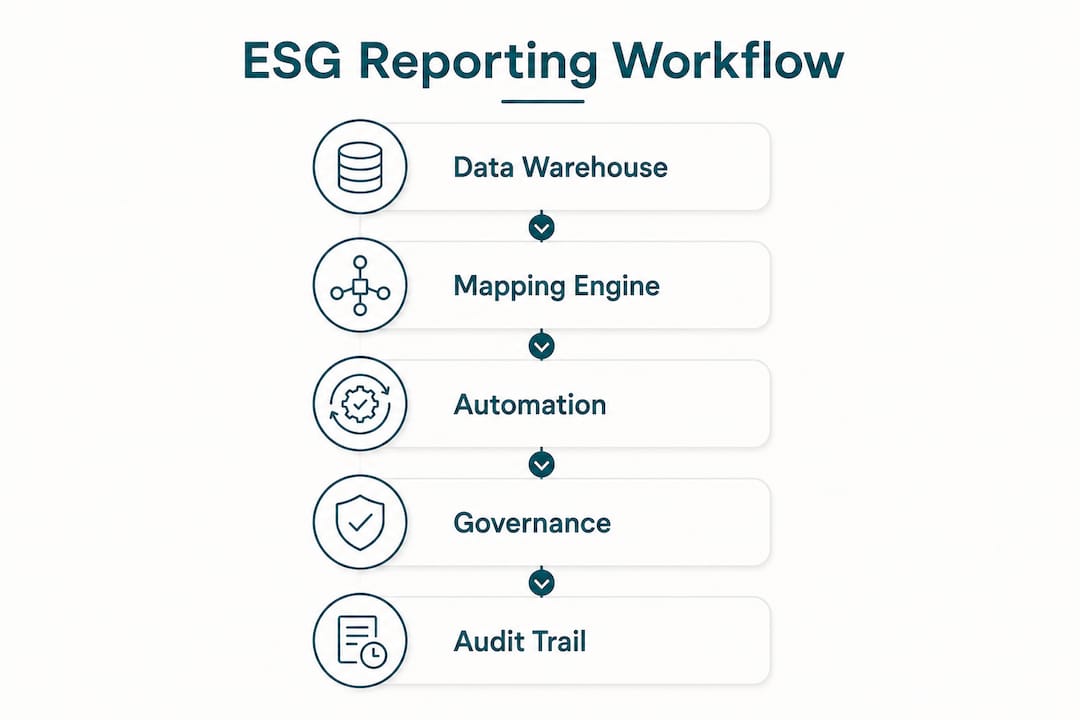
Audit trail and version control
Every data point needs a traceable path from source system to published disclosure. Audit-ready controls include drill-back traceability, structured approval workflows, and version control that records who changed what and when. These features are not optional for CSRD or ISSB compliance. They are the difference between a defensible report and a liability.
Pro Tip: Build your governance structure before you configure your technology. Assigning data ownership and approval authority first prevents the most common workflow failure: automated systems with no one accountable for the data they process.
Which major ESG frameworks drive multi-framework compliance?
Six frameworks currently define the core of multi-framework ESG compliance for mid-sized companies. Understanding their overlap is what makes a unified workflow possible.
| Framework | Primary Focus | Key Data Domains |
|---|---|---|
| ESRS (CSRD) | EU mandatory disclosure | Climate, social, governance, biodiversity |
| ISSB IFRS S2 | Climate financial risk | Scope 1, 2, 3, scenario analysis |
| GRI | Stakeholder impact | All ESG topics, sector standards |
| SASB | Industry-specific metrics | Sector-relevant financial materiality |
| CDP | Environmental disclosure | Climate, water, forests |
| TNFD | Nature and biodiversity | Ecosystem dependencies and impacts |
These frameworks share 12 core data domains: Scope 1 emissions, Scope 2 emissions, Scope 3 emissions, energy consumption, water use, waste generation, workforce metrics, board governance, supply chain risk, biodiversity impact, climate scenario analysis, and remuneration policy. Collecting data across all 12 domains once satisfies the majority of requirements across all six frameworks.
ESRS functions as the most practical master data dictionary because of its breadth. A framework-agnostic data model tags each data point with its relevance to GRI, SASB, TCFD, CSRD, and SEC standards, enabling multi-framework reports from a single dataset. This avoids rebuilding data layers for each new framework. The convergence trend across ISSB and ESRS is also narrowing remaining gaps, which means the overlap will only increase over time.
The practical implication: if you build your data architecture around ESRS data points, you cover the majority of what GRI, ISSB, and CDP require without separate collection processes. SASB adds industry-specific metrics on top of that base. TNFD adds nature-related data for companies with material biodiversity exposure.
How to build a practical multi-framework ESG reporting workflow
Building this workflow follows a clear sequence. Skipping steps, particularly standardization before automation, is the most common cause of failure.
-
Assess your reporting obligations. Identify which frameworks apply based on your jurisdiction, size, sector, and investor requirements. A company subject to CSRD that also responds to CDP and investor SASB requests has a defined framework set. Document it formally before any technical work begins.
-
Standardize definitions and boundaries. Define how you measure every metric: which sites are included in Scope 1, how you calculate market-based Scope 2, what your organizational boundary is for workforce data. Failing to standardize definitions before automating ESG data collection leads to inconsistent data that automation then amplifies across every output.
-
Build or select a centralized data warehouse. The warehouse needs API connections to your ERP, EMS, and HRIS systems, plus RPA or OCR tools for data sources that lack APIs. Automated data collection for emissions, energy, workforce, and governance data is enabled by integrating these operational systems directly.
-
Create dynamic framework mapping tables. Map each data field to its corresponding disclosure requirements across your target frameworks. Treat these tables as living configurations, not static documents. When TNFD updates its guidance or ESRS adds a sector standard, you update the mapping table, not the entire report.
-
Configure workflow automation. Assign data collection tasks to named owners. Set validation rules that flag outliers or missing values before data reaches the review stage. Build a structured approval chain with documented signoff at each stage.
-
Implement audit trail and evidence management. Every data point should link to its source document or system record. Version control should capture every change with a timestamp and user ID. Package evidence by framework for external assurance providers.
-
Roll out incrementally and scale. Start with your highest-priority framework and your most data-mature business unit. Prove the workflow works, then extend it to additional frameworks and sites. This reduces implementation risk and builds internal confidence.
Pro Tip: Treat your framework mapping tables as a product, not a project. Assign a named owner responsible for updating them within 30 days of any framework revision. Outdated mappings are the silent cause of most disclosure errors in multi-framework reporting.
What common mistakes occur in multi-framework ESG reporting workflows?
The most damaging mistakes share a common root: treating each framework as a separate reporting project rather than a shared data problem.
-
Collecting data separately per framework. Teams that pull Scope 1 data for CSRD and then pull it again for CDP create version conflicts. One number ends up in two reports with different values. Auditors notice. Investors notice.
-
Automating before standardizing. Automation scales whatever definition you feed it. If your Scope 2 calculation method differs between sites, automation produces consistently wrong outputs at speed. Standardize first, then automate.
-
Hard-coding framework mappings. Spreadsheet-based mappings require manual updates every time a framework revises its requirements. Modular platform configurations update rapidly as regulations evolve, while hard-coded setups create expensive remapping overhead.
-
Running multiple separate audits. Separate audits for CSRD, CDP, and investor requests on overlapping data scopes multiply cost and create conflicting findings. One unified audit with centralized data produces multiple framework-specific reports and eliminates redundant supplier questionnaires.
-
Ignoring ERP and HRIS integration. Manual data entry from operational systems is the largest source of ESG data errors. Direct system integration removes the human error layer entirely.
“Viewing multi-framework ESG reporting as ‘one audit, many reports’ shifts focus from volume to data quality and consistent governance, improving stakeholder confidence and reducing resource burden.” — Audit harmonization insight
The fix for all of these mistakes is the same: build governance and data architecture first, then configure technology around them. Technology cannot compensate for undefined ownership or inconsistent definitions.
What technology solutions enable effective multi-framework ESG reporting?
Modern ESG platforms do more than store data. The best ones embed framework requirements directly into their reporting models and adapt to regulatory changes without requiring you to rebuild your disclosure process.
-
Multi-framework output from a single dataset. Modern ESG platforms embed framework requirements directly into their reporting models, maintaining consistent mappings and adapting to changing regulations. This means one data entry produces GRI, SASB, and ESRS outputs simultaneously.
-
AI-assisted framework mapping. AI tools identify which data points satisfy which disclosure requirements and flag gaps when new framework versions are released. This reduces the manual review burden on your sustainability team significantly.
-
Workflow engines with governance controls. Continuous data validation, role-based access, and structured approval workflows replace ad hoc email coordination. Every action is logged, which supports both internal governance and external assurance.
-
ERP, EMS, and HRIS integration. Real-time data feeds from operational systems eliminate manual data entry. Emissions data flows from your energy management system. Workforce data flows from your HRIS. Financial boundary data flows from your ERP.
-
Audit-ready evidence packaging. Traceability features link every disclosed metric back to its source record. Version control captures the full history of each data point. Evidence packages can be exported by framework for assurance providers.
You can also use the ESG compliance gap analysis process to identify which data domains your current systems cover and where manual collection still creates risk. That gap analysis should drive your technology selection and integration priorities.
Pro Tip: Evaluate platforms on their mapping update process, not just their current framework coverage. Ask vendors how long it takes them to update their platform after a major framework revision. The answer tells you more about long-term fit than any feature list.
Key Takeaways
A multi-framework ESG reporting workflow succeeds when data architecture, governance, and technology work together from a single centralized source.
| Point | Details |
|---|---|
| Centralize data collection | Collect each ESG metric once and map it to all required frameworks from a single warehouse. |
| Standardize before automating | Define metric boundaries and calculation methods across all sites before configuring any automation. |
| Use dynamic mapping tables | Maintain living framework mapping configurations that update within 30 days of any regulatory change. |
| Treat audits as unified | Run one governed audit cycle that produces multiple framework-specific outputs to cut cost and conflicts. |
| Integrate operational systems | Connect ERP, EMS, and HRIS directly to eliminate manual data entry and reduce errors at the source. |
The case for treating ESG reporting as a data architecture problem
The companies I see struggling most with multi-framework compliance are not struggling because of regulation complexity. They are struggling because they built their ESG reporting process the same way they built their first sustainability report: manually, in spreadsheets, one framework at a time.
The shift that actually works is treating ESG reporting as a data architecture problem, not a reporting problem. When you design your data model first, define ownership second, and configure technology third, the reporting becomes an output of a governed process rather than an annual scramble. That is a fundamentally different operating model.
What surprises most sustainability leaders is how much the frameworks already agree. ESRS, ISSB, and GRI share the majority of their core data requirements. The divergence is at the edges, in sector-specific metrics and jurisdiction-specific disclosures. A well-designed master dataset handles the core, and modular additions handle the edges. You do not need a separate process for each framework. You need one process with multiple outputs.
The governance piece is where mid-sized companies most often underinvest. Assigning a data owner for each ESG domain, with a defined update cadence and a clear escalation path, is what separates companies that produce defensible disclosures from those that produce reports full of footnotes and caveats. The role of ESG in corporate governance is not ceremonial. It is operational. Boards and ESG committees that treat framework compliance as a data governance responsibility get better results than those that treat it as a communications exercise.
My strongest recommendation: standardize before you automate, and govern before you scale. The technology exists to make this process efficient. The limiting factor is almost always the human architecture around the data, not the data itself.
— ESG Team
How Esgautomated supports your multi-framework reporting needs
Mid-sized companies building a multi-framework ESG reporting workflow face a real resource constraint. You need framework expertise, data architecture skills, and compliance governance capacity at the same time.
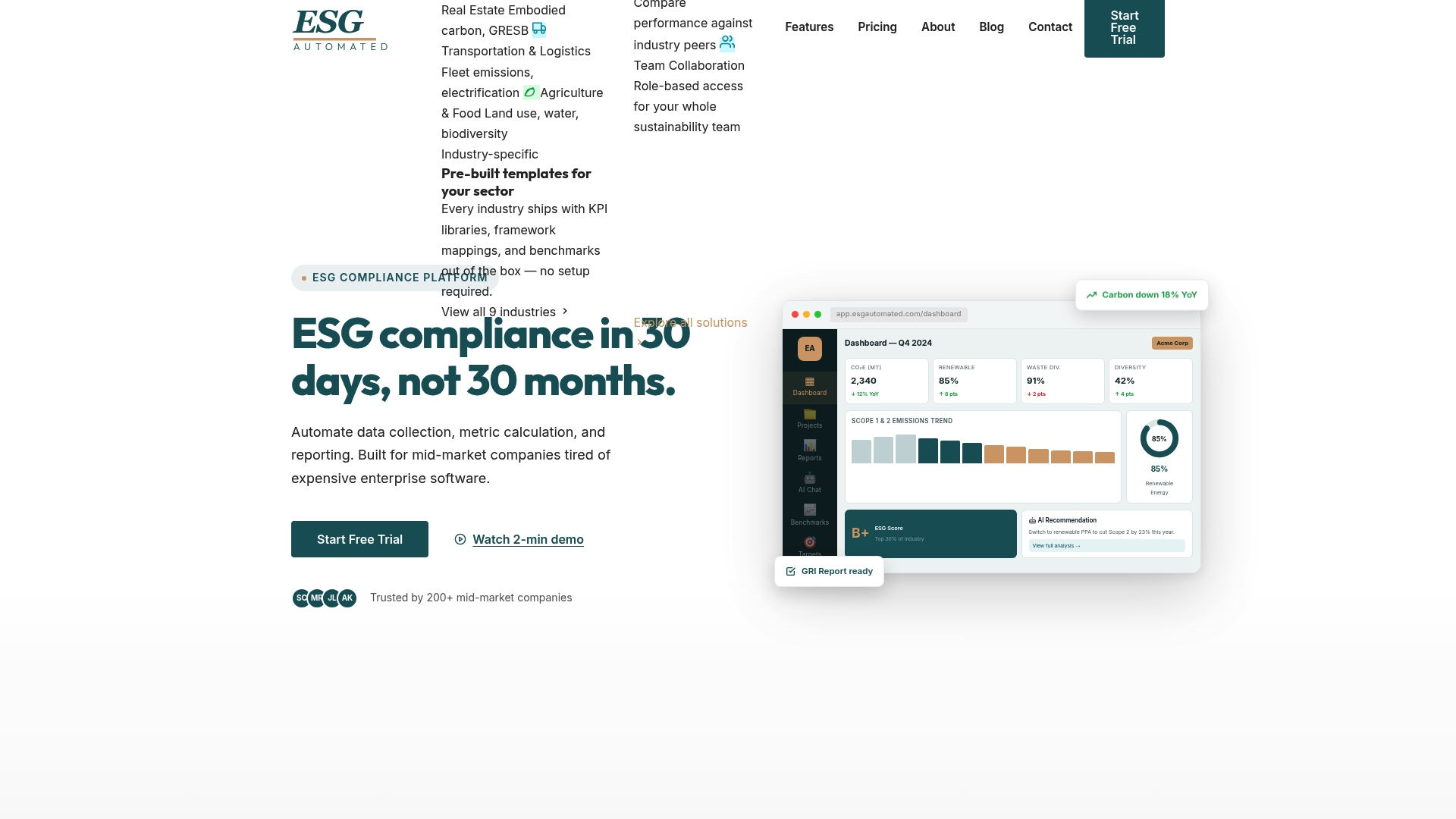
Esgautomated delivers all three through an AI-powered platform built specifically for mid-market companies. It automates data collection across GRI, TCFD, CSRD, SASB, and CDP from a single centralized dataset, maintains dynamic framework mappings, and produces audit-ready ESG reports in 30 days. The platform integrates with your existing ERP and HRIS systems, embeds governance controls directly into the workflow, and keeps your mappings current as regulations evolve. You can also explore Esgautomated’s data management solutions to see how centralized data architecture supports every framework you report against.
FAQ
What is a multi-framework ESG reporting workflow?
A multi-framework ESG reporting workflow is a centralized process that collects sustainability data once and maps it to multiple disclosure standards such as GRI, CSRD, ISSB, SASB, and CDP. It replaces separate, siloed reporting processes with a single governed data cycle that produces multiple framework-specific outputs.
Why does ESRS matter most in a multi-framework strategy?
ESRS, the standard set under CSRD, covers approximately 70% of requirements shared with ISSB, CDP, and SBTi. Building your master data model around ESRS data points satisfies the majority of other frameworks’ core requirements without separate collection processes.
What is the biggest mistake in multi-framework ESG reporting?
Automating data collection before standardizing metric definitions is the most damaging mistake. Automation amplifies whatever inconsistencies exist in your definitions, producing consistently wrong outputs across every framework simultaneously.
How does a unified audit approach reduce ESG compliance costs?
One unified audit with centralized data produces multiple framework-specific reports, eliminating redundant supplier questionnaires and separate assurance engagements. Harmonized audit workflows also improve data accuracy by moving away from parallel collection cycles that produce conflicting figures.
How long does it take to implement a multi-framework ESG reporting workflow?
Implementation time depends on data maturity and system integration complexity. Companies with existing ERP and HRIS integrations and defined metric boundaries can achieve a functional workflow within one reporting cycle. Esgautomated delivers a company’s first audit-ready ESG report in 30 days for mid-market companies starting from a low baseline.