
Manual ESG reporting fails because it lacks the centralized processes, internal controls, and data integrity that regulators and assurance providers require. The core problem is structural, not effort-related. Data sits scattered across energy management systems, HR platforms, procurement tools, and spreadsheets, with no common repository and no automated reconciliation. When a sustainability analyst finally consolidates everything weeks before a filing deadline, errors are already baked in. Regulatory frameworks like CSRD and ISSB have shifted ESG disclosure from a voluntary narrative exercise to a data-first, audit-ready obligation, and manual processes simply were not built for that standard.
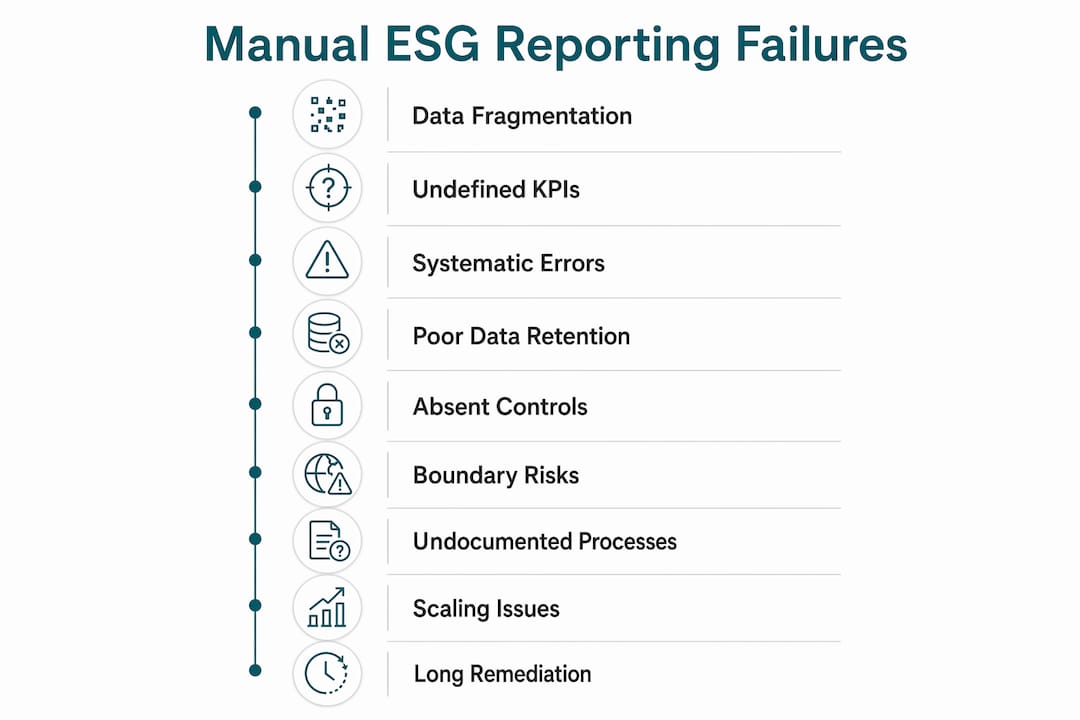
The most common failure points in manual ESG reporting:
- Fragmented data across departments with no integration or shared definitions
- Absent internal controls, including no segregation of duties or independent review
- Poor source data retention, making verification impossible during assurance
- Undefined KPIs, where different sites interpret the same metric differently
- Human errors such as unit mismatches between subsidiaries (metric tons vs. kilograms)
- Unclear organizational boundaries, causing completeness gaps in consolidated figures
- Undocumented processes that exist only in individual employees’ heads
- No audit trail, which blocks reasonable assurance under CSRD and ISSB standards
1. Data fragmentation makes accurate reporting nearly impossible
ESG-relevant data originates in systems that were never designed to talk to each other. Energy consumption lives in building management platforms. Workforce metrics come from HR databases. Emissions data spans fleet telematics, procurement systems, and environmental monitoring tools. None of these feed a common repository, and none share data models.
The consolidation process becomes a manual patchwork. A sustainability team pulls CSV exports from multiple systems, normalizes units, and reconciles overlapping data sets by hand. Errors enter at every handoff: a European subsidiary reports in metric tons, an Asian operation reports in kilograms without flagging the unit difference, and a Latin American site provides annual estimates while North American facilities report monthly actuals. Weak ESG data is manufactured in those gaps, not by negligence, but by architecture.
The result is a report that looks complete but cannot withstand scrutiny. Assurance providers trace every metric back to its source record, and fragmented data leaves too many broken chains.
2. Undefined KPIs corrupt data before collection even begins
When KPI definitions are not formally documented, different sites may interpret the same metric differently. One facility counts hazardous waste in its “total waste” figure; another excludes it. One region defines “employee turnover” to include contractors; another does not. By the time these figures reach the consolidation stage, they are measuring different things under the same label.
Assurance providers cannot evaluate whether data is prepared in accordance with reporting criteria if those criteria are not documented. That is a fundamental prerequisite for any assurance engagement, not a procedural nicety. Without formal definition sheets, calculation methodologies exist only as informal understanding, which means they shift every time a staff member changes roles or leaves the organization.
This is one of the five most common barriers to ESG audit success, alongside poor source data retention, absent controls, unclear boundaries, and undocumented processes.
3. Human error is systematic, not occasional
Manual data entry without validation checks does not produce occasional mistakes. It produces systematic inaccuracy. Unit mismatches between subsidiaries are a documented source of unreliable ESG data, and they are nearly impossible to catch without automated validation at the point of entry.
Double counting happens when the same emission source appears in two reporting streams. Omissions happen when a newly acquired entity is not added to the reporting boundary. Calculation errors happen when someone applies last year’s emission factor to this year’s consumption without updating the reference. None of these failures require negligence. They require only the absence of controls.

KPMG’s research found that 47% of survey respondents use spreadsheets to manage ESG data, even among organizations that consider themselves ahead of peers on reporting maturity. Spreadsheets offer no validation logic, no change history, and no segregation of duties. Every cell is editable by anyone with access, and overrides leave no trace.
4. Poor source data retention blocks assurance entirely
Assurance providers need to trace every reported metric back to a source record. Utility bills not retained, meter readings recorded on paper and discarded, HR system data that cannot be extracted for a historical period — these are not edge cases. They are common findings in organizations approaching ESG assurance for the first time.
Without source evidence, an assurance provider cannot perform verification procedures. Missing evidence leads directly to scope limitations or qualified conclusions. A qualified opinion is publicly available and signals data governance weaknesses to investors and regulators, which creates reputational exposure that extends well beyond the reporting cycle.

The retention problem compounds over time. Organizations that have been reporting manually for several years often discover that historical data is unrecoverable, forcing them to restate prior periods or disclose gaps.
5. Absent internal controls make audits nearly impossible to pass
Financial reporting runs through general ledger systems with automated reconciliation, change logs, and segregation of duties. ESG reporting, in most organizations, runs through spreadsheets. A single individual often collects, calculates, and reports data without independent verification. No reconciliation between data entry and source documents occurs. No formal review or approval exists.
Audit readiness for ESG assurance requires the reporting organization to substantiate all information in its sustainability report when assurance practitioners scrutinize it. That means documented internal controls, clear segregation of roles, and evidence of independent review. Manual processes, by design, lack all three.
For limited assurance, absent controls force the assurance provider to rely entirely on substantive testing, which extends the engagement and increases cost. For reasonable assurance, controls must exist and be tested. If they do not exist, the engagement cannot proceed.
6. Unclear organizational boundaries create completeness risks
The reporting boundary defines which entities, facilities, and operations are included in ESG disclosures. When that boundary is not explicitly documented, joint ventures get inconsistently included, leased facilities appear in some KPIs but not others, and newly acquired entities are simply forgotten. Different KPIs end up using different boundaries without disclosure, making the report internally inconsistent.
Completeness is a core assurance criterion. An assurance provider cannot confirm whether all required operations are captured in reported data if the boundary itself is ambiguous. This gap is particularly acute for mid-market companies growing through acquisition, where the reporting perimeter changes faster than the documentation can keep up.
The mid-market ESG reporting challenges around boundary definition are especially sharp because these organizations often lack dedicated ESG governance infrastructure and rely on finance or operations teams to define scope on an ad hoc basis.
7. Undocumented processes disappear when people leave
The process for collecting, transferring, and aggregating ESG data often exists only in the heads of individual data owners. When those people change roles or leave the organization, the institutional knowledge goes with them. The next reporting cycle starts from scratch, with new staff reverse-engineering what their predecessors did.
Undocumented processes also make walkthrough procedures during assurance more time-consuming and expensive. An assurance provider needs to understand data flows to identify where errors might occur. When the process is oral tradition rather than written procedure, the provider has to reconstruct it through interviews, which adds time and introduces its own risk of misunderstanding.
This is not a documentation problem in the bureaucratic sense. It is a control problem. Process documentation is the foundation on which every other control depends.
8. Why structured processes and controls are the real fix
Structured processes solve the problems that manual effort cannot. When KPI definitions are formally documented, every site uses the same calculation methodology. When data collection workflows are written down, new staff can follow them without relearning from scratch. When review and approval controls are embedded, no single person can introduce an error without it being caught.
ESG assurance readiness requires treating ESG data the way financial accounting treats transactions: with reconciliation, change logs, segregation of duties, and documented evidence at every step. The shift from narrative-focused reporting to data-first disclosure under ISSB and CSRD imposes exactly that standard. Organizations that build accounting-like controls into their ESG processes find assurance engagements significantly smoother.
Pro Tip: Assign ESG data ownership the way finance assigns account ownership. Each KPI should have a named data owner, a documented collection method, a review approver, and a retention policy for source evidence. That four-part structure covers the core requirements for limited assurance and positions the organization for reasonable assurance as regulatory demands increase.
Internal controls also provide segregation of duties that prevents the single-person bottleneck. When the person who collects data is different from the person who reviews it, and different again from the person who approves it, errors and overrides become visible rather than invisible.
9. Manual ESG reporting cannot scale with regulatory demands
The volume and complexity of ESG data requirements have grown faster than manual processes can accommodate. CSRD requires disclosure across environmental, social, and governance topics with a level of granularity that was not required under voluntary frameworks. ISSB standards impose comparability requirements that demand consistent methodology across periods and entities. Scaling manual data collection to meet these demands is not a matter of adding headcount. The architecture itself is the constraint.
Manual processes also cannot adapt quickly to regulatory changes. When a new metric is added to a reporting framework, a manual process requires identifying every data source, updating every spreadsheet, retraining every data owner, and hoping the changes propagate consistently. An integrated system with a centralized data model makes the same change once.
Investor expectations compound the pressure. Institutional investors now request ESG data in standardized formats for portfolio analysis, and they flag organizations whose disclosures contain gaps, inconsistencies, or qualified assurance opinions. The cost implications of manual ESG reporting failures extend beyond compliance fines to include higher cost of capital and reduced access to ESG-linked financing.
10. The remediation timeline is longer than most organizations expect
Organizations that discover their ESG data is not assurance-ready typically underestimate how long it takes to fix. Those using manual spreadsheets may need 6–12 months to reach assurance readiness. Organizations with centralized data platforms may need only 3–4 months. The gap between those two paths is the cost of manual infrastructure.
Remediation is not linear. Fixing source data retention requires going back through historical records, many of which may be unrecoverable. Defining KPIs requires cross-functional alignment between sustainability, finance, and operations teams, which takes time even when everyone agrees on the goal. Implementing controls requires process redesign, not just documentation.
A proactive readiness assessment conducted 3–6 months before a planned assurance engagement identifies and addresses gaps in a controlled environment. Organizations that wait until the assurance provider arrives discover gaps during fieldwork, which creates bottlenecks, cost overruns, and the risk of a qualified conclusion.
11. Best practices for moving beyond manual ESG reporting
The path from manual to audit-ready reporting follows a clear sequence, and the organizations that move fastest share a few specific practices.
- Centralize ESG data in a single repository. Moving all relevant data into one platform with a shared data model eliminates the fragmentation that drives most errors. KPMG’s Maura Hodge, U.S. ESG audit leader, describes this as the foundational step: move data into a centralized repository, integrate it, layer on calculations, and then make results available through a reporting tool.
- Document every KPI definition and calculation methodology. Formal definition sheets, reviewed and approved by finance and sustainability leadership, are a prerequisite for any assurance engagement.
- Implement formal review and approval controls. Segregate the roles of data collector, reviewer, and approver. Embed peer review and expert validation at each aggregation level.
- Retain source data with a documented policy. Utility bills, meter readings, HR extracts, and waste contractor invoices need to be retained and linked to reported figures. Build the retention policy before the reporting cycle, not after.
- Invest in automation to replace manual data entry. Automated data collection applies validation rules at the point of entry, catches unit mismatches before they reach the consolidation stage, and maintains a complete change history.
- Build cross-functional governance. ESG reporting accuracy depends on finance, sustainability, operations, and IT working from the same definitions and timelines. A formal ESG steering committee with internal audit representation provides the oversight structure that manual processes lack.
- Train data owners at the site level. The people entering data into source systems need to understand what they are measuring and why consistency matters. Change management principles applied to ESG data literacy reduce the error rate at the point of origin, which is where most errors start.
- Benchmark KPI definitions against peer organizations and recognized standards. GRI, SASB, TCFD, and CSRD each provide definition guidance. Aligning internal definitions to those standards reduces the risk of methodology disputes during assurance.
12. Expert insights and AI-driven solutions that close the gap
The EY global corporate reporting survey found that 96% of financial leaders reported problems with their sustainability data, citing accuracy, completeness, inconsistent formats, and unclear definitions. That figure reflects the state of ESG data management across large organizations, not just mid-market companies. The problem is not scale. It is architecture.
KPMG’s research on ESG reporting automation identifies auditability as the central challenge: collecting and managing ESG data manually in spreadsheets makes reasonable assurance nearly impossible. Automation addresses this by creating a complete, traceable record of every data point from source to disclosure. Sustainability teams that lack direct control over IT budgets often defer integration projects until an auditor flags a material discrepancy or a regulator asks for documentation that does not exist. By then, remediation is reactive and expensive.
AI-powered platforms compress the timeline from gap to readiness. Where manual remediation takes 3–9 months, centralized platforms with automated validation and built-in controls can reduce that to 3–4 months. The difference is not just speed. It is the quality of the output: data that traces cleanly to source records, calculations that apply consistent methodologies across all entities, and an audit trail that an assurance provider can follow without reconstruction.
Pro Tip: Treat ESG data the way your finance team treats the general ledger. Every figure needs a source record, a calculation methodology, an approver, and a change log. If your current process cannot produce those four things for every reported metric, that is the gap your assurance provider will find first.
Esgautomated is built specifically for this transition. The platform automates data collection, metric calculation, and sustainability reporting across GRI, TCFD, CSRD, SASB, and CDP frameworks, replacing the spreadsheet infrastructure that creates audit risk. Mid-market companies using Esgautomated get their first audit-ready ESG report in 30 days, with a complete data trail and built-in controls that support both limited and reasonable assurance engagements.
Ready to replace your manual ESG process?
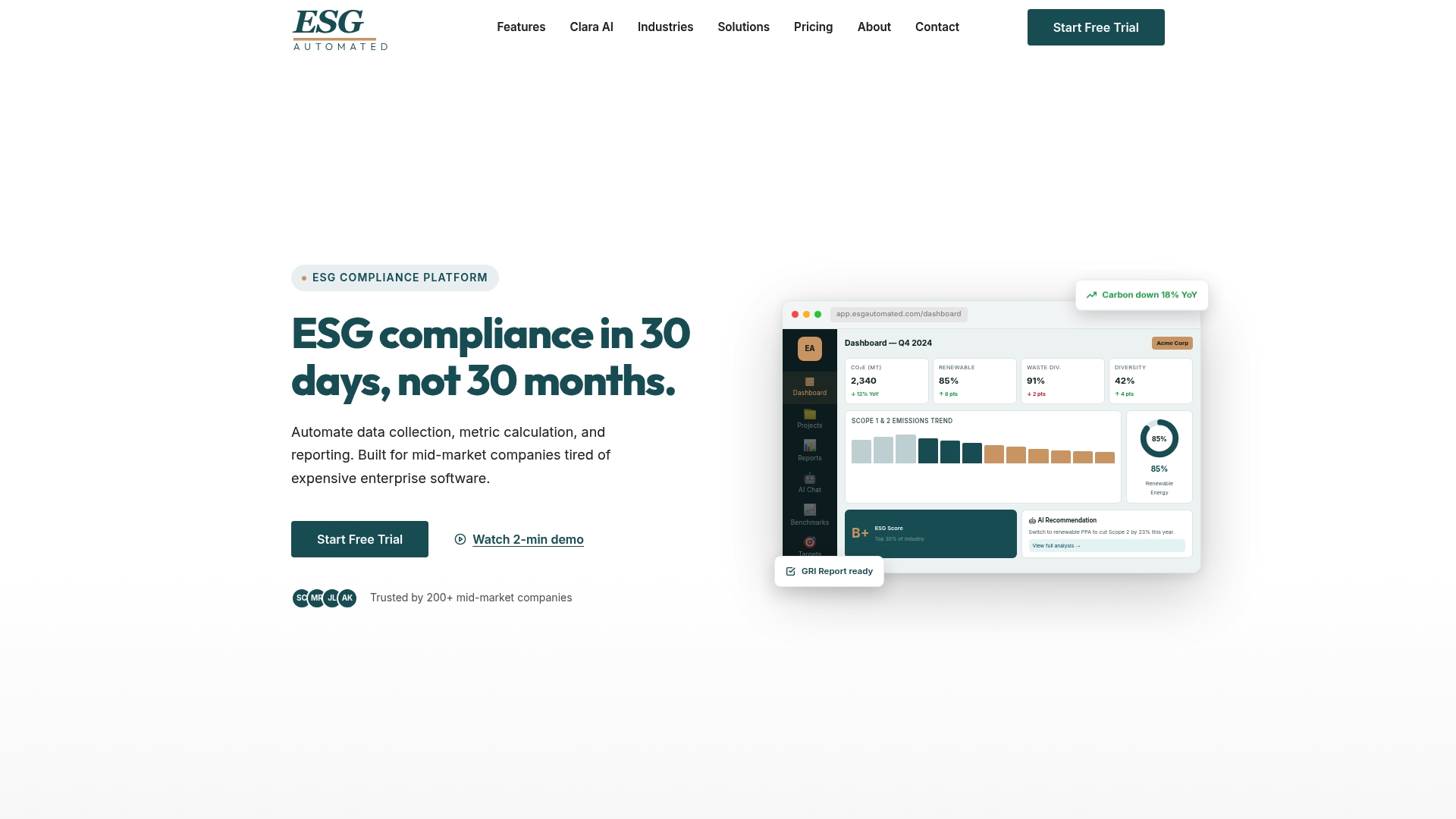
Manual ESG reporting is not just inefficient. Under CSRD and ISSB, it is a compliance liability. Esgautomated gives mid-market companies a faster path to audit-ready reporting, with automated data collection, built-in controls, and framework coverage across GRI, TCFD, CSRD, SASB, and CDP. Your first report in 30 days, not 30 months.
See how Esgautomated works or explore the platform’s data management solutions to understand what replacing your manual process actually looks like.
Key Takeaways
Manual ESG reporting fails because it lacks the centralized data, documented controls, and audit-ready processes that CSRD, ISSB, and assurance providers now require as a baseline.
| Point | Details |
|---|---|
| Spreadsheet dependency is widespread | 47% of organizations still use spreadsheets for ESG data, creating accuracy and control gaps. |
| Remediation takes longer than expected | Manual processes require 3–9 months to reach assurance readiness; centralized platforms need only 3–4 months. |
| Five gaps drive most audit failures | Missing KPI definitions, poor source data retention, absent controls, unclear boundaries, and undocumented processes are the most common barriers. |
| Controls must mirror financial accounting | Segregation of duties, change logs, and documented methodologies are prerequisites for reasonable assurance under CSRD. |
| Automation compresses the timeline | AI-powered platforms like Esgautomated deliver audit-ready reports in 30 days by replacing manual consolidation with validated, traceable data flows. |