
ESG data privacy compliance is defined as the practice of embedding data protection laws, particularly GDPR, into ESG data collection and reporting processes to protect personal data and meet regulatory and investor expectations. Compliance officers and business leaders who treat ESG reporting as a pure sustainability exercise miss a critical legal exposure: ESG metrics routinely contain personally identifiable information (PII) from employees, suppliers, and communities. ESG reporting is a massive data aggregation exercise that becomes a privacy compliance issue the moment personal data enters the picture. Frameworks like GRI, CSRD, TCFD, SASB, and CDP all require data that touches individuals, making data protection law directly relevant to every sustainability disclosure your organization produces.
What is ESG data privacy compliance and why does it matter?
ESG data privacy compliance sits at the intersection of two regulatory worlds: sustainability reporting and data protection law. Integrating data protection principles like GDPR into ESG reporting is not optional for companies operating in or selling into the EU. Failure to comply exposes organizations to significant GDPR fines and lower ESG ratings, two outcomes that compound each other in front of investors.
The governance pillar of ESG directly reflects a company’s risk management ability, including data risks. Investors and rating agencies read weak data governance as a signal of broader management failure. A company that discloses strong environmental metrics but mishandles employee diversity data has a governance problem, not just a legal one.

Regulatory bodies shaping these requirements include the European Data Protection Board (EDPB), national data protection authorities across EU member states, and the Securities and Exchange Commission (SEC) in the United States. Each body applies its own enforcement lens to how companies collect, store, and report ESG data. Compliance officers must track all of them simultaneously.
How do data privacy laws affect ESG reporting?
GDPR applies to any personal data processed during ESG data collection, including employee headcount by gender, supplier contact records, and community health metrics. The regulation requires a lawful basis for processing, data minimization, and clear retention limits. None of those requirements disappear because the data ends up in a sustainability report.
The EU’s Corporate Sustainability Reporting Directive (CSRD) and the Corporate Sustainability Due Diligence Directive (CSDDD) add another layer. CSDDD applies to non-EU firms meeting revenue or employee thresholds and requires due diligence that explicitly includes privacy governance. Compliance with CSRD or IFRS does not override national privacy regulations. Companies must assess privacy risks as part of ESG due diligence, a process known as double materiality assessment.
Double materiality means assessing both how ESG issues affect the company and how the company’s activities affect people and the environment. Privacy risks fall squarely into the second category. A company that collects supplier labor data without proper consent mechanisms creates a material privacy risk that belongs in its ESG disclosure.
| Regulation | Scope | ESG Data Privacy Implication |
|---|---|---|
| GDPR | EU and companies processing EU resident data | Lawful basis, minimization, and retention rules apply to all ESG personal data |
| CSRD | Large EU companies and qualifying non-EU firms | Requires disclosure of social and governance data, including workforce PII |
| CSDDD | EU and non-EU firms above revenue/employee thresholds | Mandates privacy governance as part of supply chain due diligence |
| SEC Climate Rules | US public companies | Requires climate-related disclosures; data handling subject to US privacy law |
Privacy-by-design and governance strategies for ESG compliance
Privacy-by-design is the practice of building data protection into a system or process from the start rather than adding it afterward. In ESG reporting, privacy-by-design means anonymizing PII before it enters reporting systems, applying data minimization at the collection stage, and documenting the legal basis for processing each data category. This approach protects the company during audits and reduces the risk of litigation.
Privacy programs that include governance structures, staff training, and breach response procedures contribute positively to ESG scores, particularly in the governance pillar. That connection is direct and measurable. Rating agencies like MSCI ESG Research and Sustainalytics assess data governance quality as part of their scoring methodology.
Key governance components for privacy-compliant ESG reporting include:
- Data inventory and mapping: Catalog every personal data set used in ESG metrics, including its source, legal basis, and retention period.
- Roles and accountability: Assign a Data Protection Officer (DPO) or equivalent role with explicit responsibility for ESG data privacy.
- Training programs: Train HR, procurement, and sustainability teams on GDPR obligations specific to ESG data collection.
- Breach response procedures: Maintain a documented incident response plan that covers ESG data systems.
- Data subject rights management: Build processes to handle access, correction, and deletion requests from employees and suppliers whose data appears in ESG reports.
- Vendor due diligence: Assess the privacy practices of third-party data providers and ESG software platforms before onboarding them.
Pro Tip: ESG data hubs are a common source of privacy violations. HR and supplier data sets containing un-stripped PII are frequently centralized for reporting purposes without anonymization. Run a data audit on your ESG hub before your next reporting cycle. Any field that identifies an individual and is not strictly necessary for the metric should be removed or pseudonymized.
Connecting ESG programs with privacy laws at the board level is what separates companies with genuine governance strength from those that treat compliance as a checkbox exercise.
How do you manage cross-border ESG data privacy compliance?
Multinational ESG reporting creates a data sovereignty problem. Data sovereignty means that data collected in a country is subject to that country’s laws, even when it is transferred to a central reporting system in another jurisdiction. Reporting frameworks demand data from subsidiaries and supply chains subject to different privacy laws, and aggregating that data without proper transfer mechanisms violates multiple regulations simultaneously.
The EU-U.S. Data Privacy Framework is the current adequacy agreement governing data transfers between the EU and the United States. Adequacy agreements confirm that the receiving country provides a level of data protection equivalent to the EU standard. Companies relying on this framework must certify their compliance annually and update their data transfer impact assessments when the framework changes.
Managing cross-border ESG data privacy compliance requires a structured approach. The steps below apply to any multinational organization consolidating ESG data across jurisdictions.
- Map all ESG data sources globally. Identify every country where your subsidiaries, suppliers, and partners collect data that feeds into ESG metrics.
- Classify data by privacy sensitivity. Separate aggregated, non-personal data from data sets containing PII. Apply stricter controls to the latter.
- Verify transfer mechanisms for each data flow. Confirm that each cross-border data transfer relies on an adequacy decision, standard contractual clauses (SCCs), or binding corporate rules (BCRs).
- Conduct transfer impact assessments (TIAs). For transfers to countries without adequacy decisions, assess whether local laws undermine the protection offered by SCCs or BCRs.
- Update supplier contracts. Require suppliers to confirm their own compliance with applicable privacy laws as a condition of providing ESG data.
- Review annually. Privacy frameworks change. Schedule a yearly review of all transfer mechanisms and adequacy agreements affecting your ESG data flows.
Mapping regulatory ESG requirements for 2026 is a practical starting point for compliance officers building this global data map.
What happens when ESG data privacy compliance fails?
Non-compliance carries financial, reputational, and governance costs that compound quickly. GDPR violations can cost businesses up to €20 million or 4% of global annual revenue, whichever is higher. That figure alone justifies treating ESG data privacy as a board-level priority rather than a legal department task.
Beyond fines, data mishandling signals governance weaknesses to investors. ESG rating agencies interpret privacy failures as evidence of poor risk management. A single data breach involving employee or supplier PII can trigger a downgrade in governance scores, which directly affects access to ESG-linked financing and institutional investment.
Organizations that embed GDPR compliance in ESG reporting gain investor trust and long-term sustainability benefits. That is not a soft claim. Institutional investors increasingly screen for data governance quality as part of their ESG due diligence. Companies that demonstrate integrated privacy and ESG compliance attract capital at better terms.
| Outcome | Without privacy-integrated ESG | With privacy-integrated ESG |
|---|---|---|
| Regulatory risk | High exposure to GDPR fines up to €20 million | Reduced exposure through documented compliance |
| ESG ratings | Governance scores penalized for data mishandling | Governance scores reflect strong risk management |
| Investor confidence | Eroded by breach disclosures and enforcement actions | Strengthened by transparent data governance practices |
| Audit readiness | Manual processes create gaps and delays | Structured data management supports faster audits |
Pro Tip: Frame your privacy compliance program as a governance asset in investor communications. Disclosing your data protection practices in the governance section of your ESG report signals maturity to institutional investors who use ESG ratings as a proxy for management quality.
Key takeaways
ESG data privacy compliance requires integrating GDPR and applicable national privacy laws into every stage of ESG data collection, processing, and reporting to avoid fines, protect governance scores, and maintain investor trust.
| Point | Details |
|---|---|
| GDPR applies to ESG data | Any personal data in ESG metrics triggers GDPR obligations, including lawful basis and data minimization. |
| Privacy-by-design prevents violations | Anonymize PII before centralizing ESG data to avoid audit-stage litigation and regulatory penalties. |
| Cross-border transfers need verification | Confirm adequacy decisions or SCCs for every jurisdiction feeding data into your ESG reporting system. |
| Non-compliance hits ESG ratings | GDPR fines and data breaches signal governance weakness, directly lowering ESG scores with rating agencies. |
| Integration creates competitive advantage | Companies with documented privacy-ESG programs attract institutional investors and access ESG-linked financing more easily. |
The case for treating ESG and privacy as one program
Most compliance failures I have seen come from the same structural mistake: ESG and GDPR compliance are managed by different teams with different reporting lines and no shared data map. Treating ESG and GDPR compliance as silos is the single most common governance error in mid-market companies, and it is entirely avoidable.
The fix is not complicated, but it requires executive sponsorship. Embedding privacy management in enterprise risk management frameworks is the most efficient path to satisfying both mandatory data privacy laws and voluntary ESG reporting frameworks simultaneously. Companies that do this stop duplicating effort and start building a compliance infrastructure that serves both purposes.
Investor expectations are moving faster than regulation. Institutional investors now ask specific questions about data governance in ESG due diligence questionnaires. Companies that cannot answer those questions with documented evidence lose deals. The regulatory trend points in one direction: more mandatory disclosure, stricter privacy enforcement, and greater scrutiny of how personal data flows through ESG reporting systems.
My practical advice for executives: start with your data inventory. You cannot protect what you have not mapped. Assign clear ownership of ESG data privacy at the DPO or Chief Compliance Officer level, and make that person a standing participant in ESG reporting cycles. That single structural change prevents most of the problems that lead to fines and rating downgrades.
— ESG Team
How Esgautomated supports ESG data privacy compliance
Compliance officers managing both ESG reporting and data privacy obligations face a real operational burden. Esgautomated is an AI-powered platform built for mid-market companies that automates data collection, metric calculation, and sustainability reporting across GRI, TCFD, CSRD, SASB, and CDP frameworks. Its data management capabilities include structured data governance tools that help teams track data sources, apply access controls, and maintain audit trails across reporting cycles.
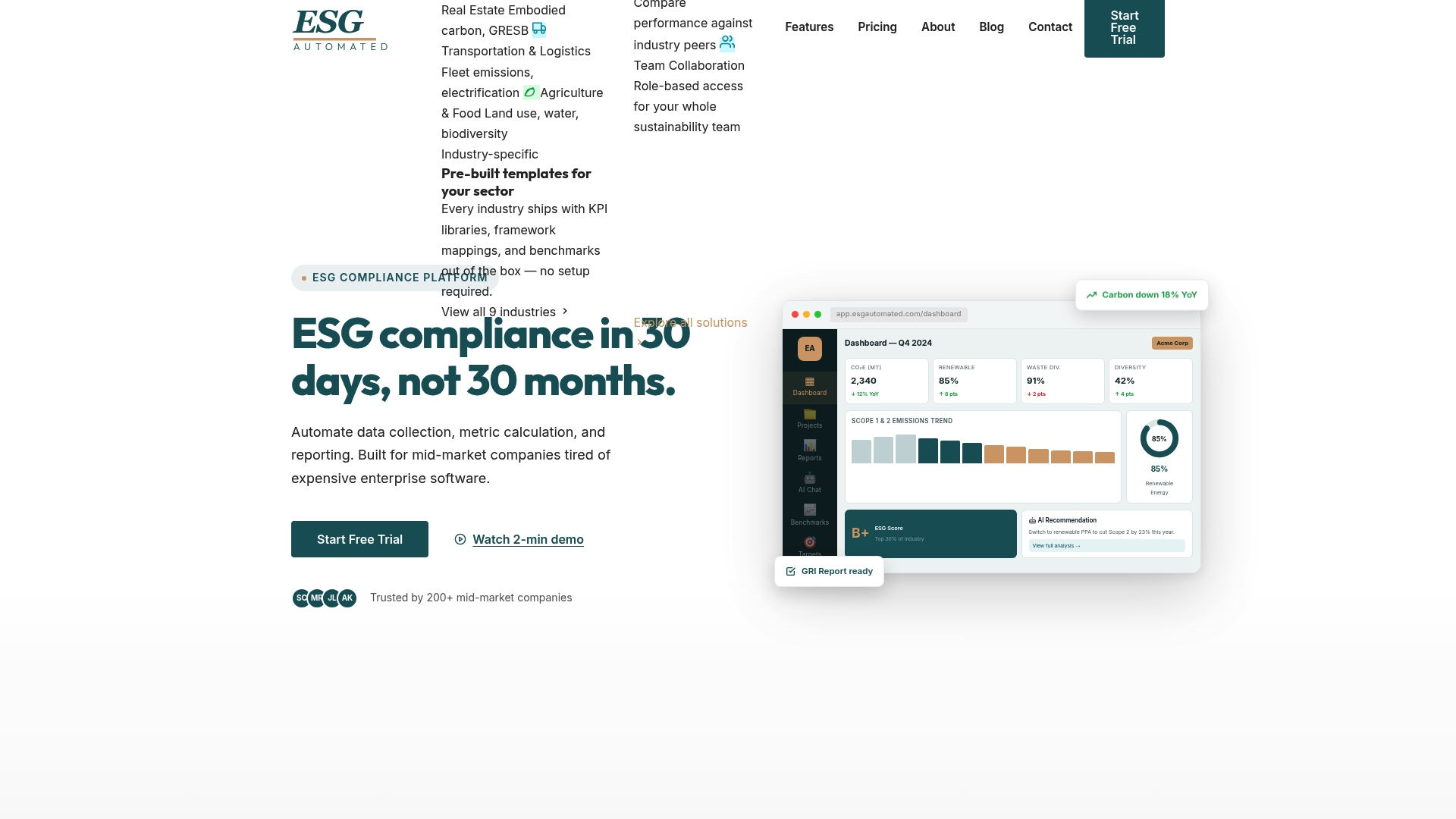
Esgautomated delivers audit-ready ESG reports in 30 days, with built-in controls that support privacy-compliant data handling for industries including financial services and technology. Visit Esgautomated to see how the platform fits your compliance program.
FAQ
What is ESG data privacy compliance?
ESG data privacy compliance is the practice of integrating data protection laws, including GDPR, into ESG data collection and reporting. It protects personal data within ESG metrics and satisfies both regulatory and investor requirements.
Does GDPR apply to ESG reporting?
GDPR applies to any personal data processed during ESG reporting, including employee diversity data and supplier contact records. Companies must establish a lawful basis for processing and apply data minimization principles to every ESG data set.
What is privacy-by-design in ESG reporting?
Privacy-by-design means building data protection into ESG reporting processes from the start, including anonymizing PII before centralizing data and documenting the legal basis for each data category collected.
How do cross-border ESG data transfers work under privacy law?
Cross-border ESG data transfers require a valid legal mechanism such as an adequacy decision, standard contractual clauses, or binding corporate rules. The EU-U.S. Data Privacy Framework currently governs transfers between the EU and the United States.
What are the penalties for failing ESG data privacy compliance?
GDPR violations carry fines of up to €20 million or 4% of global annual revenue. Beyond financial penalties, data mishandling lowers ESG governance scores and erodes investor confidence in the company’s risk management capabilities.