
An ESG regulatory change tracker checklist is a living, role-assigned framework that enables compliance officers and sustainability managers to monitor, prioritize, and act on evolving ESG regulations before deadlines hit. Over 50 countries now have live, pending, or proposed corporate climate disclosure rules, up from fewer than 10 in 2020. That expansion means frameworks like the EU CSRD, ISSB standards, and SEC climate disclosure rules now touch companies that had no ESG reporting obligation just five years ago. The industry term for managing this complexity is regulatory change management, and a well-built checklist is its operational core. Compliance teams that treat this checklist as a dynamic control mechanism, not a static document, gain the speed and audit readiness that regulators increasingly demand.
1. What are the essential components of an ESG regulatory change tracker checklist?
A complete ESG regulatory change tracker checklist covers six core components. Each one addresses a specific failure point that compliance teams encounter when regulations shift faster than internal processes can adapt.

Regulatory scoping and exposure mapping
Start by mapping every jurisdiction, framework, and legal entity your organization touches. The EU CSRD phases in through 2028 with different employee count and turnover thresholds at each stage, so a single global company may face three separate effective dates. Your checklist must log each entity’s applicable frameworks, whether GRI, TCFD, SASB, CDP, or CSRD, alongside the specific disclosure requirements that apply.
Clear ownership assignment
Every regulation on your tracker needs a named owner from legal, sustainability, finance, or procurement. Ownership gaps are the most common reason checklists fail. When a new SEC climate rule drops, someone must be accountable for assessing its impact within a defined timeframe, not the team in general.
Real-time monitoring and alert mechanisms
Manual monitoring of regulatory feeds is no longer viable at scale. Automated monitoring platforms reduce manual monitoring time by 60–80% compared to traditional workflows. Filtered alerts tied to your specific jurisdictions and frameworks prevent alert fatigue and keep owners focused on what matters.
Integrated deadline and governance calendars
Link every regulatory milestone to a calendar entry with an assigned owner and an internal review checkpoint. Reporting deadlines under CSRD, for example, require data collection to begin months before the filing date. A governance calendar makes that lead time visible to the board and senior management.
Risk prioritization framework
Not every regulation carries equal weight. Assign each tracked regulation a priority score based on impact, likelihood of enforcement, and estimated compliance cost. Probability-weighted compliance cost estimates give compliance teams a defensible basis for allocating resources before a regulation is finalized.
Audit trail documentation
Your checklist must record not just what decisions were made, but why and by whom. Companies often fail assurance despite accurate data because their audit trails omit methodology and source verification. Log every update, every owner sign-off, and every source reference from day one.
Pro Tip: Build your audit trail fields into the checklist template before you populate any data. Retrofitting documentation structure after the fact is far more costly than designing it correctly at the start.
2. How to implement a dynamic ESG regulatory change management process
A static checklist reviewed once a year is a liability, not an asset. The ESG regulatory change management process requires three distinct operating rhythms to stay current and defensible.
-
Monthly operating reviews. Each month, compliance owners report progress against open checklist items, flag new regulatory signals, and refresh exposure assessments for any entities affected by recent rule changes. Checklists should be updated immediately upon regulatory changes rather than relying on annual refresh cycles. Monthly reviews create the discipline to catch changes before they become compliance gaps.
-
Quarterly governance reviews. Every quarter, bring checklist status to a board-level or senior leadership forum. This is where resource allocation decisions get made and where the organization’s regulatory risk posture gets formally reviewed. ESG compliance teams that run quarterly governance reviews produce better board reporting and faster escalation when a high-priority regulation shifts.
-
Trigger-based updates. When a regulator publishes a final rule, a consultation paper, or an enforcement action, the checklist updates immediately. Do not wait for the next scheduled review. Assign a trigger protocol that specifies who receives the alert, who assesses the impact, and how quickly the checklist entry must be revised.
-
Tiered monitoring structure. A three-tier monitoring framework separates horizon scanning (regulations 12–36 months out), active tracking (regulations in consultation or near finalization), and compliance assurance (regulations already in force). This tiering prevents teams from treating a proposed rule with the same urgency as an active enforcement deadline.
-
Technology integration. Automated regulatory intelligence platforms handle horizon scanning well, but they require custom integration to link regulatory clauses to your internal data flows. Plan for middleware or workflow configuration that maps each requirement to the specific data source inside your ERP or sustainability platform.
-
Filtered alert protocols. Broad regulatory feeds generate noise. Configure your monitoring tools to filter by jurisdiction, sector, and framework relevance. Compliance fatigue sets in when owners receive alerts they cannot act on, and it degrades checklist discipline over time.
Pro Tip: Assign a “regulation watch lead” for each major jurisdiction. That person owns the horizon scanning tier for their geography and escalates only when a signal crosses a defined materiality threshold. This single change cuts alert volume significantly.
3. Which tools and methods best support an ESG compliance checklist at scale?
The right tooling depends on your organization’s size, geographic footprint, and internal data maturity. Three broad approaches exist, each with distinct trade-offs.
Spreadsheet-based checklists work for organizations with fewer than five active regulatory obligations and a small compliance team. They are free, flexible, and familiar. The problem is that static spreadsheets become outdated quickly in fast-moving ESG regulatory environments, and they produce no automatic audit trail.
Dedicated regulatory intelligence platforms offer AI-powered signal filtering, jurisdiction-specific feeds, and dashboard views of compliance status across frameworks. One organization reported a 30% reduction in compliance personnel time within 90 days of implementing automated monitoring. The limitation is that most off-the-shelf platforms lack the granularity to link requirements to company-specific operations without additional configuration.
Hybrid approaches combine a regulatory intelligence platform for monitoring with an internal workflow tool for ownership tracking, deadline management, and audit documentation. This is the most common setup for mid-market companies managing cross-border ESG compliance across multiple frameworks.
Key features to evaluate in any platform or hybrid setup:
- Real-time regulatory feeds filtered by jurisdiction and sector
- Modular checklist templates linked to entity-specific and product-specific requirements
- Dashboards showing compliance status across GRI, TCFD, CSRD, SASB, and CDP simultaneously
- Collaboration features that connect legal, sustainability, and finance teams in one workflow
- Audit trail logging with timestamp, owner, and source reference for every checklist update
- Integration capability with ERP systems and internal data sources
Pro Tip: Before selecting a platform, map your top 10 regulatory obligations to specific internal data sources. If a platform cannot connect those dots without significant custom development, it will not deliver the operational depth you need.
4. Practical tips to sustain your ESG regulatory change tracker long-term
Most ESG compliance checklists fail not at launch but at month six, when the initial energy fades and the maintenance burden becomes clear. These practices prevent that outcome.
-
Treat the checklist as a control mechanism, not a document. Checklists that act as living control mechanisms promote accountability and transform broad commitments into verifiable actions. Every entry should have a status, an owner, a deadline, and a last-updated timestamp.
-
Build audit trails from day one. Audit trails documenting methodology and verification filters prevent the most common failures in external sustainability assurance reviews. Do not wait until an auditor asks for evidence.
-
Prioritize exposure mapping before downstream controls. Know which regulations apply to which entities before you build monitoring workflows. Mapping gaps discovered late in a reporting cycle are expensive to fix.
-
Assign probability-weighted risk scores. Score each tracked regulation by likelihood of enforcement, estimated compliance cost, and operational impact. This gives your team a defensible basis for saying “we focused here first” when a regulator or auditor asks.
-
Engage early with regulatory consultations. Proactive regulatory impact assessments provide competitive advantages and reduce compliance surprises. Submitting comments during consultation periods also gives you advance insight into final rule language.
-
Integrate ESG monitoring into enterprise risk management. Successful ESG programs integrate regulatory monitoring into enterprise risk management using established internal control frameworks like COSO. This elevates ESG compliance from a reporting function to a board-level risk discipline.
“The compliance teams that consistently pass external assurance reviews are not the ones with the most data. They are the ones with the clearest documentation of how every number was produced, verified, and approved.”
Sustainability managers at mid-market companies often underestimate how much the 2026 reporting requirements demand from internal controls. Building that discipline now, before an auditor arrives, is the single highest-return investment a compliance team can make.
Key takeaways
A well-maintained ESG regulatory change tracker checklist requires clear ownership, tiered monitoring, and audit-ready documentation to remain effective as regulations multiply across jurisdictions.
| Point | Details |
|---|---|
| Exposure mapping comes first | Identify which regulations apply to which entities before building any monitoring workflows. |
| Ownership must be named | Every checklist item needs a specific person accountable for assessment and action. |
| Use tiered monitoring | Separate horizon scanning, active tracking, and compliance assurance to allocate resources accurately. |
| Audit trails prevent assurance failures | Document methodology and source verification from the start, not after the fact. |
| Automate to reduce manual load | Automated platforms cut monitoring time by 60–80% and support real-time checklist updates. |
The case for treating regulatory tracking as a board-level discipline
I have watched compliance teams spend months building detailed ESG checklists, only to see them collapse under the weight of their own complexity. The problem is almost never the checklist design. It is the assumption that regulatory tracking is a compliance function rather than an enterprise risk function.
The organizations that handle ESG regulatory change well treat their tracking process the same way a CFO treats financial controls. They assign clear owners, run formal review cycles, and report status to the board on a fixed schedule. They do not wait for a regulation to be finalized before assessing its impact. They engage during consultation, build provisional checklist entries, and update them as the rule evolves.
The shift from periodic manual lists to automated, living checklists is not just a technology upgrade. It is a cultural one. Teams that make this shift stop asking “are we compliant?” and start asking “how do we know we are compliant, and can we prove it?” That second question is the one auditors and regulators actually care about.
The future of ESG regulatory tracking points toward fully integrated workflows where regulatory signals automatically trigger checklist updates, ownership assignments, and board notifications. Mid-market companies that build toward that model now, even with hybrid tools, will be significantly better positioned when the next wave of CSRD phase-ins and ISSB adoptions arrives.
— ESG Team
Esgautomated and the future of ESG regulatory compliance
ESG compliance teams managing multiple frameworks across jurisdictions need more than a spreadsheet. Esgautomated is an AI-powered platform built for mid-market companies that automates data collection, regulatory monitoring, and sustainability reporting across GRI, TCFD, CSRD, SASB, and CDP.
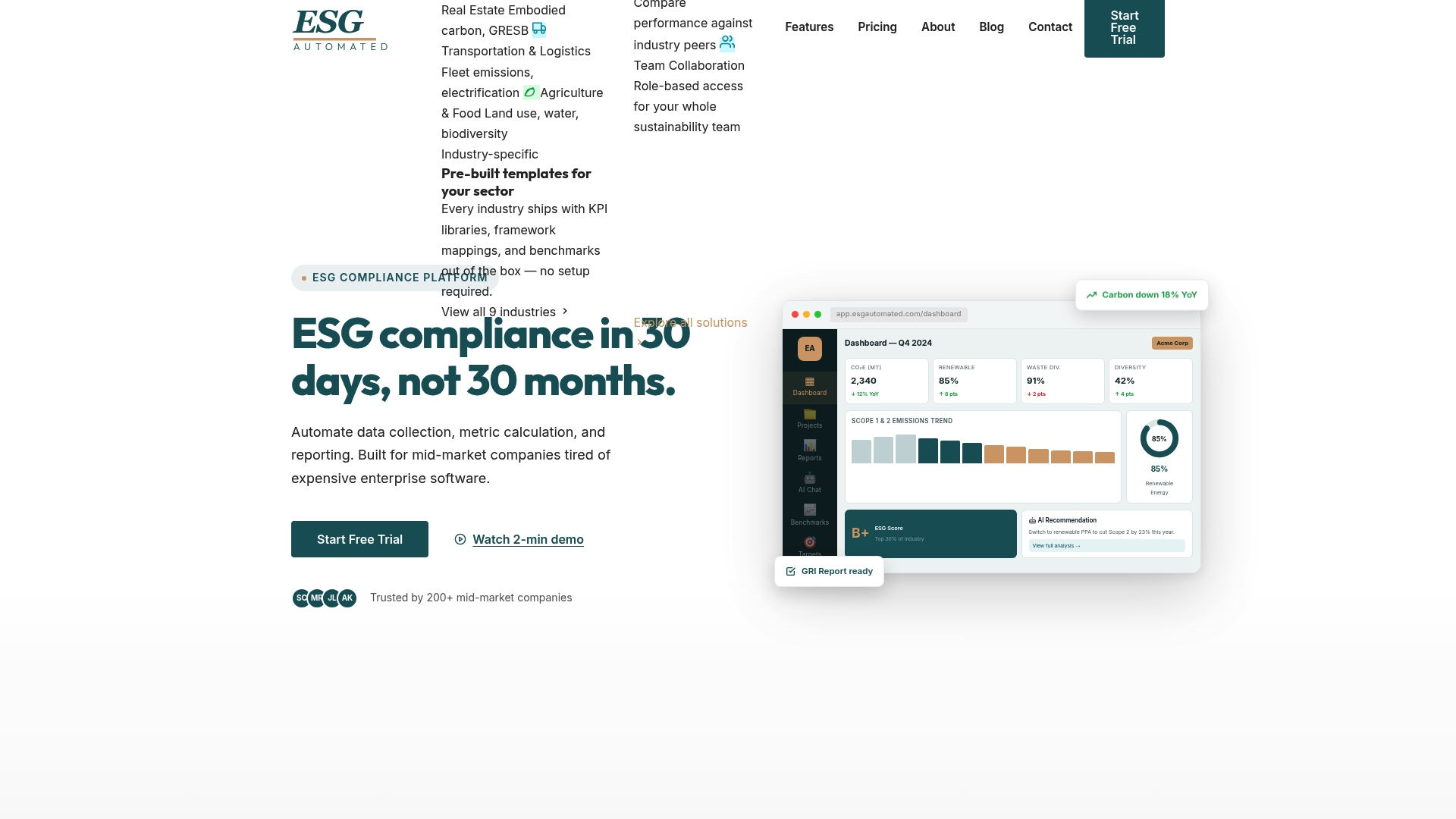
The platform’s compliance features include real-time regulatory alerts, exposure mapping tools, audit trail logging, and deadline tracking, all in one place. Teams using Esgautomated replace manual monitoring workflows with automated intelligence that keeps their checklist current without adding headcount. Companies get their first audit-ready ESG report in 30 days. Visit Esgautomated to see how the platform fits your regulatory environment.
FAQ
What is an ESG regulatory change tracker checklist?
An ESG regulatory change tracker checklist is a living document that maps applicable regulations to specific entities, assigns owners, tracks deadlines, and maintains audit trails for compliance decisions. It functions as an operational control mechanism, not a static list.
How often should an ESG compliance checklist be updated?
Checklists should be updated immediately when a regulatory change occurs, with formal monthly operating reviews and quarterly governance reviews to assess overall compliance posture.
What is the difference between horizon scanning and active tracking?
Horizon scanning monitors regulations 12–36 months from enforcement, while active tracking covers rules in consultation or near finalization. The distinction helps teams allocate resources to the right tier at the right time.
Do mid-market companies need a dedicated platform for ESG regulatory tracking?
Mid-market companies managing multiple frameworks or jurisdictions benefit significantly from automated platforms, which reduce manual monitoring time by 60–80% compared to spreadsheet-based approaches.
How do audit trails improve ESG assurance outcomes?
Audit trails that document methodology, source verification, and internal review logic prevent the most common failures in external sustainability assurance reviews, where accurate data alone is not sufficient without proof of process.