
Sustainability reporting is the practice of disclosing an organization’s environmental, social, and governance (ESG) impacts to stakeholders, regulators, and capital markets. It converts abstract commitments into comparable, auditable metrics that investors and regulators can act on. The practice has moved well beyond voluntary disclosure. Regulatory frameworks like the EU’s Corporate Sustainability Reporting Directive (CSRD) and standards from GRI, SASB, and TCFD now shape what companies must report and how. For sustainability managers and CFOs, understanding the sustainability reporting definition is no longer optional. It is a core finance and operations competency.
What is sustainability reporting, and what does it measure?
Sustainability reporting is defined as the structured disclosure of an organization’s ESG performance across three domains: environmental impact, social responsibility, and governance quality. The practice is also called corporate sustainability reporting, and it sits alongside financial reporting as a parallel accountability system. Sustainability accounting tracks the non-financial performance data that feeds these reports, providing a “triple bottom line” view of People, Planet, and Profit.
Each domain covers distinct metrics. Environmental data includes greenhouse gas (GHG) emissions across Scopes 1, 2, and 3, water consumption, waste generation, and land use. Social data covers workforce diversity, labor practices, community investment, and supply chain human rights. Governance data addresses board composition, executive pay ratios, anti-corruption policies, and shareholder rights.

The concept of materiality determines which metrics a company actually reports. A materiality assessment filters the full universe of ESG topics down to those that genuinely affect long-term enterprise value for a specific business. A mining company’s material topics differ sharply from a software firm’s. Materiality assessments shape the entire data collection strategy, so getting this step right early saves significant time later.
What is sustainability cost accounting in this context? It is a subset of sustainability accounting that assigns financial values to environmental and social externalities, such as carbon emissions or water depletion, that traditional income statements ignore. True Cost Accounting, for example, values natural and social capital that conventional financials leave off the books entirely. This approach gives CFOs a fuller picture of real operational costs and risks.
How do sustainability reporting frameworks and standards guide organizations?
Frameworks give sustainability reports structure, credibility, and comparability. Without a recognized framework, a company’s ESG disclosures are just marketing copy. With one, they become auditable data that investors and regulators can benchmark. Key reporting standards include GRI, SASB, TCFD, CSRD, and CDP, each with a distinct focus and audience.
| Framework | Primary focus | Mandatory or voluntary | Best suited for |
|---|---|---|---|
| GRI | Broad ESG impacts on society | Voluntary (mandatory in some jurisdictions) | All sectors, global |
| SASB | Industry-specific financial materiality | Voluntary | Investor-facing disclosures |
| TCFD | Climate-related financial risk | Increasingly mandatory | Finance and risk teams |
| CSRD | EU-wide comprehensive ESG disclosure | Mandatory for qualifying firms | EU-based and EU-exposed companies |
| CDP | Environmental data for supply chains | Voluntary, investor-requested | Climate and water reporting |
The shift from voluntary to mandatory sustainability reporting is the defining trend of the current decade. Mandatory adoption is accelerating across the EU, UK, and increasingly in US securities regulation. This means sustainability reporting is becoming a core requirement for finance and operations teams, not just a communications exercise.
Frameworks also shape verification. GRI and CSRD both require or strongly encourage third-party assurance. TCFD disclosures are increasingly subject to audit-level scrutiny from financial regulators. Choosing the right framework depends on your investor base, jurisdiction, and sector. Most mid-market companies need to align with at least two frameworks simultaneously.
Pro Tip: If your company has EU customers or investors, assume CSRD applies to you even if you are headquartered outside the EU. Supply chain disclosure requirements pull non-EU companies into scope faster than most legal teams anticipate.
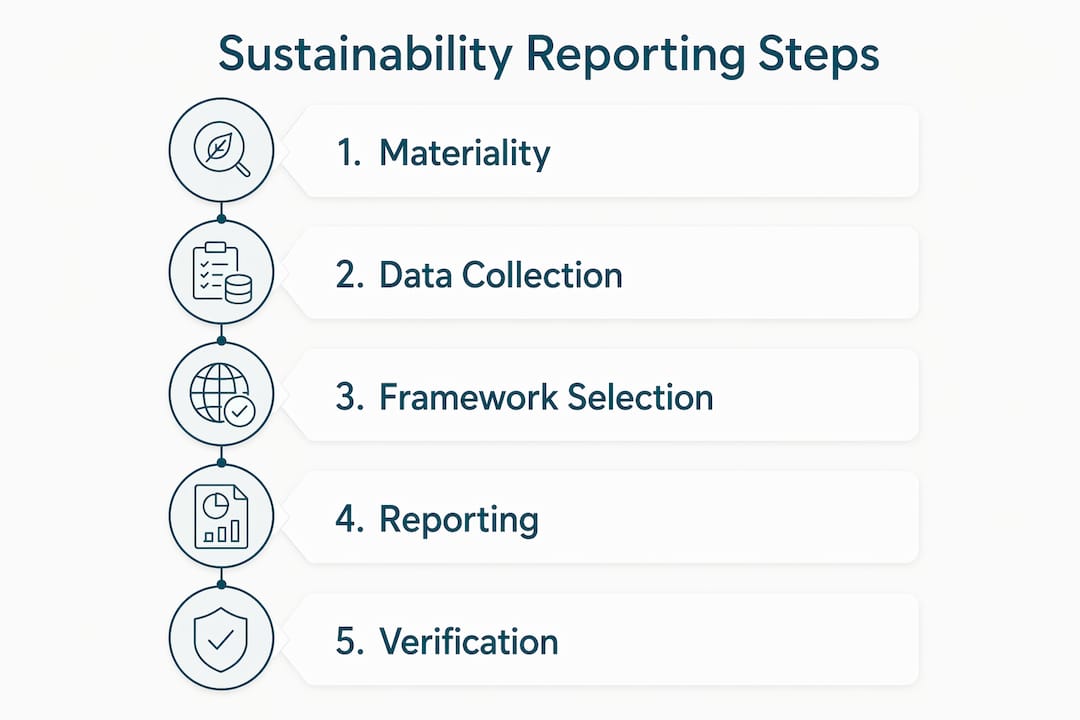
What are the main steps in developing a sustainability report?
Building a credible sustainability report follows a defined sequence. Skipping steps, especially early data governance work, creates problems that are expensive to fix at the assurance stage.
-
Conduct a materiality assessment. Identify which ESG topics matter most to your business and stakeholders. This step consumes more time than most teams expect. Data definition and materiality work take longer than the actual report writing, so start at least 6–12 months before your reporting deadline.
-
Establish reporting-grade data controls. Sustainability reporting often repurposes existing operational data, but that data needs audit-ready controls before it qualifies as reportable. Define data owners, set collection protocols, and document your methodology for each metric.
-
Integrate cross-departmental data. ESG data lives in HR systems, energy bills, procurement records, and finance platforms. Pulling it together requires a formal process. Fragmented spreadsheets create version-control problems and assurance failures. A centralized ESG data management system prevents this.
-
Run quality assurance before publication. Check calculations, verify data sources, and reconcile numbers against financial records where they overlap. GHG emissions figures, for example, should align with energy cost data in the income statement.
-
Publish aligned with financial disclosures. Integrated reporting, where ESG and financial data appear together, is the direction regulators are pushing. Aligning publication timelines signals to investors that ESG data carries the same weight as financial data.
-
Plan for assurance. Third-party verification is now expected for CSRD reporters and strongly recommended for GRI reporters. Build your audit trail from day one, not after the report is drafted.
Pro Tip: Treat your first sustainability report as a data infrastructure project, not a writing project. The report itself takes weeks. Building the data systems that make it credible takes months.
What strategic value does sustainability reporting deliver beyond compliance?
Sustainability reporting is a financial performance tool, not just a compliance checkbox. The evidence is direct: firms with verified ESG disclosures show a 10% lower cost of debt and 7% lower cost of equity compared to peers without verified disclosures. That is a material capital markets advantage.
The strategic benefits extend across several dimensions:
- Lower cost of capital. Verified ESG performance reduces perceived risk for lenders and equity investors. Sustainability managers who understand this can make a direct case to CFOs for reporting investment.
- Operational cost savings. Sustainability accounting can yield documented average 20% cost reductions in energy efficiency programs. Tracking energy consumption as an ESG metric often surfaces waste that operations teams had not quantified.
- Risk identification. Scope 3 GHG emissions reporting, for example, forces a detailed look at supply chain exposure. Companies that map this data early identify supplier concentration risks before they become financial events.
- Investor access. Institutional investors increasingly screen portfolios using ESG criteria. A company without a credible sustainability report is invisible to a growing segment of capital allocators.
- Brand and talent. Employees, particularly in competitive hiring markets, evaluate employers on ESG performance. Published sustainability data gives HR teams a concrete recruiting tool.
The integration paradox is the real challenge here. Balancing environmental, economic, and social goals without creating trade-offs requires careful strategy. A company that cuts energy costs by offshoring production may improve one ESG metric while worsening two others. Reporting forces this tension into the open, which is uncomfortable but useful. The ESG metrics board reporting process gives boards the visibility to manage these trade-offs deliberately.
Key Takeaways
Sustainability reporting is the structured disclosure of ESG performance that reduces cost of capital, surfaces operational risks, and satisfies growing mandatory regulatory requirements across GRI, SASB, TCFD, and CSRD frameworks.
| Point | Details |
|---|---|
| Start with materiality | Identify which ESG topics affect your business before collecting any data. |
| Build data controls early | Establish reporting-grade systems 6–12 months before your deadline to enable assurance. |
| Choose the right framework | Align with GRI, SASB, TCFD, or CSRD based on your sector, jurisdiction, and investor base. |
| Reporting reduces cost of capital | Verified ESG disclosures correlate with 10% lower cost of debt and 7% lower cost of equity. |
| Reporting is now mandatory for many | CSRD and similar regulations have moved sustainability disclosure from voluntary to required for qualifying firms. |
The part most companies get wrong
The biggest mistake I see mid-market companies make is treating sustainability reporting as a communications project rather than a data project. They assign it to the marketing team, produce a polished PDF, and then discover at the assurance stage that their GHG calculations cannot be traced back to source data. That is an expensive lesson.
The companies that get this right start with governance, not graphics. They appoint a data owner for each ESG metric, document their calculation methodology before collecting a single number, and treat the first report as a proof of concept for a data system they will use for years. The report itself is almost secondary.
The shift to mandatory reporting under CSRD is accelerating this reckoning. Companies that built voluntary reporting programs on informal processes are now scrambling to retrofit audit-ready controls. The ones that built proper data infrastructure from the start are finding that compliance is straightforward. The difference is not budget. It is sequencing.
Digital tools have changed the economics significantly. Automated data collection and calculation, aligned to GRI, TCFD, CSRD, SASB, and CDP, removes the manual spreadsheet layer that creates most of the errors and version-control problems. The question is no longer whether to use technology for sustainability reporting. It is which approach fits your team’s capacity and reporting obligations.
— ESG Team
How Esgautomated supports your sustainability reporting process
Mid-market companies face a specific problem: enterprise-grade reporting requirements with teams that are not sized for enterprise-grade manual processes.
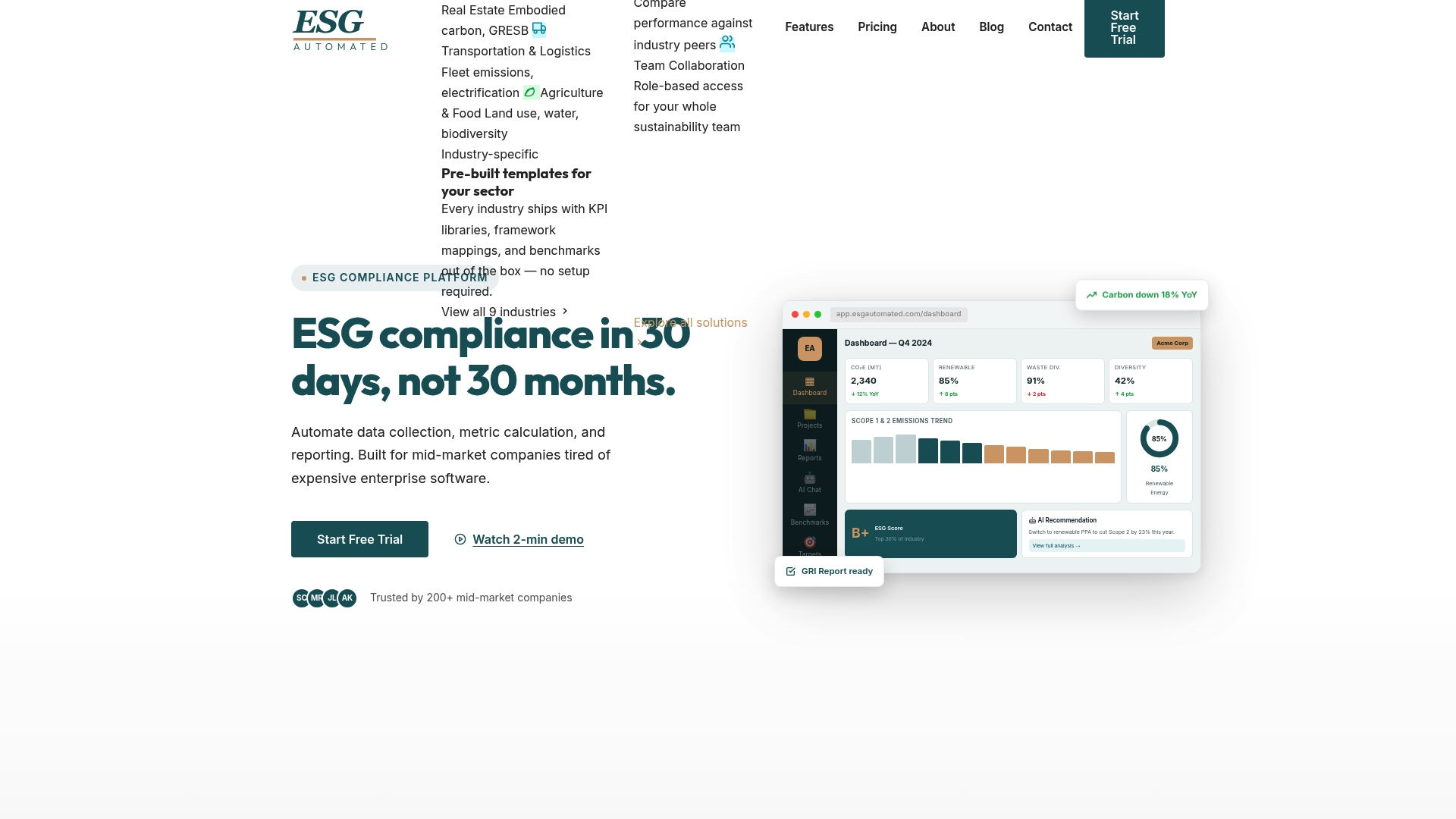
Esgautomated is an AI-powered ESG compliance platform built for exactly this situation. It automates data collection, metric calculation, and report generation across GRI, TCFD, CSRD, SASB, and CDP frameworks. Companies using Esgautomated get their first audit-ready ESG report in 30 days, replacing months of consultant-led manual work. The platform centralizes cross-departmental ESG data, applies reporting-grade controls automatically, and produces disclosure-ready outputs at a fraction of enterprise software costs. If your team is building a sustainability reporting program and needs a faster path to compliance, Esgautomated’s platform is built for that.
FAQ
What is the sustainability reporting definition?
Sustainability reporting is the structured disclosure of an organization’s environmental, social, and governance (ESG) performance to stakeholders, investors, and regulators. It converts ESG commitments into auditable, comparable metrics aligned to recognized frameworks like GRI, SASB, or TCFD.
What is sustainability accounting, and how does it differ from reporting?
Sustainability accounting tracks and quantifies non-financial ESG performance data, including environmental costs and social impacts, as the underlying data layer. Sustainability reporting is the external disclosure of that data in a structured format aligned to a recognized framework.
Which sustainability reporting standards are most widely used?
GRI is the most widely adopted global standard for broad ESG disclosure. TCFD leads for climate-related financial risk. CSRD is now mandatory for qualifying EU-based and EU-exposed companies, and SASB is widely used for investor-facing, industry-specific disclosures.
How long does it take to produce a first sustainability report?
Building the data systems and controls takes 6–12 months for most organizations. The report writing itself takes considerably less time. Starting the materiality assessment and data governance work early is the single biggest factor in meeting reporting deadlines.
What are the main benefits of sustainability reporting?
Verified ESG disclosures correlate with a 10% lower cost of debt and 7% lower cost of equity. Additional benefits include operational cost savings from energy efficiency tracking, improved investor access, supply chain risk visibility, and regulatory compliance across CSRD and similar mandates.