
Compliance in ESG strategy is defined as the systematic embedding of legal, regulatory, and governance requirements into every layer of a company’s environmental, social, and governance operations. This goes well beyond voluntary corporate social responsibility. Regulators in the EU, the US, and Australia now require mandatory, auditable disclosures backed by financial-grade internal controls. Frameworks like the EU Corporate Sustainability Reporting Directive (CSRD), SEC climate disclosure rules, GRI, TCFD, SASB, and CDP have turned ESG reporting into a legal obligation. For corporate leaders and compliance professionals, understanding how compliance integrates into ESG strategy is no longer optional. It is the foundation of credible, defensible sustainability performance.
How does compliance integrate into ESG governance and risk management?
Compliance does not sit beside ESG strategy. It sits inside it. Embedding ESG oversight directly into board-level terms of reference and risk registers is a critical 2026 best practice. That means boards are not just receiving ESG updates. They are formally accountable for ESG risk management, with documented escalation paths when obligations are missed.
The role of governance in ESG extends from the boardroom into every operational function. Compliance teams build the connective tissue between board-level accountability and day-to-day data collection. They define who owns each ESG metric, who validates it, and who signs off before it reaches a public disclosure. Without that structure, ESG reporting becomes a collection of unverified claims.

Cross-departmental collaboration is not optional in this model. Legal, finance, sustainability, and risk teams must operate from a shared data foundation. ESG governance roles must be clearly defined, with board oversight and senior management accountability preventing weak reporting and fragmented decision-making. When roles are unclear, data quality suffers and regulatory exposure grows.
Pro Tip: Map every ESG data point to a named business owner before your next reporting cycle. Ownership gaps are the most common cause of audit failures.
What are the regulatory and audit requirements shaping ESG compliance in 2026?
The shift from voluntary CSR to mandatory regulatory-grade compliance is the defining change in ESG strategy for 2026. Organizations must institutionalize audited record-keeping systems that replace ad-hoc processes to meet new standards. This is not a documentation upgrade. It is a structural change in how ESG data is collected, stored, and verified.
The regulatory picture is now multi-jurisdictional. The EU CSRD requires reasonable assurance audits for large companies, with limited assurance as the entry point. SEC climate disclosure rules demand quantified Scope 1 and Scope 2 emissions data with internal controls attestation. Regulators like ASIC in Australia are actively pursuing greenwashing enforcement. Each of these frameworks demands that ESG data meet the same evidentiary standard as financial data.
| Regulation | Jurisdiction | Key Compliance Requirement |
|---|---|---|
| EU CSRD | European Union | Reasonable assurance audit of ESG disclosures |
| SEC Climate Rules | United States | Scope 1 and 2 emissions with internal controls |
| ASIC Greenwashing Guidance | Australia | Substantiated, consistent public ESG claims |
| GRI Standards | Global | Standardized ESG metric definitions and disclosures |
| TCFD Framework | Global | Climate-related financial risk disclosures |
Data provenance is the technical requirement most compliance teams underestimate. Compliance teams must track who entered ESG data, when, and why, in preparation for mandatory reasonable assurance audits. Auditors will ask those questions. Companies without clear answers face findings that can escalate into regulatory penalties.
Pro Tip: Treat your ESG data audit trail the same way your finance team treats the general ledger. Every entry needs a source, a date, and an approver.
How do compliance teams collaborate with legal, finance, and other functions?
Cross-functional collaboration is where ESG compliance either holds together or falls apart. ESG data silos create liability. Unified governance, where legal, finance, and sustainability operate from validated data, reduces greenwashing litigation risks. The role of legal counsel in ESG is not to review the final report. It is to test the evidence behind every claim before it goes public.
The role of finance in ESG compliance is equally specific. Finance teams apply the internal control frameworks they already use for financial reporting, such as SOX-style controls, to ESG data. They verify that the numbers in the sustainability report match the numbers in the operational systems. Discrepancies between public disclosures and internal risk data are the most common trigger for regulatory scrutiny.
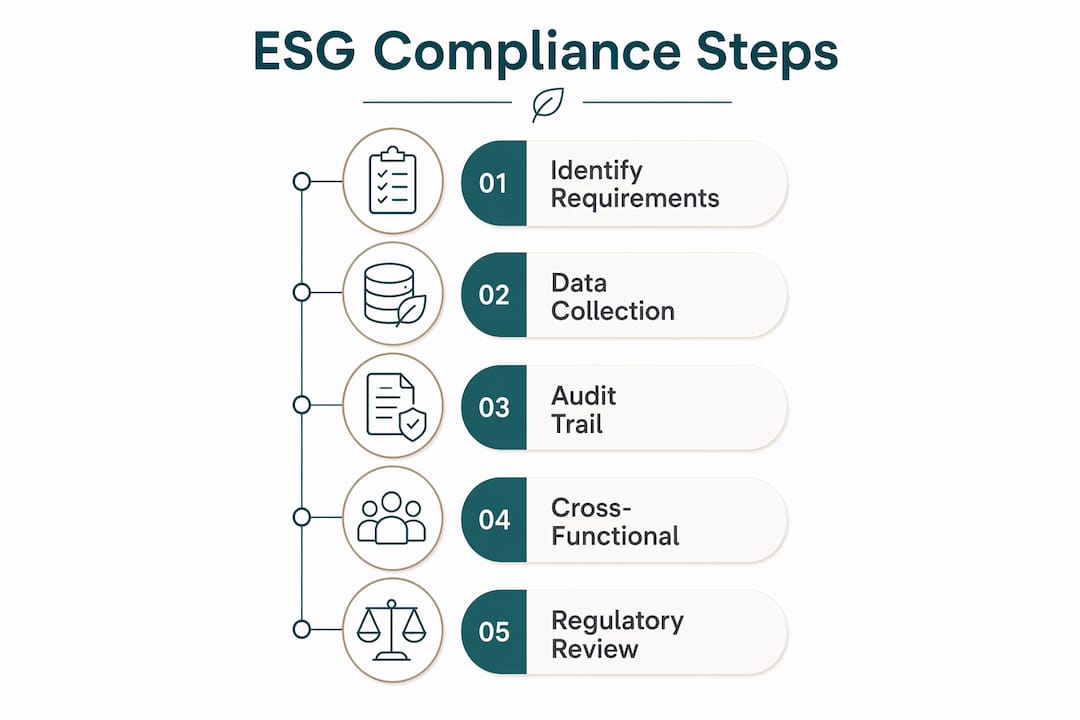
A practical cross-functional ESG compliance process looks like this:
- Define data ownership. Assign a named business owner to every ESG metric across operations, HR, procurement, and facilities.
- Establish a data validation layer. Finance reviews ESG data using the same materiality and accuracy standards applied to financial statements.
- Involve legal counsel early. Legal must vet underlying facts and evidence throughout the reporting cycle, not just at the end.
- Build an evidentiary record. Document methodologies, source systems, and board approvals for every material ESG claim.
- Align public and internal narratives. Cross-functional orchestration prevents gaps between what the company says publicly and what internal risk registers show.
- Run a pre-disclosure review. Compliance, legal, and finance sign off together before any ESG claim reaches investors, regulators, or the public.
The role of an ESG compliance officer in this process is to coordinate the workflow, not just police it. Compliance officers who act as connectors between functions produce more credible disclosures than those who act as gatekeepers at the end of the process.
What are best practices and common pitfalls in ESG compliance?
The best-run ESG compliance programs share three structural features: formal governance, executive accountability, and centralized data management. Linking executive compensation directly to ESG KPIs increases the rigor and effectiveness of compliance measures. When leaders have a financial stake in ESG accuracy, data quality improves across the organization.
Best practices that separate credible programs from paper exercises:
- Formalize ESG governance with a dedicated committee that includes compliance, legal, finance, and sustainability representation.
- Set ESG metrics for board reporting on a quarterly cycle with documented variance explanations.
- Apply financial-grade internal controls to ESG data collection and calculation.
- Conduct internal ESG audits at least annually before external assurance engagements.
- Use technology to centralize data collection and create an automatic audit trail.
The most common pitfalls are predictable and avoidable. Ad-hoc data collection, where different teams use different spreadsheets with no version control, is the single biggest source of ESG audit failures. Failing to apply financial-grade controls to ESG data causes discrepancies that can lead to greenwashing litigation, even when the underlying narrative report seems harmless.
| Practice | Outcome |
|---|---|
| Centralized ESG data platform | Single source of truth, audit-ready records |
| Ad-hoc spreadsheet collection | Version conflicts, data gaps, audit failures |
| Executive compensation tied to ESG KPIs | Higher data accuracy, stronger accountability |
| No formal ESG governance committee | Fragmented decisions, inconsistent disclosures |
| Legal review throughout the cycle | Reduced greenwashing exposure, defensible claims |
| Legal review only at final sign-off | Missed evidence gaps, personal liability risk |
Technology is not a luxury in this context. Platforms that automate ESG data management and generate audit trails replace the manual processes that create compliance gaps. Mid-market companies in particular benefit from automation because they rarely have the headcount to manage ESG data manually across multiple frameworks like GRI, CSRD, SASB, and CDP simultaneously.
Key Takeaways
Compliance is the structural backbone of any credible ESG strategy, connecting governance, data integrity, and cross-functional accountability into a defensible disclosure process.
| Point | Details |
|---|---|
| Compliance is foundational | ESG strategy without compliance produces unverifiable claims that regulators and auditors will reject. |
| Board-level governance is required | Embedding ESG oversight into board terms of reference and risk registers is a 2026 regulatory expectation. |
| Cross-functional collaboration prevents liability | Legal, finance, and sustainability must operate from validated, unified data to avoid greenwashing exposure. |
| Data provenance is non-negotiable | Every ESG data point needs a named owner, a source system, and a documented approval chain. |
| Executive accountability drives rigor | Linking compensation to ESG KPIs measurably improves data quality and compliance effectiveness. |
Compliance as a competitive advantage, not a cost center
Most compliance teams I have worked with still frame their ESG function as a risk mitigation exercise. That framing is outdated and, frankly, costly. The legal and compliance function is increasingly a strategic business partner in ESG, pivoting from a compliance-only role to enabling competitive advantage. Companies that treat compliance as a “joiner of dots” across functions convert regulatory pressure into long-term financial resilience.
The urgency is real. Greenwashing litigation is accelerating. Personal liability for in-house counsel and compliance officers is no longer theoretical. Regulators in the EU, the US, and Australia are actively pursuing enforcement actions. Compliance professionals who wait for the regulatory environment to stabilize before building proper governance structures will find themselves behind, not protected.
What I have seen work consistently is a proactive, data-driven compliance culture where the compliance officer has a seat at the strategy table, not just the audit table. That means influencing how ESG targets are set, not just verifying whether they were met. It means building the evidentiary infrastructure before the auditors arrive, not in response to their requests. The companies that get this right do not just avoid penalties. They attract better capital, stronger partners, and more credible investor relationships. That is the real return on compliance investment.
— ESG Team
How Esgautomated supports your ESG compliance program
Corporate leaders and compliance professionals managing ESG obligations across GRI, TCFD, CSRD, SASB, and CDP frameworks need more than good intentions. They need systems that produce audit-ready records without consuming the entire compliance team’s capacity.

Esgautomated is an AI-powered platform built for mid-market companies that automates data collection, metric calculation, and sustainability reporting across all major frameworks. It replaces manual spreadsheets and expensive consultants with a centralized system that creates a full audit trail by default. Companies using Esgautomated produce their first audit-ready ESG report in 30 days. The platform also supports cross-team collaboration so legal, finance, and sustainability can work from the same validated data. For compliance teams preparing for 2026 regulatory deadlines, that speed and structure matter.
FAQ
What is the role of compliance in ESG strategy?
Compliance in ESG strategy is the function that embeds legal, regulatory, and governance requirements into ESG data collection, reporting, and disclosure processes. It ensures ESG claims are accurate, auditable, and defensible under frameworks like the EU CSRD and SEC climate disclosure rules.
What does an ESG compliance officer do?
An ESG compliance officer coordinates cross-functional ESG data governance, oversees regulatory adherence, and manages the audit trail that supports external assurance. The role connects legal, finance, and sustainability teams to produce consistent, verified disclosures.
How does legal counsel contribute to ESG compliance?
Legal counsel reviews the evidence behind ESG claims throughout the reporting cycle, not just at final sign-off. Early legal involvement reduces greenwashing litigation risk and protects against personal liability for executives and in-house counsel.
What is the role of finance in ESG compliance?
Finance applies financial-grade internal controls to ESG data, verifying that sustainability metrics match operational source systems. Finance teams also manage ESG compliance budgeting and ensure reporting accuracy across material disclosures.
What are the biggest compliance challenges in ESG?
The most common challenges are ad-hoc data collection with no audit trail, unclear ownership of ESG metrics, and failure to apply financial-grade controls to sustainability data. These gaps create discrepancies that regulators and auditors identify as greenwashing risk, even when the underlying intent is genuine.