
ESG compliance gap analysis is defined as the process of mapping a company’s current data, controls, and disclosures against the requirements of frameworks like CSRD, GRI, TCFD, SASB, and CDP to identify what is missing. For mid-market sustainability officers, the decision to automate compliance gap analysis for ESG is no longer optional. Regulatory deadlines are tightening, frameworks are multiplying, and manual spreadsheet reviews cannot keep pace. Automation compresses what once took weeks of consultant time into a process that runs in minutes, with far greater consistency and audit-ready output.
How to automate compliance gap analysis for ESG: prerequisites first
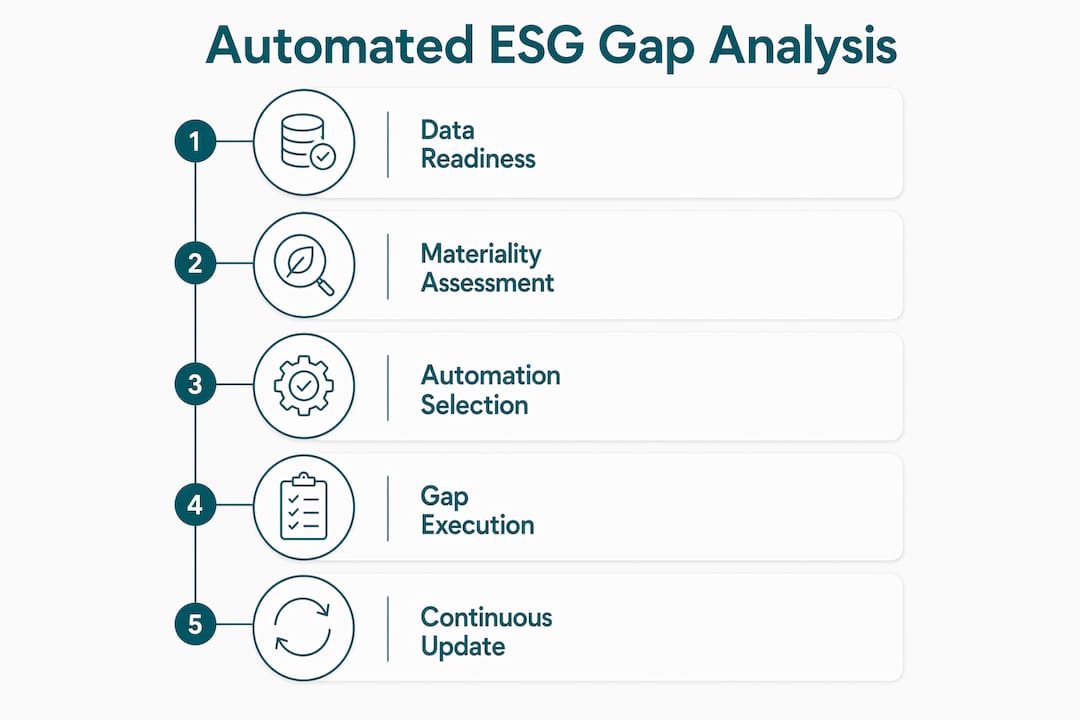
Before any automation tool can do useful work, your data foundation must be solid. Mid-market organizations typically hold 40–60% of the compliance data they need, with the rest scattered across HR systems, finance platforms, and procurement spreadsheets. That means the first job is not running a scan. It is locating and validating what you already have.
Map your internal data sources
Start by identifying every department that owns sustainability-relevant data. Finance holds energy spend and carbon costs. HR holds workforce metrics, diversity data, and training records. Procurement holds supplier information relevant to Scope 3 emissions and supply chain due diligence under EUDR. Operations holds waste, water, and safety records. Each of these teams must be engaged before automation begins, because a gap analysis tool is only as accurate as the data it ingests.

Complete a double materiality assessment first
A double materiality assessment is the required foundation before running any automated scan under CSRD and ESRS. It identifies which sustainability topics are material to your business from both a financial impact and an environmental or social impact perspective. Skipping this step means your automation tool will scan for everything, including topics that are irrelevant to your specific business model. That wastes time and produces reports that auditors will question.
Understand what automation categories exist
Not all gap analysis software for ESG operates at the same level. Entry-level tools offer framework checklists and manual data entry with basic scoring. Mid-tier platforms add data integrations, automated calculations, and regulatory mapping. Enterprise platforms layer in real-time regulatory monitoring, AI-driven scoring, and multi-entity consolidation. Mid-market companies rarely need the full enterprise stack, but they do need automated data ingestion and framework mapping at minimum.
| Feature category | Entry-level tools | Mid-tier platforms | Enterprise platforms |
|---|---|---|---|
| Framework mapping | Manual checklist | Automated against 1–3 frameworks | Automated against 10+ frameworks |
| Data ingestion | Manual upload | API integrations | Full ERP and system integrations |
| Regulatory updates | Quarterly manual | Monthly automated | Real-time live monitoring |
| Gap scoring | Basic percentage | Weighted by materiality | Risk-scored with remediation priority |
| Audit trail | None | Basic logs | Full audit-ready documentation |
How do you execute step-by-step automated ESG gap analysis?
Once your data is mapped and your materiality assessment is complete, the actual execution follows a clear sequence. Each step builds on the last, and automation accelerates every stage without removing the need for human judgment at key decision points.
-
Load your company profile. Enter your industry, jurisdiction, size, and applicable frameworks. The system uses this to filter which of the 487+ compliance requirements apply to your organization. This alone eliminates irrelevant requirements and focuses the analysis.
-
Run the automated data scan. The platform pulls data from connected systems and scores each requirement against what is available. It flags three distinct failure states: missing data, missing controls, and missing disclosure narratives. Each failure state requires a different remediation approach, so distinguishing between them at this stage saves significant rework later.
-
Review the gap report. The output should show a gap score by framework section, a list of specific missing items, and a severity rating for each. Review this with your legal and finance leads before acting on it. Automation produces the map. Humans decide the route.
-
Assign ownership and deadlines. Every gap item needs a named owner, a target close date, and an evidence source. Living action plans with assigned owners consistently outperform static spreadsheets because accountability is built into the document itself, not added as an afterthought.
-
Integrate outputs into your reporting workflow. Gap findings should feed directly into your ESG report drafting process. Platforms that connect gap analysis to disclosure templates under GRI, TCFD, or SASB reduce the manual transfer of data and cut the risk of version errors.
-
Set a review cadence. Gap analysis is not a one-time exercise. Schedule quarterly rescans to capture new data, closed gaps, and regulatory changes. Automation makes this cadence practical rather than burdensome.
Pro Tip: When assigning gap owners, require each person to confirm the evidence source for their data point, not just the data itself. This single step cuts audit preparation time significantly because the evidence chain is built during remediation, not reconstructed afterward.
What pitfalls should you avoid in automated ESG gap analysis?
The most common failure in automated ESG gap analysis is treating the tool as a substitute for governance. Automation accelerates analysis. It does not replace the decisions, ownership structures, and cross-functional coordination that make compliance stick.
-
Siloed data sources. Sustainability data readiness is routinely overestimated. Teams assume data exists in a usable form when it is actually locked in unverified spreadsheets or legacy systems. Validate data quality before ingestion, not after the gap report surfaces problems.
-
Treating gap analysis as a one-time event. Regulations change. CSRD is being phased in across company size tiers. EUDR timelines are shifting. A gap analysis completed in january 2025 is materially incomplete by the time your 2026 report is due. Build rescans into your compliance calendar.
-
No clear ownership model. Gap reports that list findings without named owners produce no action. Every item in your gap tracker needs a decision owner, a data owner, and a review date. This is the difference between a report and a compliance control map.
-
Confusing gap types. Missing data, missing controls, and missing narratives each require different fixes. Missing data means you need a new collection process. Missing controls means you need a new policy or procedure. Missing narratives means you have the data but have not yet written the disclosure. Mixing these up leads to remediation plans that solve the wrong problem.
Pro Tip: Build your gap tracker as a living document in a shared system, not a PDF. Update it every time a gap is closed or a new regulatory requirement is confirmed. A static gap report becomes misleading within weeks of publication.
You can also reduce ESG compliance cost drivers significantly by catching data gaps early rather than discovering them during audit preparation.
How does automated gap analysis align with ESG compliance risk and timeline milestones?
Gap findings are most useful when they connect directly to your compliance risk scores and reporting deadlines. A gap in Scope 3 emissions data carries a different risk level in october 2025 than it does in november 2026, the week before your CSRD report is due. Automation tools that link gap severity to deadline proximity give you a prioritized remediation queue, not just a list of problems.
The EUDR compliance deadline for large and medium operators is december 30, 2026, with small operators following on june 30, 2027. CSRD reporting waves are already underway for large public-interest entities, with mid-market firms entering scope in subsequent phases. These dates are not abstract. They are the fixed points around which your remediation priorities must be organized.
Real-time regulatory updates built into automation platforms reduce the risk of missing a deadline shift or a new disclosure requirement. When a framework updates, the platform rescores your gaps automatically rather than waiting for your next manual review cycle.
| Milestone | Deadline | Automation benefit |
|---|---|---|
| EUDR large/medium operator compliance | December 30, 2026 | Auto-tracks supply chain data gaps against EUDR criteria |
| CSRD mid-market phase-in | Phased from 2026 | Maps ESRS requirements to existing data and flags missing disclosures |
| Annual ESG report publication | Varies by jurisdiction | Connects closed gaps directly to disclosure drafts |
| Quarterly gap rescan | Ongoing | Captures regulatory changes and new data without manual effort |
| Audit readiness review | 60–90 days before filing | Produces evidence-linked gap closure documentation |
Effective ESG compliance timeline milestones require more than a calendar. Each milestone needs a data owner, a decision owner, an evidence source, and a review date. Automation makes maintaining that level of detail practical for a mid-market team without a dedicated compliance department.
ESG benchmarking against peers also becomes possible once your gap analysis outputs are structured and consistent. A well-executed gap analysis benchmarks ESG maturity against industry peers and supports audit readiness, which directly influences investor confidence.
Key Takeaways
Automating ESG compliance gap analysis requires a solid data foundation, a completed double materiality assessment, and a living action plan with named owners before any tool can deliver reliable results.
| Point | Details |
|---|---|
| Data readiness comes first | Validate and centralize data from HR, finance, and procurement before running any automated scan. |
| Double materiality defines scope | Complete a double materiality assessment to focus automation on issues that are genuinely relevant to your business. |
| Distinguish gap types | Separate missing data, missing controls, and missing narratives to apply the right remediation for each. |
| Link gaps to deadlines | Connect gap severity scores to reporting deadlines like EUDR (december 30, 2026) to prioritize remediation correctly. |
| Treat it as a continuous process | Schedule quarterly rescans and maintain a living gap tracker to stay current as regulations evolve. |
What I’ve learned from mid-market ESG gap analysis in practice
The gap between what mid-market companies think they know about their ESG data and what they actually have documented is consistently larger than anyone expects. I have seen teams enter an automated gap analysis confident they are 70% compliant, only to discover the actual figure is closer to 40% once data quality is factored in. That is not a failure of the tool. It is a failure of assumptions.
The teams that get the most value from automation are the ones that treat the gap report as the beginning of a conversation, not the end of a project. They share findings across finance, HR, legal, and procurement in a structured review session. They assign owners in that meeting, not afterward. And they build the rescan into the quarterly calendar before the first report is even published.
The other thing I would push back on is the idea that a checklist is a gap analysis. A checklist tells you whether a box is checked. A real gap analysis tells you why the box is empty and who is responsible for filling it. Automation makes the “why” visible by tracing each gap back to a specific data source, control, or narrative. That traceability is what turns a compliance exercise into a strategic ESG reporting tool that actually reduces risk.
Mid-market teams also tend to underinvest in the governance layer. The automation platform is the easy part. The hard part is getting a named human being to own each gap item and commit to a close date. Without that, even the best gap analysis software produces reports that sit unread.
— ESG Team
Esgautomated makes ESG gap analysis work for mid-market teams
Mid-market sustainability officers face the same regulatory requirements as large enterprises but with a fraction of the resources. Esgautomated is built specifically for that reality.
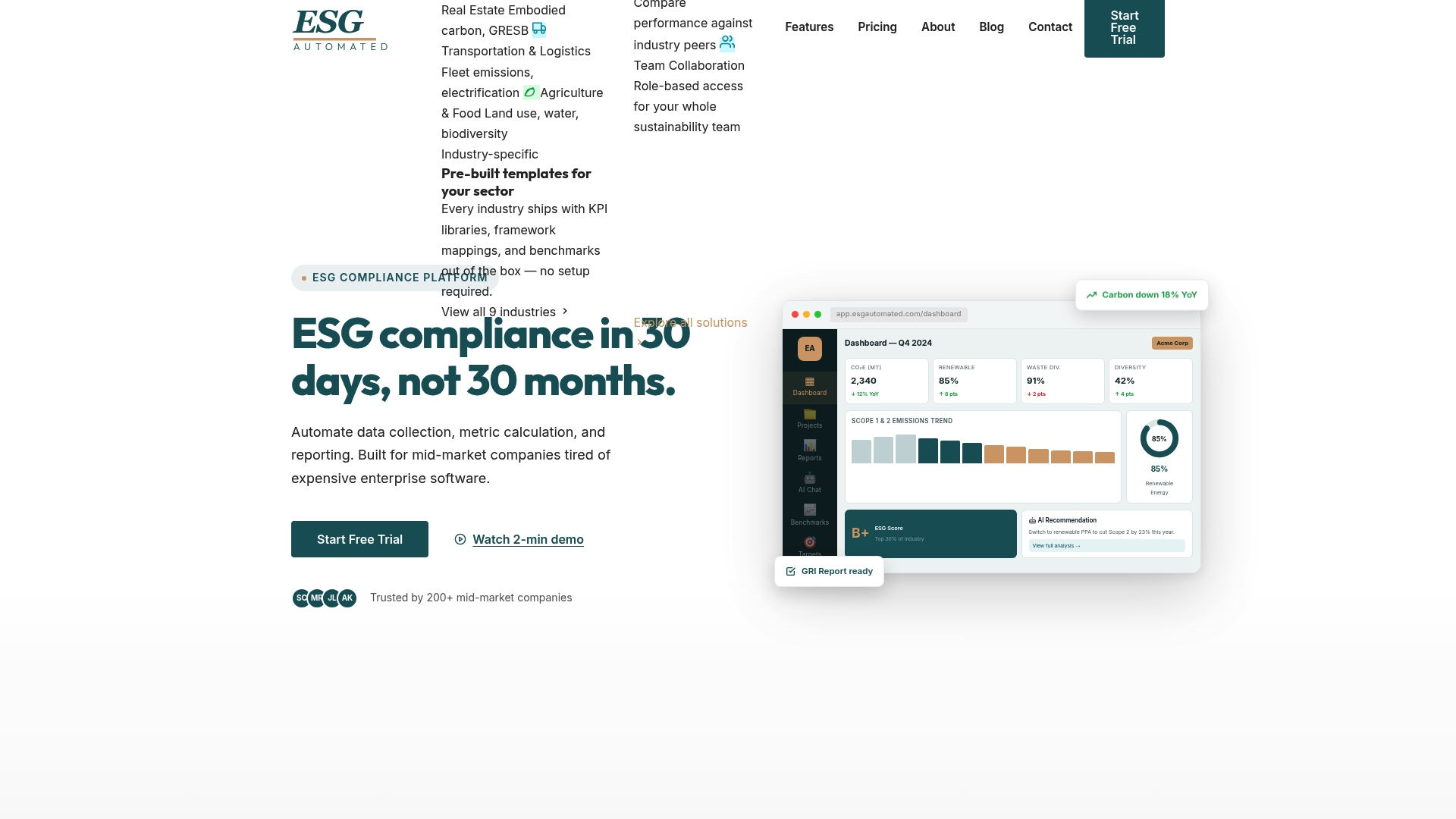
The platform automates data collection, gap scoring, and disclosure drafting across GRI, TCFD, CSRD, SASB, and CDP. It maps your operations against regulatory requirements, assigns risk scores to each gap, and connects findings directly to audit-ready report templates. Teams get their first structured gap analysis and ESG report without hiring a consultant or rebuilding their spreadsheet stack. Explore the full platform features or visit esgautomated.com to see how mid-market companies are closing compliance gaps before their 2026 deadlines.
FAQ
What is an ESG compliance gap analysis?
An ESG compliance gap analysis identifies the difference between a company’s current data, controls, and disclosures and what is required by frameworks like CSRD, GRI, or TCFD. It produces a prioritized list of gaps with remediation steps.
How long does automated ESG gap analysis take?
Automated systems can scan 487+ compliance requirements and produce a gap report in minutes, compared to weeks for a manual consultant-led review. Data preparation and validation still require human effort before the scan runs.
What frameworks does automated ESG gap analysis cover?
Most mid-tier and enterprise platforms cover GRI, TCFD, CSRD, SASB, and CDP at minimum. The specific frameworks relevant to your company depend on your jurisdiction, size, and industry sector.
How often should you run an ESG gap analysis?
Run a full gap analysis at least annually, with quarterly rescans to capture regulatory changes and newly collected data. Treating gap analysis as a continuous process rather than an annual event is the standard recommended by CSRD guidance.
What is the difference between missing data and a missing control in ESG gap analysis?
Missing data means the metric has not been collected and requires a new measurement process. A missing control means the data exists but no policy, procedure, or verification mechanism governs it. Each requires a different remediation approach.