
The ESG regulatory reporting calendar is defined as the structured timeline of deadlines, milestones, and obligations companies must meet to comply with mandatory sustainability disclosure laws. For compliance professionals managing frameworks like CSRD, ESRS, and California’s SB 261, the calendar is not optional background knowledge. It is the operational backbone of every reporting cycle. The 2026 cycle is particularly demanding, with multiple regulatory deadlines converging across jurisdictions and creating what regulators now call “evidence pressure.” Getting the schedule wrong means missed filings, audit failures, and reputational damage.
What are the key ESG reporting deadlines and milestones in 2026?
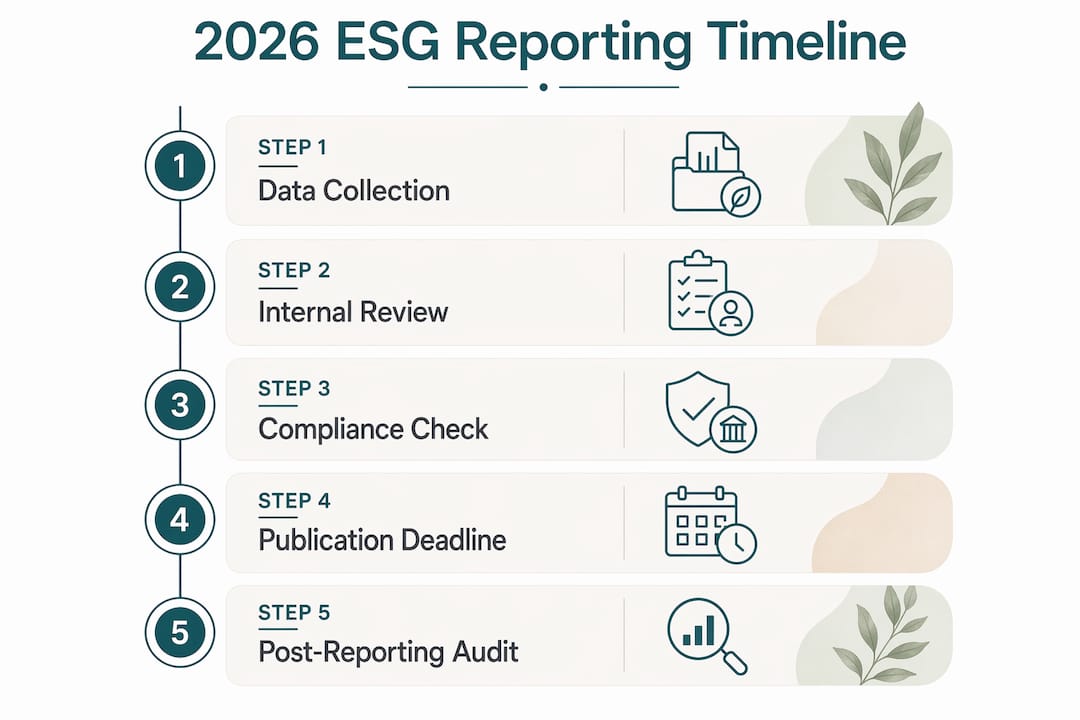
The core annual reporting cycle runs 5–6 months from the close of the financial year. That means a December 31 year-end triggers a cycle that runs from January through June, with data collection in Q1, internal review and validation in Q2, and publication by mid-year.
The 2026 ESG reporting schedule overview includes several fixed milestones compliance teams must track:
- CSRD Wave 1: Large EU public-interest entities reported FY 2024 data, with reports published in 2025. Wave 2 companies have been delayed to 2028 following the Omnibus I directive.
- California SB 261: Companies with over $500 million in global revenue must publish their first climate financial risk reports by january 1, 2026.
- California SB 253: Scope 1 and Scope 2 emissions reporting begins in 2026 for qualifying companies, with Scope 3 following in 2027.
- EU CBAM: The definitive Carbon Border Adjustment Mechanism regime began january 1, 2026, requiring importers to obtain authorized declarant status and manage embedded emissions declarations.
- EUDR: The EU Deforestation Regulation applies to large operators by the end of 2025, with extended application timelines running into 2026 for smaller operators.
- ESRS 2.0: The European Commission published a draft for public consultation in 2026, with final adoption expected to reshape reporting requirements for Wave 2 and 3 companies.
The SB 261 threshold of $500 million in global revenue captures a wide range of mid-market and large companies operating in California, not just Fortune 500 firms. That scope surprises many compliance teams who assumed US state laws would apply only to domestic giants.
Pro Tip: Build your reporting calendar backward from the publication deadline. If your target is June 30, set your data freeze date no later than April 30 to allow six weeks for validation, legal review, and assurance.

How have recent regulatory changes simplified or shifted ESG requirements?
The EU’s Omnibus I directive, which entered force on March 18, 2026, is the most significant structural change to the ESG compliance timeline in years. It raised the thresholds for CSRD applicability, delayed Wave 2 and Wave 3 reporting, and removed mandatory reporting obligations for listed SMEs entirely. Companies that had been preparing for 2026 or 2027 CSRD deadlines now have more time, but that time carries risk if teams treat it as permission to pause.
The ESRS 2.0 draft, released for public consultation in 2026, proposes reducing the original 489 mandatory datapoints. It also removes voluntary datapoints to cut administrative burden while preserving the double materiality principle. That principle requires companies to assess both how ESG issues affect their business and how their business affects the environment and society. The reduction in mandatory datapoints is meaningful, but the double materiality standard remains non-negotiable.
Key shifts compliance teams must account for in 2026:
- Wave 2 companies (large non-listed EU firms) now face a 2028 reporting deadline instead of 2026.
- Wave 3 companies (listed SMEs) are removed from mandatory CSRD scope under Omnibus I.
- ESRS 2.0 simplifications are still in consultation and not yet final. Planning around them now is premature.
- US state laws are moving in the opposite direction. California’s SB 253 and SB 261 are adding requirements, not removing them.
Pro Tip: Do not let EU simplifications create false confidence. If your company operates in California or has US-based subsidiaries, the regulatory burden is increasing, not decreasing. Run parallel calendars for EU and US obligations.
The divergence between EU simplification and US expansion is the defining tension in the 2026 ESG reporting schedule. Companies with cross-border operations face the hardest planning challenge. Understanding cross-border ESG compliance requirements is no longer optional for global firms.
What practical steps build an effective ESG reporting calendar?
Preparation must be continuous, not episodic. Companies that treat ESG reporting as a once-a-year sprint consistently produce lower-quality disclosures and face higher assurance costs. The compliance teams that perform best treat materiality assessment, metric definition, and data governance as year-round functions.
A practical ESG compliance timeline follows four phases:
- Q1: Data collection and system setup. Pull raw data across Scope 1, 2, and 3 emissions, social metrics, and governance indicators. Assign data owners in finance, procurement, HR, and operations. Confirm which frameworks apply: GRI, TCFD, CSRD, SASB, or CDP.
- Q2: Validation and internal review. Cross-check data against prior-year figures and sector benchmarks. Flag anomalies early. Run a gap analysis against mandatory ESRS datapoints or applicable US disclosure requirements. This is also when legal and finance teams review draft disclosures for consistency with financial statements.
- Q3: Assurance and finalization. External assurance providers need at least six to eight weeks. Build that window into the calendar explicitly. Assurance scope under CSRD begins at limited assurance and is expected to move to reasonable assurance over time.
- Q4: Publication and post-reporting review. Publish the report, file any required regulatory submissions, and immediately begin a lessons-learned review. Document what data was missing, what took too long, and what controls need strengthening before the next cycle.
Cross-functional coordination is the most common failure point. Finance controls the financial data. Procurement owns supply chain emissions. Legal tracks regulatory changes. Sustainability teams synthesize everything. Without a shared calendar and clear ownership, these functions work in silos and produce inconsistent disclosures. The ESG metrics board reporting process requires all four functions to operate on the same timeline.
Companies often need a full first year to build the internal controls and evidence retention protocols required for a compliant, audit-ready report. That means starting now, even if your first mandatory filing is two years away.
How do overlapping ESG regulations affect the reporting calendar?
The 2026 ESG regulatory environment is not a single framework. It is a patchwork of overlapping obligations with different scopes, thresholds, and deadlines. Managing parallel regulatory deadlines requires a consolidated view that most companies do not yet have.
The table below maps the major 2026 obligations by jurisdiction and deadline type:
| Regulation | Jurisdiction | Key 2026 Obligation | Deadline Type |
|---|---|---|---|
| CSRD / ESRS | EU | Wave 1 reporting complete; Wave 2 delayed to 2028 | Annual filing |
| California SB 261 | US (California) | Climate financial risk report publication | january 1, 2026 |
| California SB 253 | US (California) | Scope 1 and 2 emissions disclosure | Annual, starting 2026 |
| EU CBAM | EU | Authorized declarant status; emissions declarations | Ongoing from january 2026 |
| EUDR | EU | Deforestation due diligence documentation | Phased by operator size |
The CBAM obligation is particularly underestimated. Importers must not only track embedded emissions in goods crossing EU borders but also manage certificate purchases and surrender on an annual cycle. That evidence burden runs parallel to, not instead of, CSRD reporting obligations. Companies importing steel, cement, aluminum, fertilizers, electricity, or hydrogen into the EU face both obligations simultaneously.
Framework interoperability reduces duplication when planned correctly. The ISSB’s IFRS S1 and S2 standards share significant overlap with TCFD disclosures. CSRD’s ESRS standards reference ISSB baselines explicitly. A company that maps its data once to a core framework can often satisfy multiple reporting requirements without rebuilding its data architecture from scratch. The key is doing that mapping before data collection begins, not after.
The most common pitfall is treating each regulation as a separate project. That approach multiplies workload and creates inconsistencies between disclosures filed in different jurisdictions. A consolidated reporting approach that aligns ESG data with financial reporting timelines produces more consistent, defensible disclosures.
Key Takeaways
A well-structured ESG regulatory reporting calendar is the single most effective tool for managing overlapping global disclosure obligations without missing deadlines or producing inconsistent reports.
| Point | Details |
|---|---|
| Core cycle runs 5–6 months | Data collection starts in january; target publication by june for december year-ends. |
| 2026 is an evidence pressure year | CSRD, CBAM, EUDR, and US state laws all impose parallel obligations requiring coordinated data governance. |
| Omnibus I delays Wave 2 to 2028 | EU simplifications give more time, but US obligations under SB 261 and SB 253 are expanding simultaneously. |
| Continuous preparation is required | Episodic reporting efforts produce audit failures; materiality and metric work must run year-round. |
| Framework mapping reduces duplication | Aligning CSRD, ISSB, and TCFD data structures once prevents rebuilding evidence for each separate filing. |
What working through 2026’s evidence pressure taught me
The phrase “evidence pressure” sounds bureaucratic until you are the one managing three simultaneous regulatory deadlines with a team that was built for one. That is the reality for most compliance professionals in 2026. CSRD Wave 1 companies finished their first filings. Wave 2 companies got a reprieve from Omnibus I. But CBAM started, EUDR continued, and California’s laws kicked in. The calendar did not get simpler. It got wider.
What I have found is that the teams handling this best are not the ones with the largest budgets. They are the ones that built their data governance infrastructure before the deadlines arrived. They ran materiality assessments in Q3 of the prior year. They assigned data owners in finance and procurement before the reporting window opened. They did not wait for the final ESRS 2.0 text before deciding which datapoints to track.
The EU’s simplification agenda is real and worth understanding. But treating it as a reason to slow down preparation is a mistake I have seen made repeatedly. Regulatory simplification reduces the number of mandatory disclosures. It does not reduce the need for clean, auditable data. The role of compliance in ESG strategy is to build systems that work regardless of which specific datapoints end up being mandatory.
The other lesson from 2026 is that the financial reporting team is your most underused ally. ESG data and financial data share the same source systems in most companies. Aligning the ESG calendar with the financial close calendar cuts duplication and improves data quality. The teams that figured this out early are producing better reports in less time.
— ESG Team
How Esgautomated helps compliance teams manage the reporting calendar
Managing a multi-framework ESG reporting calendar across CSRD, CBAM, and US state laws is a coordination problem as much as a data problem.
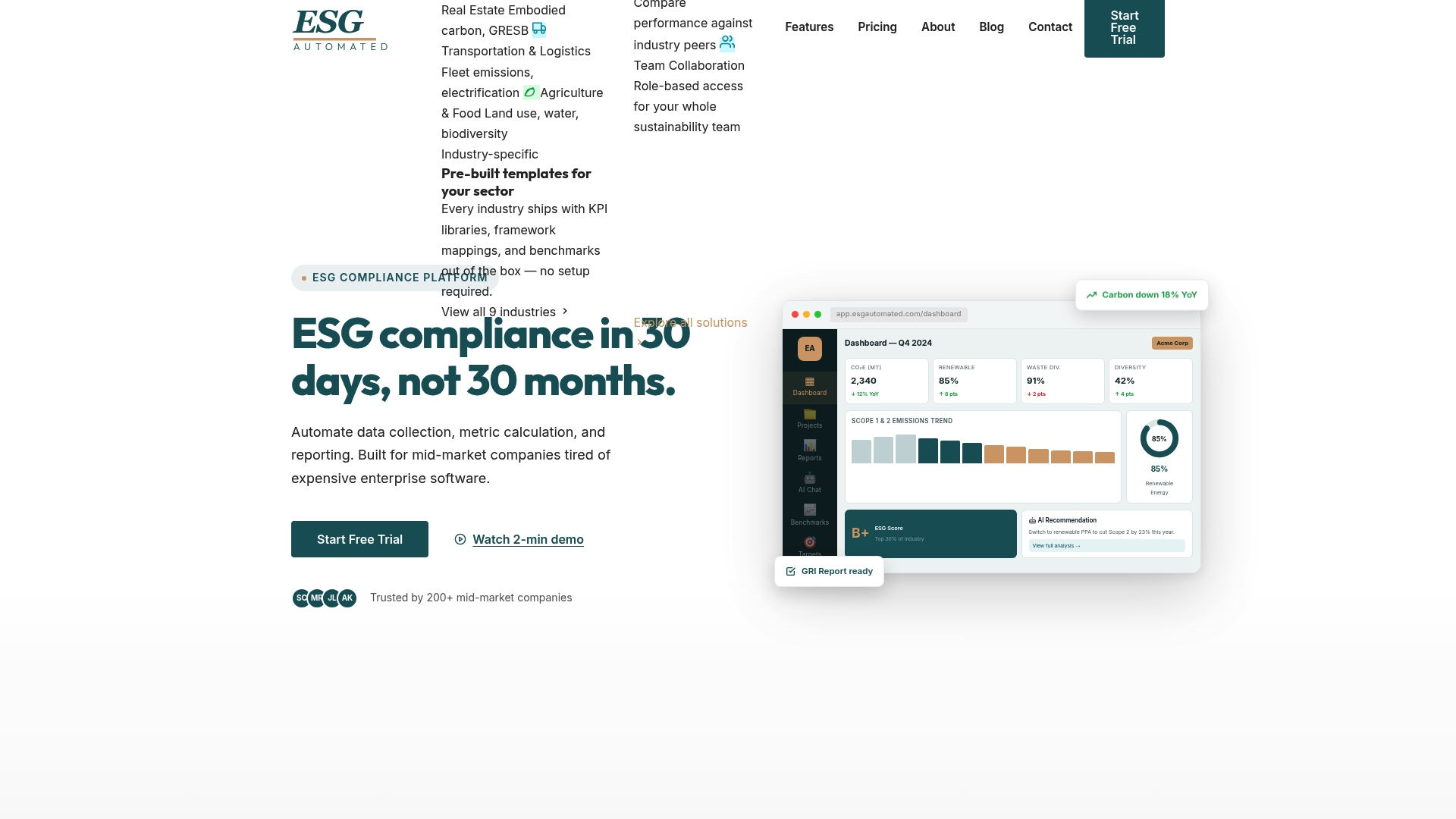
Esgautomated is an AI-powered ESG compliance platform built for mid-market companies. It automates data collection, metric calculation, and reporting across GRI, TCFD, CSRD, SASB, and CDP frameworks. Compliance teams use it to replace manual spreadsheets and expensive consultants, producing their first audit-ready ESG report in 30 days. For sustainability managers tracking parallel 2026 obligations, Esgautomated provides a single platform to manage deadlines, assign data owners, and maintain evidence controls across every active framework. Request a demo to see how it fits your reporting calendar.
FAQ
What is an ESG regulatory reporting calendar?
An ESG regulatory reporting calendar is the structured timeline of deadlines, data collection windows, and publication dates a company must follow to meet mandatory sustainability disclosure requirements under frameworks like CSRD, GRI, and applicable national laws.
What is the ESG reporting deadline for California SB 261?
Companies with over $500 million in global revenue must publish their first climate financial risk report by january 1, 2026, under California SB 261. Scope 1 and 2 emissions reporting under SB 253 also begins in 2026, with Scope 3 following in 2027.
How did Omnibus I change the CSRD reporting schedule?
The Omnibus I directive, which entered force march 18, 2026, delayed Wave 2 CSRD reporting from 2026 to 2028 and removed listed SMEs from mandatory reporting scope entirely. Wave 1 companies were not affected and completed their first filings in 2025.
How long does the core ESG reporting cycle take?
The core annual ESG reporting cycle runs 5–6 months from the end of the financial year. For a december 31 year-end, that means data collection in january, validation through april, and publication by june.
What is ESRS 2.0 and how does it affect reporting requirements?
ESRS 2.0 is a revised draft of the European Sustainability Reporting Standards, published for public consultation in 2026. It proposes reducing the original 489 mandatory datapoints to lower administrative burden while preserving the double materiality principle. Final adoption has not yet occurred, so companies should not restructure their reporting architecture around the draft text.